




The global automotive manufacturing industry is changing. Production strategies are now closely tied to software, artificial intelligence, supply-chain flexibility and new vehicle designs. A recent Automotive World manufacturing intelligence brief shows how automakers and suppliers are adjusting their operations as the industry shifts toward software-defined vehicles.
This shift comes with pressure on manufacturers to keep costs under control while still investing in new technologies. As a result automakers are moving beyond efficiency goals. They are now looking at how factories engineering methods and supply networks can be made adaptable.
Flexible Manufacturing Networks Are Gaining Importance
A key trend is the rise of manufacturing networks. Automakers are rethinking where vehicles and parts should be built. Tariffs, energy prices, demand and supply-chain risks are all influencing these decisions.
Nissan’s actions show this clearly. The company announced that its Sunderland plant in the UK will start making the new Kicks hybrid crossover for Europe. This follows a £170 million investment. The model will be produced alongside the Qashqai, Juke and Leaf. This shows how existing plants can be adapted to support types of powertrains.
For manufacturers flexibility means they may not need to build new facilities for every new model or technology. It also allows them to respond faster when customer demand changes in regions.
Artificial Intelligence Is Entering the Factory Floor
Artificial intelligence is becoming more important in manufacturing. AI systems can help with quality inspections, predictive maintenance, production planning, engineering simulations and managing supply chains. The goal is no longer to use AI in isolated tasks. Instead companies want to link data from parts of the production process.
The larger automotive technology market is already seeing investment in AI, software-defined vehicles and connected mobility. Recent developments include AI- manufacturing projects and software partnerships meant to handle the growing complexity of vehicle development.
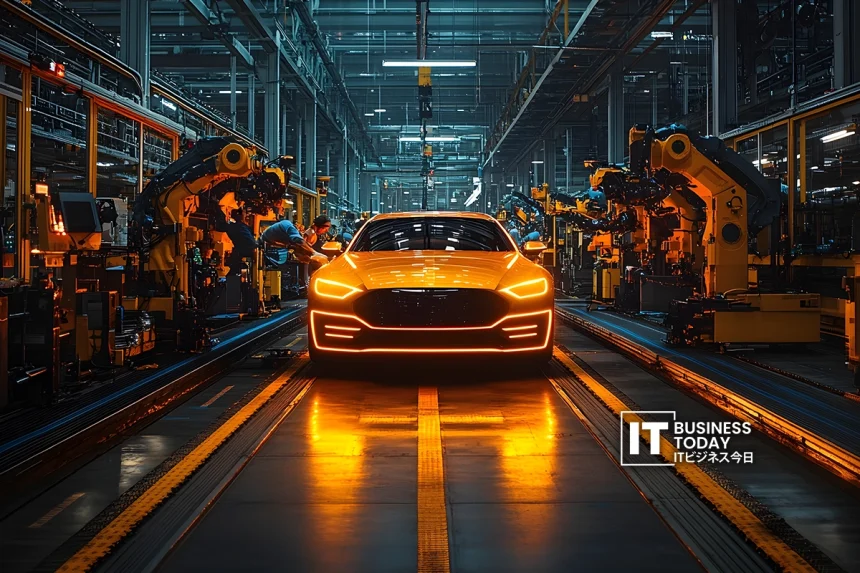
These advances create a layer of technology inside factories. Machines, sensors, robots and manufacturing execution systems all generate amounts of operational data. This data opens up possibilities, for real-time analytics and machine learning. These tools can improve decision-making. Make factory operations smarter and more responsive.
Software-defined vehicles change manufacturing requirements.
The move toward software-defined vehicles is also changing how manufacturers think about production.
Traditional vehicles have been mostly defined by parts and hardware that are specific to each model. Software-defined vehicles focus more on computing systems, connectivity, electronic designs and software that can be updated during the life of a car.
This means that manufacturing processes must now support complex electronic systems and different software setups.
The shift creates links between vehicle engineering and factory engineering. Software configuration, electronic testing and cybersecurity checks may become part of the production process like traditional mechanical quality checks.
For suppliers this could mean demand for skills in embedded software, semiconductors, cybersecurity, sensors and vehicle computing.
Implications for Japans Automotive Industry
These changes are especially important for Japan’s industry. Japan has a network of automakers, electronics suppliers, robotics firms and precision manufacturers.
Japanese manufacturers have built their strength around high-quality production, automation and tight supply-chain coordination. The next phase of manufacturing may require combining those strengths with intelligence, cloud platforms, digital twins and software development.
This opens opportunities for tech companies that can connect factory automation with advanced data analysis. Robotics makers, semiconductor suppliers and industrial software developers may no longer just provide parts. They could become players in vehicle development.
Japanese automakers are also facing the shift to vehicles and software-defined cars while still running hybrid and internal combustion engine production. This makes flexible manufacturing very important. Factories need to handle powertrain types at the same time.
Energy and Cost Efficiency Become Strategic
Energy costs are another factor shaping manufacturing choices. Automotive factories use a lot of electricity and other resources. Energy efficiency is becoming critical for profit margins.
Digital tools can help factories spot which processes use much energy. With monitoring production schedules can be adjusted for lower costs. Adding sensors, industrial analytics and AI allows factories to react quickly to energy availability and pricing.
This connects manufacturing to a larger trend, in industrial technology: factories are turning into smart data-driven systems. Manufacturing sites are no longer places where things are built. They are becoming infrastructure that uses data to improve performance.
The Factory of the Future
The new developments shown in the automotive manufacturing intelligence coverage indicate that the automotive manufacturing industry is moving toward greater flexibility and digital intelligence both of which are becoming more and more important.
Automakers are not swapping old machines for newer ones. Automakers are also redesigning how factories respond to changing vehicle architectures shifting supply‑chain conditions and evolving customer demand.
こちらもお読みください: コパートがACVを買収、自動車再販事業を拡大する
For Japan this transition could strengthen the connection between manufacturing and Japan’s broader technology strengths in robotics, semiconductors, industrial automation and AI.
The competitive question for manufacturers will increasingly be how quickly manufacturers can translate these technologies into production, lower costs and adaptable operations.
As software becomes more central, to the vehicle itself the factory that produces the vehicle will also need to become connected more flexible and more software‑driven.