 日本語
日本語 





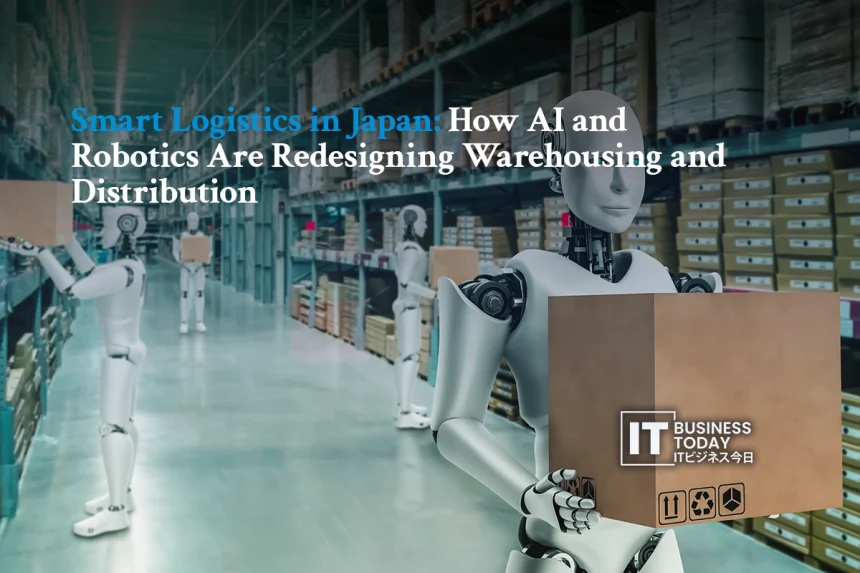
But can Japan stay on top of automation when its logistical system doesn’t have enough workers to keep everything moving? It’s an important question as the number of packages being sent through the network continues to grow and the country’s aging workforce is hit hard.
The total sales value of B2C ecommerce in Japan increased to ¥26.1 trillion in 2024 with 5.1% growth compared to the previous year. But as order volume increases, more than just speed-to-market is required.
This article looks at where AI, robotics and automated delivery systems are having the greatest impact on Japan’s logistics industry, what the challenges still are and what the industry can do to overcome them.

Why Japan is Forcing a Logistics Revolution
 Japan is actively embracing smart logistics. Its logistics networks are caught in a challenging math: Even as the need to move items persists, fewer workers are available to do the job. In the high-density urban environment of Tokyo and Osaka, the daily barrage of online orders is demanding on warehouses, sorting facilities and last-mile delivery networks. With every package there’s a need to store, sort, move and make a final delivery, often to multiple locations.
The demographic change makes the issue even more impossible to ignore. As of 2025, 13.7% of the labor force of Japan was 65 years or older. Japan could see a shortfall of 34% in its transport capacity in FY2030 by if it does not introduce further countermeasures. This is a projected risk, not a shortfall already being experienced at that scale.
Labour is also a reason for the push to automation from government, with policies encouraging new ways of delivering goods and the use of driverless technology. For logistics operators, AI, robotics and driverless delivery systems are a short-term solution to managing deliveries and staying efficient when the labor market is tight.
The Brains Behind the Supply Chain
Preparing a warehouse not only makes it run more efficiently, but it allows decisions to be made before problems ever occur on the warehouse floor. Many legacy systems are reactive when it comes to inventory because they track where things are kept and how much stock is available. AI and predictive analytics can add context to that information and help warehouse managers anticipate exactly what types of inventory will be needed.
Another area where AI could be used to improve processes within the warehouse is goods routing. Algorithms can help find the most optimal routes for human employees and robotic pickers to minimize travel from one storage shelf to another and between packing and dispatch zones.
There is even greater intelligence in digital twins as well. Virtual copies of physical warehouses can be created to test different setups, simulate processes, and see where there may be any issues with the workflow.
The overall trend toward physical AI encompasses all of these. Physical AI can synchronize sensor data, computer vision, robotic workflows, inventory data, and simulation to create a more dynamic warehouse environment. The key is how all these systems can interact such that inventory management, movement, and task assignment all become part of a coordinated effort.
Robotics and Last-Mile Automation
AI finds new ways for logistics operators to work smarter; robotics puts those smarter workflows into practice. Automated Guided Vehicles (AGV) are mobile robots that will transport items along fixed pathways or via navigation technology within warehouses, allowing inventory to be moved from storage to the picking and packing areas, which means humans don’t have to manually fetch each individual load. Automated Storage and Retrieval Systems (AS/RS) employs machinery like cranes, shuttles and robotic devices to store and pick items, which, when paired with automated sorting machinery, enable huge distribution centers to process goods efficiently and uniformly.
Delivery drones and other autonomous vehicles are making delivery outside of warehouses, providing better options in hard-to-reach or inefficient areas. In dense cities, they could provide certain delivery options while in far-flung rural areas, delivery drones and ground vehicles could help solve the problem of great distances and limited delivery ability. These possibilities are still subject to regulation and ensuring they are safe, usable, and affordable.
Next component in the delivery chain are smart parcel lockers. Integrated with the Internet of Things (IoT), the lockers can ‘talk’ to delivery platforms, provide updates to recipients on arrival and accept collection without a face-to-face handover, saving time and effort on the part of logistics providers by limiting the need to coordinate delivery times with customer availability. Robotics and integrated infrastructure bring automation to the last mile of delivery.
Key Players Leading the Charge
Japan’s logistics transformation is taking shape across both established delivery networks and newer technology-led services. Yamato Holdings and Sagawa Express are major names in the country’s parcel-delivery industry, while Rakuten is demonstrating how autonomous technology can extend delivery options beyond conventional vehicles.
Rakuten’s work offers a concrete example. In February 2025, the company expanded its autonomous delivery service in Tokyo, introducing Avride’s delivery robots and extending coverage across Harumi and parts of Tsukishima and Kachidoki. The service connects participating retailers with customers through autonomous ground delivery, showing how robotics can support the final leg of an order’s journey. Rakuten’s expansion also highlights an important operational challenge: delivery robots need effective management systems to allocate machines and coordinate orders as coverage grows.
Efficiency gains can also come from redesigning distribution-center operations. At the Home Logistics Kobe project, planned operational changes were projected to reduce combined waiting and handling time from 37 minutes to 12 minutes. This is a projected improvement, rather than a confirmed result, but it illustrates how process changes can complement automation.
These examples point to a broader lesson for Japan’s logistics sector. Technology creates value when companies integrate it into everyday operations, whether that means deploying delivery robots, coordinating parcel flows, or removing avoidable delays inside distribution centers.
Overcoming the Barriers to Adoption
 Smart logistics is not cheap, and it’s not necessarily easy either. For SMEs, there are significant costs to automate infrastructure and systems, in the form of robotics, AI platforms and connected infrastructure, and there are operational challenges around integrating these systems and making automation worthwhile when the process has yet to benefit from being smarter. Legacy sites might also need costly infrastructure upgrades to unlock automation.
Also Read: Boomi and Jade Global Partner on Manufacturing AI
Safety and compliance with regulations another concern when dealing with autonomous vehicles on public roads, and relevant considerations need to be made in terms of pedestrian safety, traffic, liability, and operating guidelines before delivery robots or similar systems are rolled out. Japan’s progress will depend on making automation commercially viable while ensuring that new technologies operate safely and reliably.
Conclusion
The challenges currently facing Japan’s logistics sector are not long-term experiments, but must-have infrastructure. As the country’s population ages, the number of deliveries increases, and the available transport capacity is squeezed, companies are being forced to find new ways to store, sort, and deliver. But technology will not be the ultimate answer to the country’s logistics problems. Instead, real benefits will require companies to strike a delicate balance between the automation of distribution networks, managing safety and security, and controlling costs. And Japan offers a broader lesson for logistics executives in other Western countries.



 English