 日本語






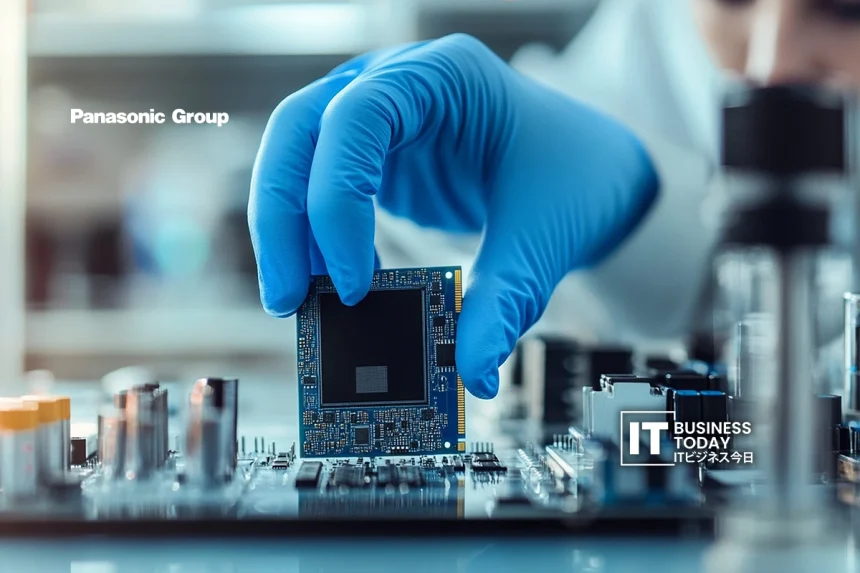
Panasonic Holdings and Panasonic R&D Company of America developed Tactile-Reactive Dexterous Manipulation (T-Rex), an operation AI for two-handed robots capable of manipulating fragile objects while moving and gripping them by responding in real time to sensations at the fingertip.
Scientists from UC Berkeley, Nvidia, Stanford University, Sapienza University of Rome and ItalAI also partnered with the researchers on the paper. T-Rex merges the use of vision and language to generate movement and tactile sensory feedback to adjust the robot’s response to changes in pressure, contact or slip.
In contrast to conventional VLA models relying solely on camera images, T-Rex also uses tactile signals as part of control. While the VLA visual-language module runs at about 5Hz, the tactile correction module works at about 20Hz, allowing T-Rex to react faster and not to re-recognize images.

Also Read: Advanced Technology Recycling Expands Secure IT Asset Disposal
Training data Researchers recorded 100 hours of data of two-handed robot manipulation of over 200 everyday objects and 22 simple tasks for training. They captured more than 7,700 datapoints of visual data, robot motions, force data, fingertip deformation and spoken instructions.
T-Rex was tested on 12 everyday tasks like turning pages, passing a card, unscrewing a light bulb, and applying toothpaste, as well as dewing pages and transferring eggs. It had a success rate of 65% (whereas the prior state-of-the-art was 35%). Without touch input, success rate would have been 42%, for comparison.
The paper will be presented at the Conference on Robot Learning in Austin, US, from 9-12 November 2026. The intention is to use the technology in manufacturing and logistics, in particular for fragile objects and delicate work that needs to be performed with exacting force control.



 English