 日本語






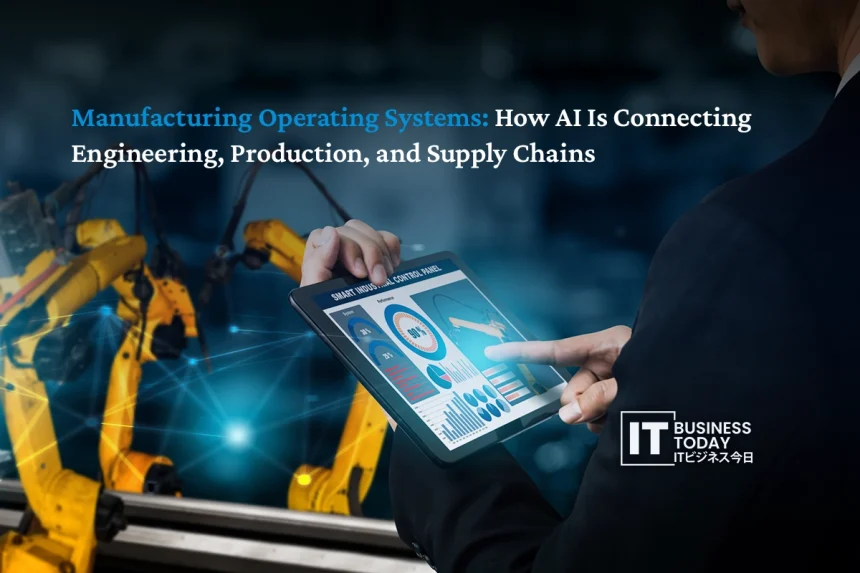
The MOS links engineering, manufacturing, and the supply chain using common information and AI-based insights. The MOS assists manufacturers in making decisions, finding issues, optimizing resource allocation, and adapting to changes in the business environment.
What if the plant finds an issue with a machine but the engineering can’t find out the reason for it and the procurement can’t determine if there is a risk of supply shortage? Such silos slow down the decision-making process and raise costs. Current systems handle individual processes separately, while connecting the decisions within these systems is hard. The MOS with the AI capabilities touches all aspects of the business including enterprise systems, shop floor activities, engineering, and suppliers.
Here’s a quick look at how it operates, where it provides value, and what to watch out for prior to adoption.

Breaking the Silos Between ERP, MES, and MOM
 ERP (Enterprise Resource Planning) systems usually include accounting, purchase and inventory process. MES (Manufacturing Execution System) captures and controls shop floor. Manufacturing Operations Management (MOM) is the whole manufacturing process management. All three have their role, but we only run into trouble when these systems work in silos.
This disconnect means teams must resolve an issue with the wrong information, or no information at all. If there’s a delay in production, they can see the impact on delivery schedules, order quantities, and supplier commitments but in multiple systems. The managers then begin re-touching data rather than solving the real issue.
It can be the nervous system linking these functions. That’s where an AI manufacturing operating system can bring nervous system capabilities to your shop floor. AI can serve as a translator between business information and shop-floor signals so teams can better understand how that one machine-level problem will impact production goals, costs, and supply commitments.
AWS exemplifies this methodology with a manufacturing control tower built on the same ‘wrapping’ of data that integrates a customer ERP system, manufacturing execution system, manufacturing resource planning (MRP), telemetry generated by IoT devices, and other data around supply chain and fulfillment systems. This initiative was deployed in a multi-year, phased approach across some 15 factories in India.
The distinction matters. ERP, MES, and MOM continue doing their jobs. The Manufacturing Operating System helps those systems work together, turning fragmented information into coordinated operational decisions.
Connecting Engineering Through Digital Twins and Generative Design
Design engineering decisions impact everything that happens on the factory floor. Even a good CAD design doesn’t always work well in the real world of manufacturing where it can cause bottlenecks, scrap, quality issues. A Manufacturing Operating System helps fill this gap by returning operational intelligence to engineering before costly rework is needed.
Manufacturing digital twin technology allows the engineers to create virtual replicas of their factory equipment and production lines among others and compare it to the real world. Through the use of artificial intelligence, the engineers can exploit digital twins to discover possible limitations and do cost and efficiency analysis. Generative design can use digital twin scenarios to consider different design solutions before committing to design time.
The bigger shift comes from continuous feedback. If a sensor detects an anomaly in the manufacturing process or in the products being produced, engineers can be notified and they can analyze the issue based on this data to decide whether the CAD design, materials used, or settings on the machine need to be changed. Human review remains important before changes affect production.
Microsoft reports that Krones uses AI agents and physically accurate digital twins to reduce filling-line simulation runs from three to four hours to five minutes or less.
This connection makes engineering a continuous process. Incorporating a Manufacturing Operating System can help connect design intention to real-world production results for testing of various decisions in a virtual world before making any improvements to the process or product.
Powering Production Through Smart Factories and Autonomous Operations
Shop floors are where manufacturing takes place. Breakdowns of machinery, wastage of material because of faulty products, and unequal distribution of work all lead to ineffective use of machinery. The use of Artificial Intelligence in the form of Manufacturing Operating System helps manufactures move from reactive approach to predictive decision-making.
Predictive maintenance utilizes machine data and sensor readings to predict machine malfunctioning and take preventive measures. In case of any anomalies, the maintenance teams can look into it before any small problem turns into big failure that results in production stops.
The dynamic quality control will use computer vision and AI which will be able to spot any defect during the manufacturing process. The connection between the inspection data and the machine data will help the team spot the root cause of the issue and solve it immediately.
Lastly, using the AI helps improve OEE which means Overall Equipment Effectiveness. It measures the three factors: availability, performance, and quality of manufacturing equipment.
AWS reports that Apollo Tyres’ AI-driven closed-loop controller reduced setup rework by approximately 26%. It analyzes process data, monitors measured tyre profiles, and automatically adjusts extrusion-line speed when deviations occur.
The lesson is clear. A connected factory does more than detect operational problems. It facilitates the connection between data and actions, enabling the companies to produce more consistently while engaging people in important decision-making.
Unifying the Supply Chain Through Predictive Logistics and Dynamic Sourcing
A company can operate efficiently yet fail to deliver in time if its suppliers lag behind or if there is any disruption in its supply chain. An MfgOS goes beyond production and links demand forecasts, supplier inventories, and logistics decisions.
AI-powered demand forecasting allows companies to forecast changes in the demand and take actions such as changing their purchase and production planning in time to avoid shortages and overstocking. Linking tier-1 and tier-2 supplier inventories could allow seeing risks and give time for finding alternatives.
In case of disruption, the system could suggest other transportation routes, modes, and even sources at different costs in order to find a solution. The decision-makers would be able to review the alternatives.
Microsoft claims that it uses more than 25 AI bots and applications in its logistics operations. These help with demand simulation, spare parts inventory management to manage space and shortage issues, and ship recommendation according to route, mode of transportation, cost, carbon footprint, and time cycle. Microsoft also reports that AI saves hundreds of hours each month in its logistics operations.
The value of a Manufacturing Operating System lies in connecting these decisions. Procurement, production, and logistics can respond to changing conditions using shared information rather than managing disruptions in isolation.
An Actionable Roadmap for Implementing an AI-Powered MOS
 Manufacturers need to view Manufacturing Operating Systems as a phased transition rather than an outright technological replacement.
Phase 1: Identify the siloes of information. Identify the movement of information from the ERP system, MES system, the machines, and the supply chain system. The emphasis should be on integration and not replacement of existing systems.
Phase 2: Address the major bottlenecks first. Focus on a modular AI system that tackles a concrete problem. For example, unplanned downtime, recurring defects, or stock outs. Then build upon this initial success.
Phase 3: Ensure the buy-in of workers. Prepare your employees for the analysis produced by an AI system and for managing automated processes and exceptions.
Also Read: Nexdata, Realworld Labs Partner on Physical AI Data
According to Google Cloud’s ROI of AI research (NRG Research, 2026), 56% of manufacturing executives indicated that cloud and infrastructure modernization were their key enablers in adopting AI. Next came workflow redesign (51%) and workforce training and change management (49%).
Conclusion
The manufacturing ecosystem works together to ensure that engineering, manufacturing, and supply chain work with common understanding. Information drives value creation when decisions are improved, actions are accelerated, and operations are improved. Manufacturers don’t have to automate all systems in one fell swoop. They have to integrate the relevant systems, solve important problems, and build on success.


 English