 日本語
日本語 





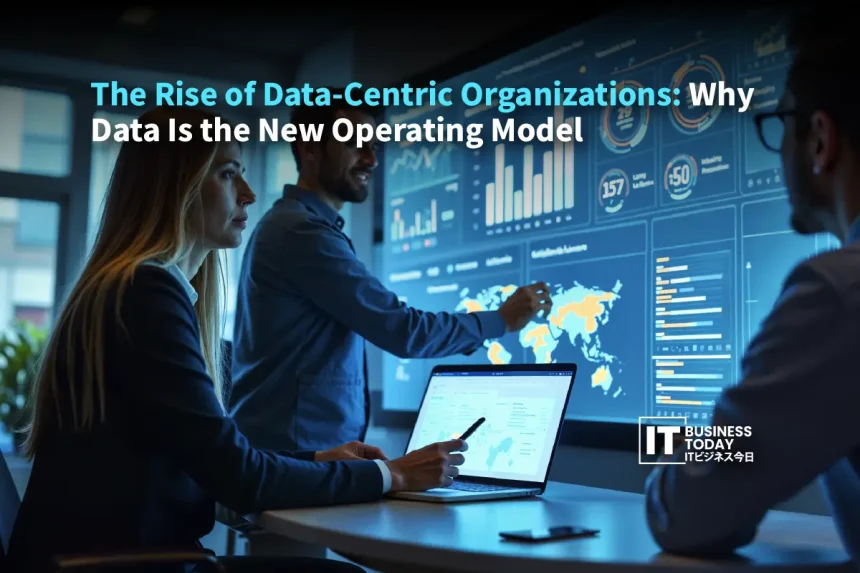
Most companies still think they are ‘data-driven.’ They collect reports, build dashboards, and use data to justify decisions already made. That sounds good on paper. In reality, it changes very little.
A data-centric organization flips that logic. Data does not support the business. It runs the business. Every system, every decision, every workflow is built around a shared data layer that acts like an operating system.
And yet, there is a gap no one likes to admit. While almost every company claims to be data-driven, very few have actually rebuilt their operating model around data. The proof is uncomfortable. 30% of CEOs report increased revenue from AI, 26% see cost reduction, but 56% have seen neither.

Also Read: AI-Driven Workforce Planning in Japan: From Talent Shortage to Skills Intelligence
So the problem is not adoption. It is structure. And that is exactly what this piece breaks down.
Why Data Is the New Operating Model
Most enterprises today still run on an app-centric architecture. Finance has its tools. Marketing has its own stack. Sales runs on another system. Each one stores its own version of reality.
That creates silos. And silos kill speed.
A data-centric organization works differently. Instead of data sitting inside applications, data sits at the center. Applications plug into it. Not the other way around. That one shifts changes everything. Now every team works off the same truth. Decisions move faster. Coordination improves without extra meetings.
But the real trigger is velocity.
Real-time analytics, AI agents, and generative AI systems do not wait for weekly reports. They need instant access to clean, connected data. Traditional models simply cannot keep up.
And the numbers make that painfully clear. Only 4% of 767 leaders have achieved all four conditions at once. AI fully embedded. Scalable agents. A horizontal operating model. And actual return from tech investments.
That is not a minor gap. That is a structural failure.
So when companies struggle with AI or analytics, it is rarely about tools. It is about the fact that their operating model was never designed for speed in the first place.
The Four Pillars of a Data-Centric Organization
A data-centric organization is not built with one tool or one team. It stands on four pillars. Remove one, and the whole thing slows down.
Pillar 1: Decentralized Data Ownership
Central IT teams used to control everything. Every data request had to pass through them. That worked when data was limited. It breaks when data scales.
A data-centric organization pushes ownership to the edges. Each business unit owns its data as a product. Marketing owns marketing data. Finance owns financial data.
The core purpose of data mesh technology. The system eliminates bottlenecks which results in faster access. The system establishes responsibility for others. Teams that possess data responsibility will monitor and maintain its quality.
Decentralization without proper management leads to complete disorder. The next essential element becomes more critical because of this situation.
Pillar 2: Data Literacy as a Core Skill
Most companies invest heavily in tools. Very few invest in people who can actually use them.
A data-centric organization treats data literacy like reading and writing. It is not optional. It is expected. HR, marketing, finance, operations. Every function must understand how to interpret and question data.
Otherwise, dashboards become decoration.
And this is where many transformations quietly fail. Leaders assume that access equals understanding. It does not. Without literacy, more data only creates more confusion.
So the shift is simple but uncomfortable. Stop asking ‘Do we have the data?’ Start asking ‘Do our people know what to do with it?’
Pillar 3: The Unified Data Layer That Actually Works
This is where the technical foundation comes in. And this is where most companies either win or stall.
A data-centric organization relies on a unified data layer. This often takes the form of a lakehouse architecture combined with a semantic layer.
The lakehouse stores and processes large volumes of structured and unstructured data. The semantic layer makes that data understandable for business users.
But the bigger shift is conceptual.
Enterprise data is moving from a passive resource to a ‘System of Action’ through an Agentic Data Cloud that unifies models, analytics, and operational databases. That means data is no longer just stored and analyzed. It actively drives workflows and decisions in real time.
So instead of dashboards telling you what happened yesterday, systems start acting on what is happening now.
That is the difference between reporting and operating.
Pillar 4: Automated Governance Without the Bottlenecks
More data means more risk. That part is obvious. What is less obvious is how quickly governance becomes a bottleneck.
Manual governance does not scale. It slows down access and frustrates teams. So companies either enforce it and lose speed, or ignore it and increase risk.
A data-centric organization does neither. It automates governance.
Policies are embedded into the data layer. Access is controlled dynamically. Data quality checks run continuously in the background.
And the urgency is real. More than 70% cite data security and privacy as a high or very high concern, with 68% investing in security and compliance controls.
So governance is no longer a compliance task. It is a core part of the operating model.
Overcoming the Cultural Debt That Slows Everything Down

Technology gets most of the attention. Culture quietly decides the outcome.
Most companies carry what can be called cultural debt. Systems change faster than people. Tools evolve, but behaviors stay stuck.
And the data shows it clearly. Only 32% of leaders have achieved enterprise-wide AI impact. Only 27% of employees are comfortable delegating tasks to AI. At the same time, 39% now try AI before asking a colleague.
That gap tells a story.
People are experimenting. But they are not fully trusting. Leaders are investing. But they are not fully transforming.
So the issue is not resistance. It is misalignment.
In many organizations, teams are still rewarded for speed, not accuracy. Decisions made on instinct often get more credit than decisions backed by data. That creates a subtle but powerful signal. Data becomes optional.
A data-centric organization flips those incentives. It rewards evidence-based decisions. Even when they fail. Especially when they fail.
Because failure backed by data teaches. Success without data hides risk.
And that shift, more than any tool, determines whether transformation sticks.
Steps to Transition into a Data-Centric Organization
Moving toward a data-centric organization is not a one-step change. It is a sequence. Skip steps, and the whole thing collapses.
Phase 1: Audit and Fix the Foundation
Start with visibility. Where is your data? Who owns it? How clean is it?
Most companies underestimate this step. Legacy systems, duplicate data, and inconsistent definitions create friction. Moving to the cloud is not the goal. Fixing the structure is.
Phase 2: Define What Actually Matters
Not all data is useful. Not all metrics drive decisions.
A data-centric organization focuses on a few North Star metrics. Three to five numbers that truly reflect business performance. Everything else supports these.
This reduces noise. It also aligns teams.
Phase 3: Treat Data Like a Product
This is where the mindset shifts.
Instead of thinking of data as an internal asset, treat it like a product. It has users. It has quality standards. It has a lifecycle.
Each dataset should be discoverable, reliable, and easy to use. If internal teams struggle to use data, the problem is not the user. It is the product.
Phase 4: Build for Scale, Not Just for Today
Many data initiatives work at small scale. They fail when usage grows.
Design systems from their initial stages to handle three specific requirements which include real-time analytics and AI workloads and increased data volume storage needs. Modern data architecture establishment requires this process to be executed.
The rebuilding process will cost more money than the original work.
Phase 5: Scale with AI as the Interface
The last section of this work contains the essential part that follows.
Generative AI changes how people interact with data. Users can ask questions using natural language instead of writing queries. The systems deliver their answers through complete insights which go beyond basic numerical data.
This reduces dependency on technical teams. It also speeds up decision-making.
But again, AI is only as good as the data it sits on. Without a strong data-centric foundation, it amplifies noise instead of clarity.
How Leaders Actually Use Data
Look at companies like Amazon or Netflix and one thing stands out.
They do not treat data as a reporting layer. They treat it as infrastructure.
Pricing changes in real time. Recommendations adapt instantly. Supply chains adjust based on live signals.
That is not possible with siloed systems.
It works because every part of the business connects to a shared data layer. Decisions are not escalated. They are automated.
That is what a data-centric organization looks like in practice.
End Note
A data-centric organization is not about having more data. It is about building the business around data.
The difference is simple. In an app-centric model, data follows systems. In a data-centric model, systems follow data.
And that difference shows up in results. Slower decisions versus real-time action. Fragmented insights versus unified intelligence.
The cost of staying app-centric is not just inefficiency. It is missed opportunities.
So the next step is not another dashboard. It is a data audit. Understand where your data lives, how it flows, and who actually uses it.
Because once data becomes the operating model, everything else starts to move faster.



 English