 日本語
日本語 





A factory that cannot find enough people has two choices. It can accept lower output, or redesign how work gets done. Japan is increasingly choosing the second path. With 36.24 million people aged 65 and over, representing 29.6% of its population, the country is dealing with a workforce challenge that makes automation less of a technology upgrade and more of an industrial necessity.
That pressure is changing what automation means. Robots still matter, but the bigger shift is toward connected machines, sensors, AI and systems that can make decisions closer to the production floor. This article looks at 10 Japanese industrial automation companies shaping that transition, and why their role now extends beyond machines to the wider architecture of smart manufacturing.
The Catalyst Behind Japan’s Automation Evolution
 Japan’s demographic problem is also becoming a manufacturing problem. People aged 15 to 64 represented 59.8% of the population, putting more pressure on companies to produce more without simply adding more workers. That is one reason Japanese industrial automation companies are becoming central to the country’s manufacturing strategy.

The answer, however, is not simply the fully unmanned factory. Lights-out manufacturing has its place where repetitive work can be automated. Yet many factories still need people for maintenance, judgment, quality decisions and complex tasks. The more realistic direction is a mix of autonomous machines and human support, with automation taking over repetitive work while people handle what machines still struggle to manage.
Government policy is pushing this transition further. Japan’s Society 5.0 vision has long focused on connecting digital systems with the physical world. In 2026, that thinking is becoming more industrial. The government’s revised AI Robotics Strategy maintains a target of approximately 10 million robots by 2040 across 18 areas. That target signals a wider shift. Robotics is becoming part of a broader productivity, innovation and economic strategy.
10 Japanese Companies Shaping Industrial Automation in 2026
FANUC Corporation
FANUC sits at the intersection of CNC systems, industrial robots and factory automation. Its AI-focused direction is relevant to more predictive and resilient operations. FANUC belongs on this list because automation needs to solve more than movement. It must keep production running, reduce interruptions and make machines more useful with less manual intervention. That makes FANUC a key part of how Japanese industrial automation companies are pushing manufacturing toward more autonomous and reliable production.
Yaskawa Electric Corporation
Yaskawa built its reputation around mechatronics, bringing motors, drives, control and robotics together. Its collaborative robots reflect the industry’s shift toward machines working alongside people rather than simply operating behind barriers. Its i³-Mechatronics vision points toward a connected production model where motion, control and production data work together. That makes Yaskawa important to the next phase of Japanese industrial automation companies, where flexibility matters alongside robot speed.
Mitsubishi Electric
Automation at Mitsubishi Electric is viewed within the context of the entire manufacturing facility. Mitsubishi’s e-F@ctory strategy combines production equipment and information technology, and its industrial control and edge computing technologies enable more analytical processing near the factory floor. This is significant because intelligent manufacturing is about more than just gathering data; it’s about machines being able to process data in time to make better decisions. Mitsubishi Electric therefore represents the infrastructure layer behind Japanese industrial automation companies.
Keyence Corporation
Keyence occupies a different part of the automation stack. Its sensors, machine vision and measurement systems help factories see what is happening inside production processes. That can mean detecting defects, measuring components or checking process performance. In other words, robots provide action, while sensing provides awareness. Keyence made the list because modern Japanese industrial automation companies increasingly depend on this feedback loop between the physical process and the system making decisions about it.
Omron Corporation
Omron brings sensing, control and robotics together, with autonomous mobile robots playing an important role in automated material movement and warehouse logistics. Factory automation does not stop at the production machine. Components still have to reach the right place at the right time. By connecting mobile robotics with broader automation systems, Omron addresses one of the less visible bottlenecks in manufacturing. That makes Omron relevant to Japanese industrial automation companies building connected production environments.
SMC Corporation
SMC operates in a part of automation that rarely gets the same attention as robots but is fundamental to industrial equipment. Its pneumatic and fluid-control technologies support the movement and handling functions inside automated machines. Energy efficiency is increasingly important as factories look beyond output. SMC represents the component layer of Japanese industrial automation companies, where improvements across machine operations can matter at scale.
Kawasaki Heavy Industries
Kawasaki Heavy Industries brings heavy-duty robotics and advanced assembly capabilities into the picture. Its work in human-robot collaboration is relevant where automation has to deal with complex tasks rather than simple repetitive movements. Some processes need strength and precision, while others need human judgment. Kawasaki’s robotics work reflects that wider spectrum within Japanese industrial automation companies.
DENSO Corporation
DENSO’s robotics expertise grew from the demanding requirements of automotive production, where speed, precision and compact equipment matter. Its COBOTTA platform extends that thinking into collaborative applications, giving manufacturers another option when conventional industrial robot setups are not practical. DENSO matters as automation moves into smaller workspaces and flexible production environments. That makes compact and precise robotics an important part of how Japanese industrial automation companies can support changing factory layouts.
Yokogawa Electric
Yokogawa expands the definition of industrial automation beyond discrete manufacturing. Its strength lies in process automation, particularly across industries such as chemicals and energy. The company’s push toward autonomous industrial operations reflect a broader shift from systems that simply control processes to systems that can increasingly monitor, analyze and optimize them. This matters because Japanese industrial automation companies serve more than one type of factory. Process industries need automation too.
Panasonic Holdings
Panasonic’s factory solutions work across areas such as human assistance and connected logistics. That puts Panasonic close to the practical question of how people, machines and materials interact across production. Human-assist technologies are especially relevant because automation does not always mean removing people from the process. Often, the goal is reducing physical strain and improving worker interaction with complex systems. Panasonic adds that human-centered dimension to Japanese industrial automation companies.
The Technology Trends Reshaping Factory Automation
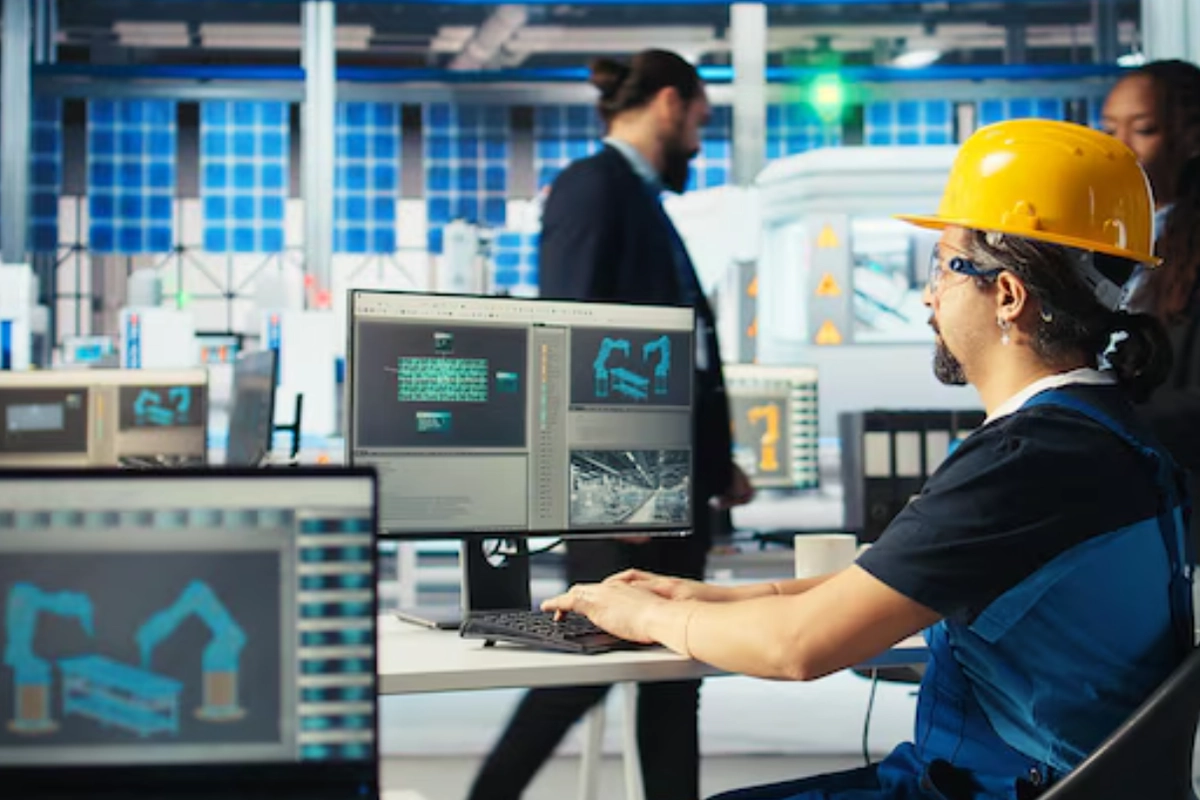 The next phase of Japanese industrial automation companies will be shaped by where intelligence sits. Instead of sending every decision to a distant cloud, manufacturers are increasingly interested in processing information closer to the machine. Edge computing can reduce delays and support faster responses when production conditions change. That matters for machine vision, quality control and predictive maintenance, where slow responses can undermine automation.
The deeper change is happening in AI itself. A June 2026 JST workshop report says foundation models and generative AI are moving beyond content generation toward recognition and prediction, with potential to improve the control of automobiles and robots. That points toward a different kind of factory intelligence. Machines can work with more varied information and respond to changing conditions.
Sustainability is another pressure on automation. Energy efficiency cannot be treated as a separate initiative when machines, motors, pneumatic systems and production lines run continuously. Better control and monitoring can reduce wasted energy while maintaining output. For Japanese industrial automation companies, the goal is not only to produce more with fewer people, but also with less wasted energy.
What Japan’s Automation Blueprint Really Says About Manufacturing
Japan’s automation story is often reduced to robots. That misses the more important change. The country is building an industrial environment where robotics, sensors, controllers, software, data and AI increasingly work as one system.
The interesting part is that this does not remove the human as neatly as the phrase lights-out factory suggests. In many cases, the smarter model is selective automation. Machines handle repetition, movement and monitoring, while people focus on exceptions, maintenance and decisions that require context.
This is the reason why these 10 industrial automation firms from Japan are important outside Japan as well. Their products are at different levels of manufacturing. They signify a move from the individual machine to an integrated system which can sense, analyze, and react. The next manufacturing revolution is not about the number of robots a factory has. It will be defined by how intelligently the entire factory works.
FAQs About Japanese Industrial Automation
What is the largest robotics company in Japan in 2026?
There is no single answer without defining the measure. Company size, robot shipments, installed base and robotics revenue can produce different results. FANUC, Yaskawa and Kawasaki are among the major Japanese industrial robotics companies, but they operate across different parts of the automation market.
Why is Japan a leader in factory automation?
Also Read: Murata Manufacturing Partners With Melt Interface Technologies
Japan combines deep robotics expertise with strong capabilities in CNC, motion control, sensing, machine vision, process automation and manufacturing equipment. Its demographic pressures and long-term government focus on robotics have also created strong incentives to automate industrial work.
What is the difference between industrial robots and cobots?
Robotic systems used in industrial settings are typically meant for fast and extensive automation operations carried out within a controlled environment. In contrast, cobots are meant for operations that require closer interaction between human beings and machines, hence making automation simpler in such situations.



 English