 日本語





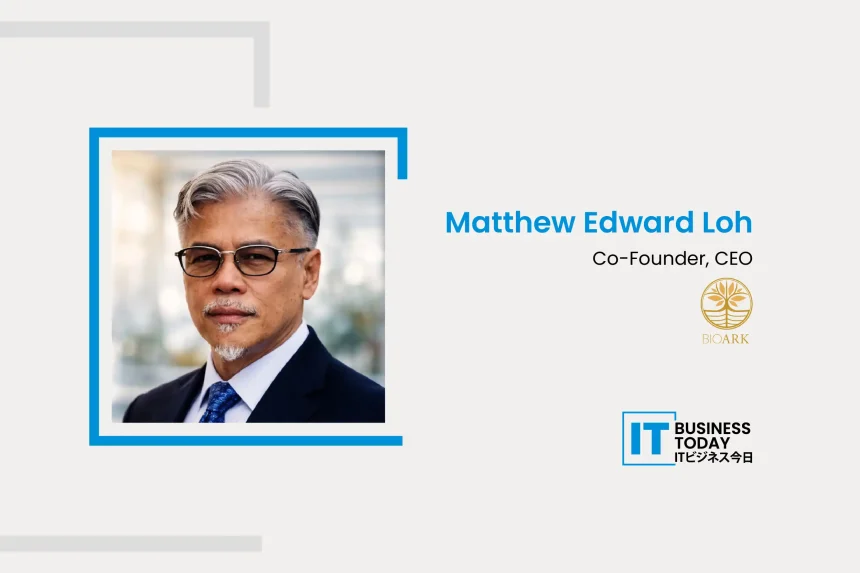
Matthew, your career has moved from photography, filmmaking and brand storytelling to building a climate agritech business. What changed in how you saw the problem that led you to focus on soil restoration and agricultural waste?
My years in the creative industry taught me how to capture attention and create desire. Over time, though, I found myself thinking more about what we actually need to live well: food, water, clothing, and a sense of purpose.
Between my creative career and Bio Ark, I also started food and beverage outlets and a streetwear business. Looking back, there was a connection running through those experiences. I was involved in what people eat, wear, and build their lives around. As I grew personally and spiritually, I wanted my work to contribute more directly to the foundations of life.

My faith led me to reflect on creation and how renewal happens. Something we discard can still hold the ingredients for new life. That idea drew me towards agricultural waste and soil restoration.
I wanted to take a more direct role in bringing about the change I cared about. Co-founding Bio Ark Global gave me a way to turn that conviction into practical work: recovering value from organic waste and returning it to the land that feeds us.
The name “Ark” carries meaning for me. It represents preserving life and a new beginning in creating the conditions for all to flourish in harmony. That is what I hope we can contribute, for our generation and those who come after us.
Bio Ark is positioning its work around rebuilding soil infrastructure through decentralised waste conversion. What have you learned about making this model commercially viable when waste availability, production costs and farmer demand vary across regions?
The first lesson is that the model has to work locally before we can take it elsewhere.
Having plenty of waste does not automatically make a viable business. We need to understand its nutrient content, moisture, consistency, and processing requirements, along with what it costs to collect and transport. We also need to understand the farmers in those regions, what they grow, what they currently spend, and what would make our product worthwhile for them.
That is why we favour production close to suitable waste sources and farming communities. It can reduce transport costs, carbon footprint, and help us build relationships with the people supplying and using the product. Each facility still needs enough production volume, dependable operations and consistent quality to support itself.
One thing I have learned is never to confuse “waste” with “free”. There is a cost to turning discarded material into something safe, useful, and reliable.
Ultimately, the business must earn its place through everyday performance. It needs to make commercial sense while delivering environmental and social benefits that people can see.
Farmers need to see economic value from regenerative agriculture without taking unnecessary risks with their harvests. How can bio-organic inputs make the transition to healthier soils commercially practical for the farmers who need it most?
We have to remember what a harvest means to a farmer. It pays household bills, school fees, and the cost of planting the next crop. When we ask a farmer to change an input or a practice, we are asking them to trust us with part of their livelihood.
That trust has to be earned gradually. A manageable trial gives farmers a chance to compare results with their usual practice, understand the costs and decide for themselves. Where appropriate, bio-organic inputs can be introduced alongside existing fertilisation practices as the results are assessed.
Through our work with farmers, we have seen encouraging results. Those experiences help build confidence, but each farmer still needs to see how the product performs under their own conditions.
With Arktivate, we aim to provide nutrients and beneficial microbes that support crop growth and soil health. For the farmer, the practical questions are straightforward: How much can I harvest? How long will it take? What will I spend? What will I have left?
I often say that farmers are very good mathematicians. They know what every expense means. A cheaper bag of fertiliser may cost more over a season, and a bigger harvest may not deliver a better profit.
The transition becomes practical when healthier soil also makes sense in the farmer’s accounts.
Bio Ark’s work spans different crops and farming conditions across Indonesia. When field results vary, how do you determine whether the solution needs to change, farming practices need to adapt, or the soil needs more time to respond?
I start by asking three questions: Was the product consistent? Was it applied correctly? What else happened in the field?
Farming involves many variables. Soil condition, irrigation, weather, pests, application timing, and other inputs can all influence the outcome. We need to look at those factors together before concluding.
A good result does not automatically mean our product deserves all the credit. Equally, we cannot explain away a disappointing result by saying the soil needs more time. Both situations deserve a proper investigation.
That means checking production records, reviewing how the product was used, and comparing the results with a control plot managed under similar conditions. If we find a problem with the formulation or production, we need to correct it. If the application needs adjusting, we need to give the farmer clearer guidance. If recovery takes longer, the measurements over time should show that.
I try to keep an open mind. The field will not always give us the answer we hoped for, but it can give us the information we need to do better.
Regenerative agriculture needs credible evidence of both environmental and economic value. Which measures matter most when evaluating Arktivate, and how do you establish that improvements in soil health translate into outcomes farmers can verify?
We need to connect what is in the product, what changes in the soil, and what the farmer gains.
It starts with product quality. Representative samples, laboratory testing, and batch records help us assess nutrient content, safety, and consistency. Without that foundation, it becomes difficult to explain differences in field performance.
In the soil, we look at measures such as pH, organic carbon, and nutrient availability. Cation exchange capacity, or CEC, helps us understand the soil’s ability to hold certain nutrients. Water retention and biological activity can also provide useful information where we can measure them reliably. We need a starting point and consistent sampling methods so that later comparisons are meaningful.
Then we have to connect those findings to the harvest: yield, crop quality, time to harvest, total costs and net income. Labour matters too. If Arktivate reduces the number of fertiliser applications or other management tasks, we should record the time and money saved.
The most convincing evidence comes from comparable plots, clear records and results across more than one season, supported by independent testing.
I want farmers to be able to explain the benefit in their own words: “This is what I used, this is what I spent, and this is the difference it made.”
Bio Ark is combining agricultural inputs with soil monitoring and data-driven recommendations. What becomes possible when farmers can track how their soil responds over time rather than judge a solution by a single harvest?
A single harvest tells us what happened that season. Records over several seasons help us understand why, and whether the farm is moving in the right direction.
For example, a difficult harvest may be linked to unusual weather rather than declining soil health. Without records, it is easy to draw the wrong conclusion and change something that was actually working.
We want to strengthen our ability to bring together soil measurements, application records, weather information, and harvest results. That would allow us to give advice that is more relevant to the individual farm.
Over time, farmers could see which practices are paying off, where they may be applying more nutrients than necessary, and which parts of their land need attention. It also gives agronomists a better basis for recommending changes.
AI could help identify patterns in those records, but the data must be reliable and the recommendations checked against local conditions.
I am interested in technology that farmers can use with confidence. Its value shows up when it helps someone make a better decision about their land, their costs or their next crop.
Bio Ark’s circular model depends on waste suppliers, farmers, local authorities and commercial partners working together. Where have you found the greatest challenge in aligning their incentives, and what has it taught you about scaling a circular agricultural business?
The biggest challenge is that people can agree with the overall vision while having very different day-to-day priorities.
A waste supplier needs dependable collection. A farmer needs an affordable product that performs. A distributor needs a reasonable margin. Local authorities need confidence that waste is being handled responsibly and that communities will benefit.
Those needs can fit together, but we have to be clear about how. Who is responsible for the quality of the waste? Who pays for transport? Who supports the farmer? What happens when something goes wrong?
I have learned that enthusiasm at the beginning is only a starting point. A partnership lasts when the responsibilities are understood, the economics are fair, and people follow through on their commitments.
There is also an ongoing responsibility to look after the relationship. We need to stay in contact, listen when circumstances change, and address problems before they undermine trust.
As we grow, that work remains essential. Equipment gives us production capacity; dependable relationships help keep the whole operation working.
Your transition from creative industries to climate agritech brought you into a field shaped by science, farming economics and environmental outcomes. How has that shift changed the way you make decisions as a founder?
It has taught me to be more careful about the assumptions behind a good idea.
My creative background helps me see connections, imagine possibilities, and communicate a vision. Those are useful qualities when starting a business. In agriculture, I also have to ask whether the idea holds up in the laboratory, in the field, and in the farmer’s practical accounts.
I have become more comfortable asking questions and relying on people whose expertise is different from mine. I do not need to have every answer, but I do need to bring the right people together, ask the right questions, listen carefully, and take responsibility for the decisions we make.
The consequences also feel very immediate. A farmer who uses our product is committing money and part of a growing season to it. That makes me think carefully about what we promise and how we support them.
My faith continues to guide the purpose behind my work. Evidence helps me make responsible choices about how to carry it out.
I still believe in pursuing a vision with courage. I have also learned that changing your mind when the facts call for it is part of being a responsible founder.
Bio Ark aims to replicate its model across markets where soil conditions, waste streams and farming economics differ. What needs to remain consistent for the model to scale, and where is local adaptation essential?
Our standards for safety, quality, traceability and honest communication need to stay consistent wherever we operate. Farmers should be able to trust what we supply and what we say about it.
How we deliver that locally will vary.
Different waste materials may need different preparation and processing. Different soils and crops will require appropriate formulations and application guidance. Energy costs, labour, transport, regulations and distribution also affect whether a facility can operate profitably.
We therefore need clear procedures and well-trained teams, with enough flexibility to respond to local conditions. We also need a reliable way to record results, identify problems and correct them.
Local partners are central to this. They understand the farming practices, relationships and practical constraints of their communities. That knowledge has to be part of the business from the beginning.
For me, the real test of expansion is whether a local team can run the operation reliably and support its farmers well. We should grow at a pace that allows us to maintain that standard.
Looking five to ten years ahead, what would convince you that Bio Ark has made a lasting difference to agriculture, and what needs to change for soil restoration to become an economic priority rather than an environmental aspiration?
I would want to see farmers choosing to keep improving their soil because they have experienced the benefits themselves. I would want local teams to be running viable businesses, with organic waste becoming a useful resource in their communities.
Those changes would need to hold up over time: stronger farmer incomes, healthier soils, and environmental improvements that can be independently verified.
One idea I often return to comes from my country, Singapore, which I am very proud of. Singapore understands the value of good governance, investing in infrastructure and dependable systems above ground. I want Bio Ark to bring that same long-term thinking beneath our feet.
With Arktivate, our ambition is to help rebuild the soil infrastructure that allows roots and microbial life to thrive and prosper. That living foundation supports crops, livestock and ultimately the people who depend on them.
Also Read: Interview with Kelvin Tan, Chief Executive Officer @audax
For soil restoration to become an economic priority, farmers need practical support, credible evidence and financing that recognises benefits beyond the next harvest. They need to be able to afford the improvements we are asking them to make.
Personally, I want to look back and know we helped leave the world better than we found it. To me, that means learning to draw from the earth in ways that also replenish it, so that feeding ourselves today protects the ability of future generations to do the same. It also means giving farming the respect it deserves as an essential contribution to life itself. If we can pass on healthier soil, more nutritious food and a future in which farmers are valued as both providers and stewards of the land, I would consider that a legacy worth building.
That is the future I want Bio Ark to help build.



 English