 日本語
日本語 




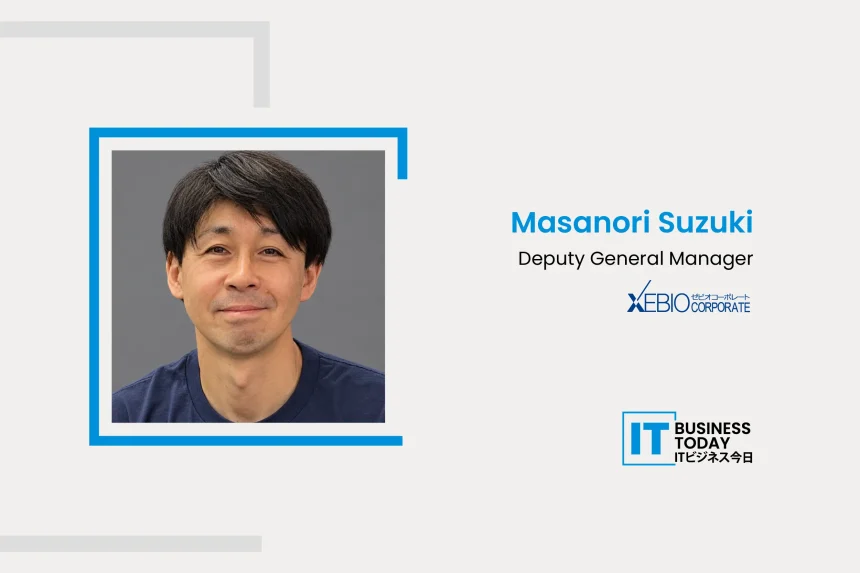
Masanori, your career has moved from SAP and enterprise IT through digital advertising, business transformation and e-commerce, and now into IT and AI transformation at XEBIO. Looking back, what experience most changed how you understand what technology should actually enable for a business?
ERP, particularly SAP, had a major impact on how I first understood the role of technology in business. It showed me how technology could integrate major business functions across the value chain into a single system and eliminate enormous amounts of manual data exchange between functions.
However, the experience that changed my thinking the most came later, when I worked with Jive, an enterprise social networking and collaboration platform. I was particularly influenced by the concept behind the platform – bringing people, information, communication and work together in one place.
When I combined that concept with what I had learned from ERP, Lean Six Sigma, business process management and IT service management, I began to see a much bigger possibility: what if we could describe not only systems and data, but also business processes, individual tasks, responsibilities and the communication around them within a single environment?

That changed my view of technology. I came to believe that its real purpose is not simply to automate individual tasks or implement systems, but to make the way an organization works visible, connected, measurable and continuously improvable.
AI is now taking this idea much further. I believe its impact will ultimately be even greater because AI can become an active participant in business processes, rather than simply a system that people use.
You have worked across pharmaceuticals, digital businesses and retail, while repeatedly moving closer to the point where technology meets business operations. What has that journey taught you about the difference between implementing technology and actually changing how a business works?
There is always a business process between technology and business outcomes.
A company operates through business processes, and technology should improve those processes. Simply implementing new technology without understanding or optimizing the underlying operations does not necessarily create real value.
That is why I believe we need to start by understanding how work is actually performed: where information comes from, who makes decisions, where work is delayed, and where unnecessary effort exists. Technology can then be applied to redesign or improve that process.
So, for me, the difference is quite simple: technology implementation changes systems; transformation changes the way the business works.
At XEBIO, you have been reshaping the IT organization alongside systems, processes, governance and business collaboration. What did that experience teach you about what an IT organization needs to become when its role extends beyond keeping systems running?
An IT department is not simply an organization that manages computers, networks and business systems. Its real role should be to become a business partner that helps the company achieve its goals through technology.
To do that, IT professionals need to understand not only technology but also the business itself – its strategy, processes, customers and operational challenges. At the same time, the IT organization needs to provide a stable and reliable technology foundation. Transformation cannot happen if basic systems are unstable.
So I see the role of IT as having two responsibilities: maintaining reliable business infrastructure and working with business teams to create new value. As technology becomes more central to every business function, that second responsibility will become increasingly important.
You have described using ITIL as a common language for bringing structure to systems, ownership, processes and communication rather than simply making the organization conform to a framework. What did that experience teach you about where structure enables transformation and where it can start getting in the way?
I have used ITIL more as a dictionary and common language for organizing our IT activities than as a framework that must be followed exactly.
For example, concepts such as service, incident, problem, change, configuration and ownership help people describe IT operations consistently. This makes it easier to clarify responsibilities, organize processes and communicate across teams.
However, every company has different operations, organizational structures and priorities. So rather than forcing our organization to fit ITIL, I customize and simplify the framework so that it fits the way our teams actually work.
Structure is valuable when it makes work easier to understand and manage. But when following the framework itself becomes the objective, it can create unnecessary complexity and bureaucracy. For me, the framework should support the operation – the operation should not exist to support the framework.
Japan’s 2026 DX research found that AI adoption is spreading, but its impact is still more visible in efficiency and speed than broader business transformation. After training around 600 employees at XEBIO, what have you learned about the point where AI adoption becomes an organizational change rather than another technology initiative?
The training program was designed for beginners, but we intentionally went beyond simply explaining how to use generative AI.
It included basic AI knowledge, current trends, our internal AI usage policy, concrete examples for different roles, prompt-writing techniques, information security, personal and confidential information, copyright, hallucination risks, and the principle that humans remain responsible for reviewing AI outputs. We also included practical exercises based on real work.
One important development was that employees from business teams voluntarily began helping us prepare the training and examples. I think that is an important signal.
AI adoption starts becoming organizational change when it is no longer something promoted only by the IT department, and business employees themselves begin asking, “How can we change the way we work with AI?”
The objective is not simply to increase the number of people using AI. It is to create an environment in which employees understand both its possibilities and its risks, and can identify opportunities to improve their own work.
Your AI work includes customer inquiry transcription and AI-assisted pricing, placing AI close to everyday business decisions. When you evaluate a new AI use case, what tells you that it is ready to become part of the operating process rather than remain an interesting proof of concept?
I always tell our team to start from the issue, not from AI.
AI is one of many possible technical solutions. First, we need to identify the real business issue and understand its root cause. Then we consider different measures and evaluate them from multiple perspectives, such as effectiveness, cost, operational impact, risk and maintainability. Only after that should we decide whether AI is the appropriate solution.
At the same time, AI is extremely powerful and versatile. I believe it will be particularly valuable in what I call the “last mile” of business processes – areas that were previously difficult to automate because they required interpretation, communication, judgment or the handling of unstructured information.
For an AI solution to move into production, however, the organization also needs to define how its output will be reviewed, who is responsible for the final decision and how errors or exceptions will be handled. A proof of concept proves that AI can do something. Production requires us to prove that the business can actually rely on it.
XEBIO is accelerating the integration of e-commerce and physical stores, while your work spans order management, inventory, fulfillment and digital platforms. What changes when the goal moves from connecting channels to making the customer experience feel like there was never a separation between them?
A good example of offline-to-online integration at XEBIO is FEET AXIS, which measures the shape and size of a customer’s feet and recommends shoes that fit. Once customers know their foot measurements, they can later purchase suitable shoes online without having to repeat the measurement.
The opposite direction – online to offline – is also important. For example, customers can order products online and have them delivered to their preferred store.
Sports products are particularly interesting because customers often value the real-world experience: trying on shoes, touching equipment or receiving advice from staff. Online services, on the other hand, provide convenience, selection and accessibility.
So I do not see physical stores and e-commerce as competing channels. The goal is to combine the strengths of both so that customers can move naturally between them without needing to think about organizational or system boundaries. We continue to work on improving that customer experience.
Your experience spans global technology environments as well as businesses operating in Japan. What have you learned about adapting transformation approaches across cultures, and what do global teams sometimes misunderstand about how change takes root in Japan?
One thing I have learned from working in both global and Japanese environments is that the same transformation approach does not always work in the same way across cultures.
In Japan, organizations often spend more time building consensus among stakeholders before making a decision. From the perspective of a global organization, this can sometimes look unnecessarily slow. However, that process can also create strong alignment once a decision has been made.
At the same time, excessive consensus-building can slow transformation, especially when technology and markets are changing quickly.
So I believe the important point is not to decide whether the global approach or the Japanese approach is better. We need to combine the strengths of both: clear direction and speed in decision-making, together with sufficient communication and stakeholder involvement to make the change sustainable.
You have repeatedly worked at the intersection of technology, people and business processes. As AI becomes more deeply embedded in everyday work, what do you think leaders most often underestimate about the human side of transformation?
I think leaders sometimes underestimate how important it is for people to understand why their work is changing, not only how to use a new technology.
AI can automate or assist many tasks, but employees still need to understand what their role becomes, which decisions remain their responsibility, and what new capabilities they need to develop.
This is also why I believe education is important. When we introduced AI training, we did not only teach employees how to write prompts. We also explained security, privacy, copyright, hallucinations and the principle of human responsibility.
People need both the confidence to use AI and the judgment to know when they should not rely on it. In the AI era, transformation is therefore not only about replacing work with technology. It is also about redesigning the relationship between people and technology.
You began your career close to enterprise systems and now work across AI, digital transformation, governance and business outcomes. As AI takes over more of the work traditionally associated with technology teams, what do you think the IT function will need to become exceptionally good at next?
Understanding the business will become increasingly important.
Traditionally, there have been two ways to close the gap between business and IT: IT engineers can learn more about business, or business people can learn more about technology. AI is changing that relationship because it can now perform an increasing number of technical tasks.
Also Read: Interview with Dieter J. Runge, Co-Founder, VP Global Strategy & Business Development, Boostlingo
As a result, I believe the competitive advantage will move toward the ability to identify the right problem, redesign the process and execute transformation.
That is why I encourage people not only to study technology, but also to learn project management and operational improvement methodologies such as Kanban, Lean Six Sigma and functional approaches.
AI may make building technology easier, but organizations will still need people who can decide what should be changed, how it should be changed, and how to make that change actually work. I believe that will become one of the most important capabilities of the future IT function.


 English