 日本語
日本語 





Japan’s 2025 Digital Cliff was never just a deadline on a technology calendar. It exposed a deeper problem. Many Japanese organizations still depend on legacy systems that were built for a different business era, maintained by people whose knowledge is becoming harder to replace. The real risk is not that these systems are old. It is that they make change expensive when businesses now need to move faster.
Japan’s Legacy Systems Modernization Committee was created because legacy systems were obstructing DX. Its report points toward flexible, modern systems that can keep pace with business change. The question for CIOs is no longer how to move yesterday’s architecture into tomorrow’s cloud. It is how to build an enterprise that can keep changing. Composable enterprise architecture becomes relevant.
The Legacy Crisis in Japanese IT Modernization
The Mainframe Sunset and the Demographic Time Bomb
Over decades, companies built customized systems around their own processes. Those systems became embedded in finance, manufacturing, supply chains, HR and other core operations. They work, but they can be difficult to explain, change or connect with newer applications.

That is the Galapagos effect of Japanese IT. Systems evolved for specific corporate needs instead of broad interoperability. The result is dependence on old logic and the people who understand it. A mainframe can keep processing transactions reliably for years, yet every change may depend on knowledge that exists in very few places.
Japan’s demographic pressure makes that problem harder to ignore. The country’s 2026 population projection is about 122.661 million, including 72.742 million people aged 15 to 64 and 36.564 million aged 65 and above. The concern is what happens when organizations depend on specialized knowledge while the pool of available workers’ changes.
A system that only a shrinking group can safely modify is a business dependency. Composable enterprise architecture reduces the amount of change locked inside one giant system.
The AI Readiness Gap
The pressure becomes sharper with AI. Japanese companies are adopting AI, but adoption alone is not the same as transformation. IPA’s 2026 survey covered 1,799 Japanese companies and found that AI adoption is expanding, while the benefits remain concentrated around operational efficiency and speed. Progress toward new value creation and broader business transformation remains limited.
That gap matters because AI needs usable data, accessible processes and systems that can interact without constant custom work. A monolithic environment can hold valuable information while making it difficult to reach. Data may sit across disconnected applications, while business logic remains buried inside systems that were never designed for today’s integration demands.
Composable enterprise architecture should therefore be viewed as an AI readiness strategy as well as a modernization strategy. The harder question is whether the architecture lets an AI tool work with the business without creating another silo.
What Is Composable Enterprise Architecture
Composable enterprise architecture is an IT framework that moves organizations away from tightly coupled, monolithic applications toward modular business capabilities that can be developed, connected, replaced and scaled with less disruption.
The core idea is simple. Instead of treating the enterprise as one enormous application, organizations break important business functions into reusable building blocks. These blocks can then work together through APIs and other integration layers. A company can change one capability without rebuilding everything.
Packaged Business Capabilities, or PBCs, sit at the center of this model. A PBC represents a distinct business function that can be packaged as an independent capability. Billing, employee management, inventory and customer identity can become separate blocks rather than permanent pieces of one application.
This approach fits the direction of Japanese legacy modernization. The Digital Agency has highlighted how modernization can clarify data, connect it with newer tools and services, and move organizations away from bespoke systems toward standardized, reusable components.
That creates a useful contrast. Traditional monolithic development tends to be rigid, tightly coupled and expensive to change. Composable enterprise architecture aims for modularity, API-first connectivity and selective replacement. The difference is not about making IT look modern. It is about making change safer.
The Path to Composability for Japanese Firms
 Phase 1: Decoupling the Monolith with the Strangler Fig Pattern
Modernization does not require a clean break from the mainframe. Core systems may support transactions that cannot simply be switched off while a new platform is built.
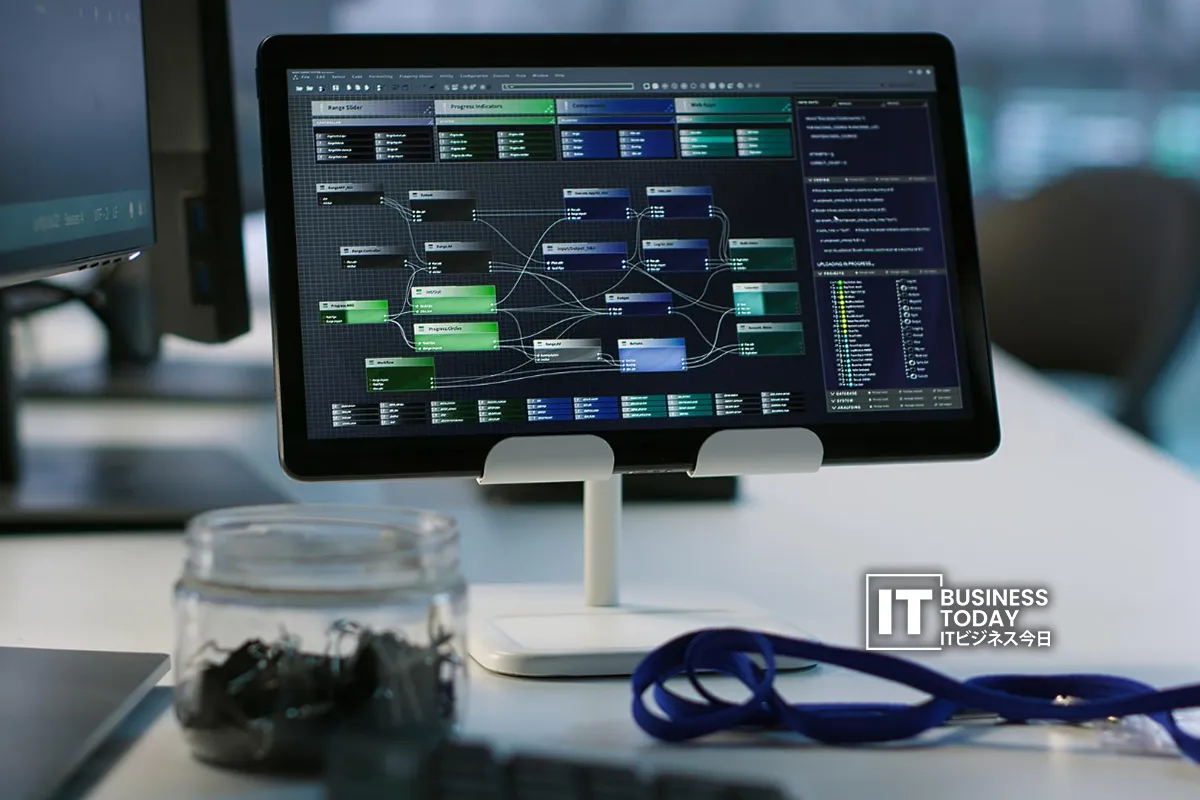
The Strangler Fig Pattern offers a more practical route. The organization identifies one business function, extracts the required data and logic, and gradually places a modern service around it. New functionality starts using the modern component while the old system continues to handle what has not yet been replaced.
This creates a controlled migration path and helps teams discover what is actually inside the legacy environment. Documentation often tells only part of the story. Business rules can be hidden in code, workflows and years of operational practice.
The first pilot should be narrow and measurable. Choose a capability with clear boundaries, manageable risk and a visible business outcome. The objective is to prove that one piece of the business can change without touching the entire machine.
Phase 2: Embracing API-Led Connectivity
Once a capability is separated, connectivity becomes the next challenge. A modern service is not useful if it remains isolated from the systems that still run the business.
API-led connectivity creates that bridge. API gateways can control access, security and traffic, while Integration Platform as a Service tools can connect legacy on premise applications with cloud services and newer applications.
This layer makes composable enterprise architecture practical. APIs create defined ways for systems to communicate and boundaries around business capabilities. Instead of connecting every application directly to every legacy database, organizations can expose controlled services that evolve independently.
It also creates architectural discipline. Teams can understand what a capability provides without knowing every detail behind it.
Phase 3: Moving Toward Packaged Business Capabilities
The third phase is where modularity becomes part of the operating model. Organizations can identify domains such as HR, billing, procurement, supply chain or customer management and decide which capabilities should become independent services.
Cloud-native microservices can support this transition, but microservices should not become the goal. Splitting a bad architecture into hundreds of tiny services can simply create a new form of complexity.
The real objective is business modularity. Each component should have a clear purpose, clear ownership and a defined way to interact with other components. Composable enterprise architecture follows the business.
Overcoming Cultural and Structural IT Barriers in Japan
Technology is only half the modernization problem. The harder part is changing how organizations make technology decisions.
Japanese enterprises have traditionally relied heavily on System Integrators for development, maintenance and operational knowledge. That model can work when the objective is to build and maintain a large bespoke system. It becomes more difficult when the organization needs to continuously redesign capabilities, test new services and change architecture in smaller increments.
Composability requires stronger architectural governance inside the enterprise. Internal teams do not need to build everything themselves. They do need enough technical understanding to define standards, own APIs, evaluate dependencies and decide which capabilities should remain with a vendor and which should become strategic internal assets.
The same shift applies to delivery culture. A perfectionist approach can feel responsible when systems are critical. Yet waiting for every requirement to be finalized before releasing anything can become a liability when business conditions keep changing. Composable enterprise architecture works better with smaller releases, controlled experiments and continuous feedback.
Discipline still matters. It simply moves from exhaustive planning toward clear boundaries, governance and measurable outcomes. The organization becomes less dependent on one massive project and more capable of improving the architecture continuously.
 The Business Outcomes of a Composable Approach
The business case for composable enterprise architecture is freedom to change.
A modular environment can reduce dependence on a single vendor because individual capabilities can be replaced without rebuilding the whole enterprise. It can also reduce the cost of carrying unnecessary complexity across every application change. More importantly, it can shorten the distance between a business idea and the technology needed to support it.
That matters for product launches, customer experiences, internal operations and AI initiatives. Easier access to data and business capabilities lets teams experiment without repeatedly opening the same legacy bottleneck.
The strongest outcome is organizational flexibility. A company that can replace one component, expose one API or modernize one business domain without destabilizing everything else has more room to respond when markets, regulations or technology change.
Conclusion and Next Steps
Also Read: Exture and Snowflake Expand Data and AI Services
Japan does not need another grand migration project that moves a tightly coupled legacy estate into a different hosting environment and calls the job finished. That approach can change the location of the problem without changing its structure.
Japan’s AI Basic Plan was approved by the Cabinet on July 14, 2026. The strategic direction is clear. AI is becoming part of how Japan thinks about economic and business transformation. Yet AI ambitions will run into the same old wall if enterprise systems remain difficult to change and data remains trapped inside rigid structures.
Composable enterprise architecture offers a more realistic path. CIOs should audit their monolithic dependencies, assess their API capabilities and select one business capability for a controlled decoupling pilot. The goal is not to modernize everything at once. It is to make the next change easier than the last. That is the real test here.



 English