 日本語
日本語 





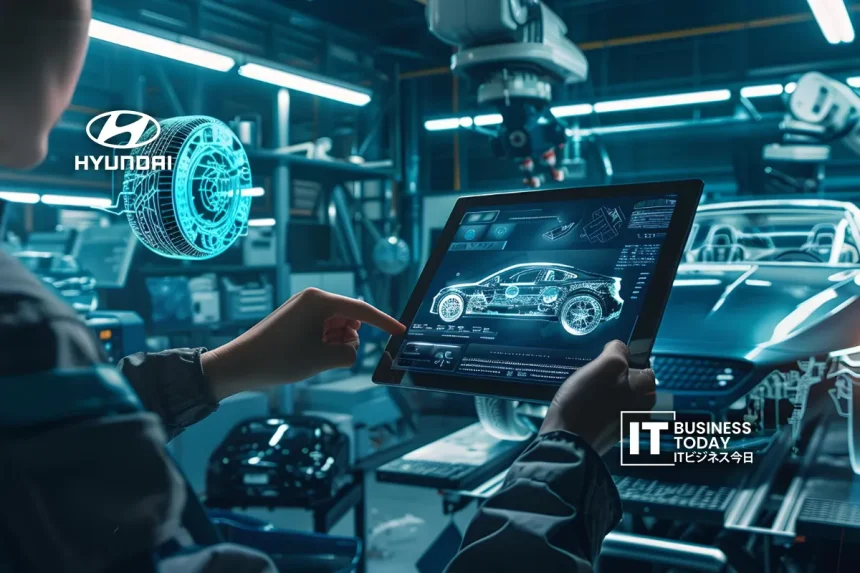
Hyundai Motor Group is speeding up its company- artificial intelligence plan showing clearly how old-fashioned industrial companies are going past small AI tests and moving toward systems that directly affect engineering, manufacturing, customer service and new ways of getting around. This change could mean a lot more than, for South Korea especially for Japans car, robot and industrial technology industries.
At its August 12, 2026, AI Transformation Showcase in Seoul, Hyundai outlined how years of digital transformation have prepared the company for broader AI adoption. The automaker said its strategy now combines accumulated business data, generative AI, AI agents and operational expertise as it moves toward what it calls the Physical AI era—where intelligent systems interact with vehicles, robots, factories and other physical environments.
Hyundai’s Enterprise AI Strategy
A key element of Hyundai’s approach is its Global One Data Pipeline, which connects information from research, production, quality management and sales. This allows data generated in one part of the business to inform decisions elsewhere, creating a foundation for AI-driven operations. The company has also expanded access to its H Chat Pro generative AI platform. As of July 2026, more than 30,000 employees were actively using the platform, representing approximately 80% of Hyundai Motor and Kia’s general employee population. Employees are using AI for tasks including document creation, data analysis, information retrieval and software development.

The results suggest that enterprise AI is becoming more measurable. Hyundai says its Crash Safety AI Assistant reduced the time engineers spend identifying and reviewing relevant cases by about 90%. In manufacturing, an AI-powered recognition system deployed across roughly 70 processes generated annual cost savings of about KRW 5.24 billion, while an AI-based production routing system reduced unnecessary downtime by approximately 86%.
Why This Matters for Japan
The announcement comes at an important time for Japan’s technology industry. Japanese companies already have deep expertise in automotive manufacturing, industrial automation and robotics, but they are increasingly under pressure to combine that hardware expertise with advanced AI and software capabilities.
Japan’s government is actively supporting this transition. The Ministry of Economy, Trade and Industry (METI) has launched initiatives focused on making manufacturing data AI-ready and developing robotics foundation models. These programs are intended to help AI systems operate directly within physical environments such as factories, vehicles and other machines.
Japan is also seeing major private-sector investment in physical AI. In July, Noetra and major Japanese companies including Sony, SoftBank, NEC and Honda began full-scale research into a Japan-developed multimodal foundation model intended to support AI-enabled robots and physical AI applications.
This means Hyundai’s progress could intensify competitive pressure on Japanese manufacturers. Companies that once competed primarily on vehicle engineering, production quality and hardware may increasingly compete on AI platforms, proprietary data, software-defined products and intelligent automation.
For businesses the most important thing is not to use a chatbot or another kind of artificial intelligence tool. What Hyundai did shows that it is very important to build a digital system first.
Manufacturers need to have systems to move information around. This includes things like design, production, quality control, logistics and customer information. Companies that make robots may need to make their machines easier to use and train using models. Companies that supply parts to car makers may see an increase in demand for things like software, sensors, cloud computing, cybersecurity and parts that use artificial intelligence.
This change could be good for Japans technology companies. Software makers, semiconductor companies, robot makers, system integrators and artificial intelligence startups could all benefit. This is because manufacturers will be looking for partners who can help them make their factories smarter.
At the time businesses will face new problems. These include keeping information managing data making sure artificial intelligence is reliable and training workers. Using intelligence in the physical world is very hard. If something goes wrong in a factory, vehicle or robot it can cause problems. Japan is very focused on using intelligence with robots so it is very important to make sure these systems are safe and trustworthy. The Ministry of Economy, Trade and Industry or METI has a plan, for robots that focuses on creating environments where robots can be used safely and effectively in all areas of life.
The Bigger Picture
Hyundai’s AI transformation signals a broader change in the global technology industry: AI is moving from the screen into the physical economy.
Also Read: Insignia Group Unveils ACE Sales Platform
For Japan, this could become a competitive opportunity. The country’s strengths in robotics, precision manufacturing and industrial engineering provide a strong base for physical AI. But maintaining that advantage will require companies to connect their hardware expertise with modern AI infrastructure and software capabilities.
As Japanese companies and businesses around the world go this way the competition is expected to change. The businesses that do well might not just be the ones with the AI systems but the ones that can take data, software and real-world operations and turn them into clear business value.
Hyundai’s plan therefore gives a message to Japan’s technology sector: the next part of the AI race will be mainly about more than just data centers. It will also be about factory floors, inside cars and all the machines that drive the economy.



 English