 日本語
日本語 





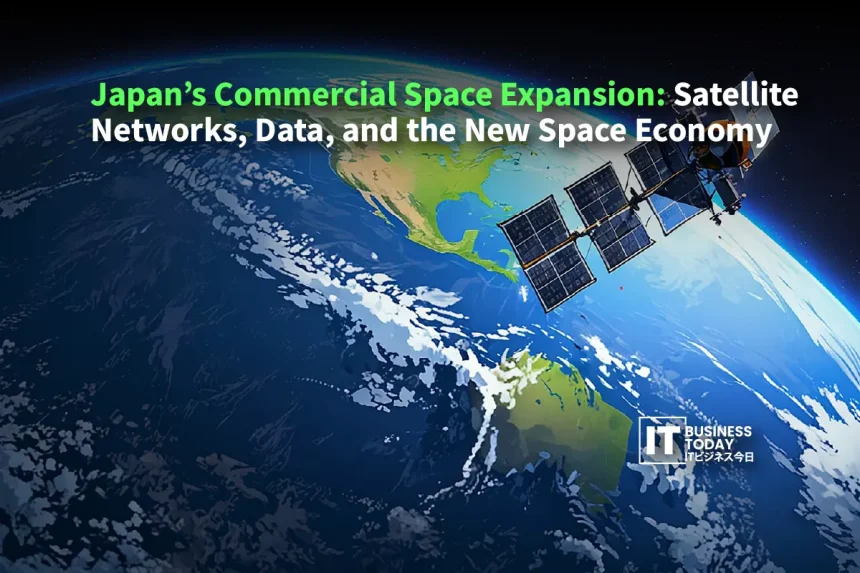
For decades, Japan’s space ambitions were largely defined by government missions, scientific discovery, and the engineering excellence of JAXA. Space was important, but it remained a specialized domain with high barriers to entry and limited participation from private industry. That reality is changing rapidly. In 2026, Japan’s commercial space industry is no longer operating at the edge of the economy. It is steadily moving toward the center of it.
The shift is kind of being pulled along by a mix of geopolitical realities, technological advances, and plain economic necessity. Since the International Space Station is edging toward retirement and the competition is getting sharper across the Indo-Pacific region, Japan is speeding up its efforts to build something like a commercially sustainable space ecosystem. And no, the intention isn’t just about launching extra satellites or backing more startups, it’s more about stitching it all together into an integrated space economy where infrastructure, data, research, and actual commercial uses keep feeding into each other.
You can already see the size of this change. Rockets and satellites make up roughly 85% of Japan’s total space equipment production, which basically underlines how central space technologies have become to the country’s industrial backbone. Even more, Japan is supporting the whole direction with long-range funding, new commercial agreements, and a startup ecosystem that keeps growing. All of this combined, is placing Japan as a real, key player in the global space economy.

The Regulatory Shift from JAXA R&D to Private Capital Acceleration
A common misunderstanding about Japan commercial space industry is that it only showed up because of startup brilliance. But really the shift started much earlier, through policy, and not just some kind of spark from new ventures. Governments often have trouble building fresh industries, however they’re also able to lower the obstacles that keep those industries from showing up in the first place. Japan seems to have noticed that difference.
In the last several years, Japan space strategy has moved, sort of, from a setup mostly centered on research and development, into something more tied to commercialization, buying, procurement, and market making. Instead of looking at private firms as people who simply support government missions as contractors, policymakers are increasingly treating them as the next engines for economic growth.
That shift becomes clear when examining the Space Strategy Fund. The program supports private companies, startups, universities, and national research organizations through initiatives that can extend for up to 10 years and are coordinated across four ministries. The structure itself sends a message. Japan is not pursuing short-term experimentation. It is attempting to create long-term commercial capacity.
Also Read: Next-Gen Mobility Platforms in Japan: How Software, Data, and AI Are Redefining Vehicles
Even more revealing is the government’s stated ambition to create more than 10 new business projects using Low Earth Orbit by the early 2030s while simultaneously developing lower-cost transportation systems capable of supporting diverse satellite launch demand. This is not the language of scientific exploration alone. It is the language of industrial development.
Meanwhile, those old school aerospace players are adjusting to this new environment. Firms that used to lean heavily on government contracts, and defense related work are now more often acting like infrastructure partners for commercial ventures. The border between public and private activity is getting less strict, and somehow that sort of wiggle-room is helping speed up innovation.
At the same time, commercial space capabilities are becoming more strategic than just about economics. Satellite systems are taking on a bigger role in maritime awareness, communications resilience, and regional security. Because of that, commercial space development is getting tied in closely with national priorities, which adds even more pull for investment and growth.
Commercial LEO Infrastructure and Japan’s Post-ISS Strategy

The approaching retirement of the International Space Station presents a challenge that many countries are still trying to solve. For Japan, the issue extends beyond prestige or participation in international programs. The real concern is continuity.
For decades, the ISS has provided researchers and companies with access to microgravity environments for scientific experiments, technology demonstrations, and industrial research. Losing that platform without a commercial alternative would create a significant gap in Japan’s innovation pipeline.
As a result, Japan’s commercial space industry is increasingly focused on securing access to the next generation of Low Earth Orbit infrastructure. Rather than building every component independently, the country is pursuing a strategy that combines domestic capabilities with international partnerships.
This approach reflects a broader trend within the global space sector. The future of orbital infrastructure is likely to be commercial, multinational, and service-oriented. Nations that secure access early will gain advantages in research, manufacturing, and emerging space-based industries.
One of the strongest signals of this transition emerged in January 2026 when Mitsubishi Heavy Industries and Mitsubishi Electric invested in Japan LEO Shachu, a commercial space venture established by Mitsui. The significance of this move extends beyond the investment itself.
Large industrial companies rarely deploy capital without a clear view of future demand. Their involvement suggests growing confidence that commercial Low Earth Orbit infrastructure will become a viable market rather than a speculative concept.
The development also highlights an important shift in mindset. Japan is no longer approaching space solely as a destination for exploration. Increasingly, it is being treated as an operational economic domain where research, manufacturing, logistics, and commercial services can generate long-term value.
Downstream Data Economics and the Rise of Satellite Intelligence
Space may capture public attention through rockets and missions, but the largest economic opportunities often emerge after a satellite reaches orbit.
The most important transformation within Japan’s commercial space industry is occurring in the downstream economy, where data collected from space is converted into business value on Earth. This shift is changing how companies think about satellites. Instead of viewing them as isolated hardware assets, organizations increasingly see them as continuous sources of intelligence.
At the same time, satellite architecture itself is evolving. Large and expensive single-purpose satellites are gradually giving way to smaller, more flexible constellations capable of delivering higher revisit rates and more frequent observations. This allows organizations to access fresher information and respond more quickly to changing conditions.
The practical applications are expanding across multiple industries.
Satellite data is being used to improve agricultural productivity through more precise monitoring of crops and environmental conditions. It is helping logistics providers and infrastructure operators track assets more efficiently. It is also supporting disaster preparedness and response efforts by delivering timely observations when traditional monitoring systems may be disrupted.
In addition, advanced manufacturing sectors are beginning to benefit from space-derived intelligence. Semiconductor production, supply chain management, and industrial planning increasingly depend on accurate environmental and operational data. Space technologies are becoming part of these workflows, even when their role remains largely invisible to end users.
This evolution represents a fundamental change in how value is created. The future winners in the space economy may not necessarily be the organizations launching the most satellites. They may be the ones extracting the most useful insights from the data those satellites generate.
The Ground Segment Expansion and the Startup Vanguard
A satellite network is only as valuable as the infrastructure that supports it. This reality is often overlooked in discussions about the space economy.
Satellites may operate in orbit, but the real work of processing, transmitting, securing, and analyzing data happens on the ground. Without modern ground infrastructure, even the most sophisticated satellite constellation becomes significantly less useful.
As satellite deployments increase, Japan’s commercial space industry is investing not only in orbital assets but also in the systems required to manage growing volumes of information. Ground stations, communications networks, data processing platforms, and analytics capabilities are becoming strategic assets in their own right.
At the center of this evolution is a new generation of companies, chasing rather focused opportunities, like sort of laser minded ones.
Astroscale has risen as one of the more notable players in orbital sustainability, and still, many organizations admit the growing threat of space debris. What sets Astroscale a bit apart is the push toward practical solutions. Its ADRAS-J mission completed 293 days in orbit first, then it began controlled deorbit operations in March 2026. More importantly, the mission demonstrated capabilities that could become essential as orbital activity continues to increase. The challenge of maintaining safe and sustainable operating environments in space is no longer theoretical. It is becoming a commercial necessity.
Meanwhile, ispace is advancing commercial lunar logistics and infrastructure development. Although lunar activities remain outside the immediate focus of many commercial markets, they represent an important extension of Japan’s broader space ambitions. Companies that establish capabilities today may become key participants in future cislunar economies.
Axelspace represents another critical dimension of the ecosystem. Its focus on Earth observation and data services highlights the growing importance of downstream applications. Rather than just racing on raw hardware, companies are more and more chasing, the quality, accessibility, and overall usefulness of the information they put out.
Together, these kinds of companies quietly show something crucial about Japan’s strategy. Japan is not betting everything on one single breakthrough technology, or on one dominant business approach. Instead, it keeps nurturing a mixed ecosystem, where infrastructure providers, data specialists, sustainability pioneers, and exploration oriented companies, can each help in a more steady, long term growth path.
Japan’s Pursuit of Orbital Sovereignty
The most important story in Japan’s commercial space industry is not the rise of any single company, technology, or mission. It is the emergence of an ecosystem that is beginning to reinforce itself. Government funding is creating opportunities for private innovation. Industrial giants are investing in commercial infrastructure. Startups are solving problems that did not even exist a decade ago. Meanwhile, satellite networks and data platforms are creating entirely new economic possibilities.
What makes this moment significant is that Japan is no longer preparing for a future space economy. It is actively building one. The real test will not be whether more satellites reach orbit or whether more startups enter the market. It will be whether Japan can convert technological capability into sustained commercial value. Based on the direction of policy, investment, and industry activity in 2026, the country appears increasingly well positioned to do exactly that.



 English