 日本語
日本語 





AI changed the data center conversation. The question is no longer how much compute enterprises can buy. It is whether the power grid can support the compute they want to run.
That shift matters because AI workloads are far more demanding than many traditional cloud workloads. Training large models requires huge, sustained bursts of compute. Inference creates a different challenge, with workloads often needing to sit closer to users for speed and reliability. As a result, AI data center power demand is becoming an IT architecture issue, not just a facilities problem.
This article looks at what is driving that pressure, why location decisions are changing, and how enterprises can rethink power, workload placement, orchestration, and cloud contracts before electricity becomes the constraint that slows their AI strategy.

Why AI Is Breaking the Grid
Traditional data centers were built around predictable workloads. AI changes that equation. Modern GPU systems pack more computing capability into the same physical footprint, increasing pressure on power and cooling.
NVIDIA’s 2026 Vera Rubin systems show where this is heading. Custom Vera Rubin systems can support up to 144 GPUs per rack. It changes the physical profile of the data center. More compute is concentrated into smaller spaces, putting greater pressure on electrical distribution, cooling and backup capacity.
That is where AI data center power demand runs into a much slower-moving system. A company can order compute hardware relatively quickly. Expanding the electricity infrastructure behind it is another matter.
The IEA notes that new transmission lines can take four to eight years to complete in advanced economies. Building grid projects involves land use, engineering work, hardware, permits, on site construction, and physical tie ins. AI systems can move much faster, like software, but the power grid still has to go through all of that.
The problem also stretches beyond transmission. Turbines, transformers, transmission capacity and skilled tradespeople become part of the same bottleneck. A delay at any point can push back an entire data center project.
The issue is no longer simply whether enough cloud capacity exists. AI data center power demand now makes the location of that capacity just as important. Enterprises must ask whether enough power will exist where that compute is needed.
Chasing Power Over Proximity
For years, data center location strategy was heavily influenced by connectivity, latency, customer concentration and access to established cloud regions. Those factors still matter. However, AI data center power demand adds another question. Can the location support the electricity load?
Google’s 2026 infrastructure discussion makes the pressure clear. The company says AI compute demand can exceed the space and power capacity of individual facilities. Google also says it strategically locates data centers near sustainable energy sources or in locations where clean energy can be added to the local grid.
That changes how enterprises should think about geography. The best AI location may not always be the closest to the customer. It may be where sufficient power and grid capacity can be secured.
That does not mean every workload should move to a remote power-rich region. Inference differs from training. An inference workload serving a customer interaction may need to stay close to the user. Training is generally more flexible and can run where large-scale compute and power are easier to secure.
This creates a two-speed architecture. Latency-sensitive workloads should stay close to users and critical data. Flexible workloads can move where infrastructure and energy conditions make more sense.
The result is a more distributed AI infrastructure strategy. AI data center power demand will increasingly shape that distribution. Instead of asking where the biggest cloud region is, ask where power, connectivity, resilience and flexibility align.
How Enterprises Can Mitigate the Power Crunch
The power problem cannot be solved by simply buying more cloud capacity. AI data center power demand requires enterprises to treat energy availability as another infrastructure variable, alongside compute, storage and network capacity.
Embracing On-Site Generation and Microgrids
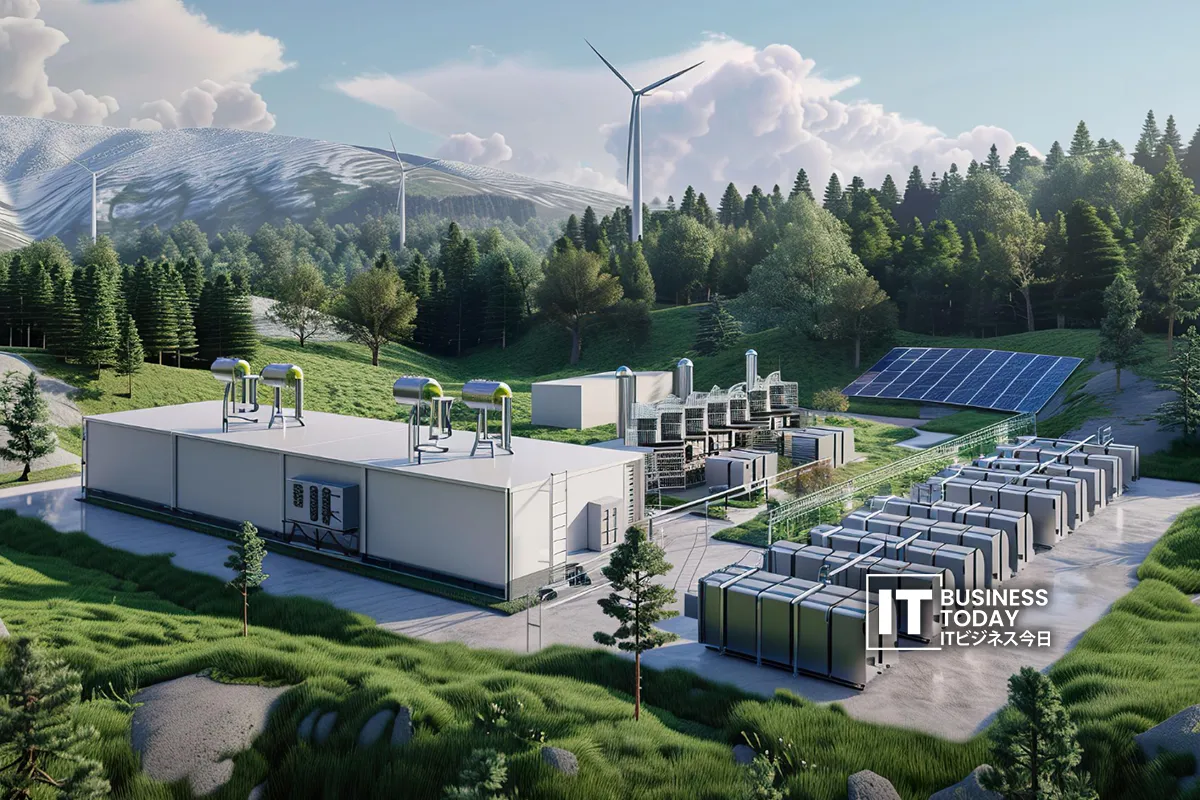 Grid power will remain central to enterprise computing. Still, relying on the grid as the only answer can expose AI projects to interconnection delays and local capacity limits.
Amazon’s planned data center campus in Pecos County, Texas offers a useful example. The campus will use new onsite generation while working toward grid-connected service as interconnection timelines allow. Amazon is also exploring solar energy and battery storage onsite.
The lesson is not that every enterprise should build its own power plant. The practical takeaway is that large AI deployments may need a hybrid energy strategy. Onsite generation, batteries, renewable sources and grid power can work together rather than being treated as separate systems.
With AI data center power demand rising, some organizations may treat onsite energy as part of the primary operating architecture rather than emergency backup.
Economics and regulation vary by location. Still, ask the question before a data center design locks the enterprise into a power model the grid cannot support.
AI-Driven Workload Orchestration
Energy management does not have to happen only at the physical layer. Software can help decide when and where compute should run.
AI workload orchestration can match demand with available infrastructure. Instead of sending every job to one region by default, enterprises can route workloads around urgency, latency, data location, capacity and energy conditions.
Agentic AI could help here. Intelligent systems can evaluate workload requirements and infrastructure conditions, then recommend or execute placement decisions within defined rules.
The idea becomes especially useful for training and other flexible workloads. If a task does not need an immediate response, the enterprise has more freedom to choose where it runs. Compute can potentially move between locations based on capacity and operating conditions.
The opportunity is to make workload placement more dynamic. That matters as AI data center power demand spreads across facilities.
Data residency, security, application dependencies and service-level commitments still apply. Energy-aware orchestration should complement cloud architecture, not override business requirements.
The Resurgence of Nuclear Energy
 Some AI workloads need something more basic than flexibility. They need reliable power around the clock.
That is why nuclear energy is returning to the enterprise technology conversation. Microsoft’s power purchase agreement with Constellation supports the restart of the Crane Clean Energy Center, formerly Three Mile Island Unit 1. Microsoft says the facility will provide reliable, around-the-clock carbon-free electricity to meet the needs of its data centers.
The significance goes beyond one agreement. AI data center power demand creates a need for power that is not only cleaner but also dependable. Renewable generation and storage can play important roles, but enterprises also need to think about firm power for continuous operations.
Small Modular Reactors are part of that longer-term conversation. Their appeal lies in the possibility of providing dedicated, reliable power closer to major loads. The IEA expects the first SMRs to come online around 2030, showing that this remains an emerging option rather than an immediate fix.
Nuclear should not be treated as a futuristic technology story. It is becoming part of the strategic discussion around securing long-duration power for AI.
Future-Proofing Your IT and Cloud Architecture with a 3-Step Playbook
- Audit workload priority
Separate workloads by how sensitive they are to latency and location. Training and other flexible workloads can be distributed more widely, while inference that directly affects customer experiences may need to remain closer to users and data.
- Optimize token usage
Do not use the largest model for every task simply because it is available. Smaller, domain-specific models can be more appropriate for simple or repetitive workloads. Better model selection can reduce unnecessary compute and make AI infrastructure more efficient.
- Update vendor RFPs
AI data center power demand means power should become part of the cloud and colocation buying conversation. Ask providers for PUE transparency, power availability, power commitments, renewable-energy options, resilience measures and clear service expectations around capacity.
Conclusion
Also Read: AI Data Center Power Demand: How Enterprises Are Rethinking Energy, Grid Capacity, and Compute
The uncomfortable reality is that AI data center power demand is turning electricity into a strategic constraint on digital growth. Enterprises spent years designing cloud architectures around flexibility and abstraction. AI is forcing some of that abstraction back into the physical world.
The winners will not necessarily be the companies that secure the most GPUs. They will be the ones that understand where those GPUs can run, how much power the infrastructure can support, and which workloads actually need to be there.
Energy strategy is now IT strategy. Power planning, workload orchestration, site selection and vendor contracts can no longer sit in separate rooms. As AI scales, electricity will increasingly decide how far enterprise compute can go.



 English