 日本語
日本語 





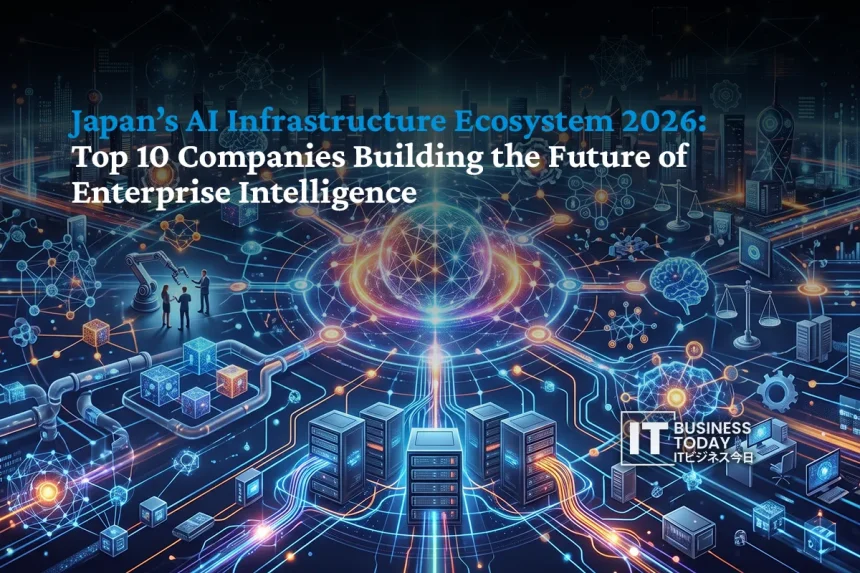
Japan spent decades building the machines, networks and industrial systems that powered the global economy. Now, the country is turning that engineering depth toward a different challenge. AI is moving from something businesses test to something they expect to run inside core operations.
The scale of that shift is already visible in government. During FY2026, approximately 180,000 government employees across Japan’s ministries and agencies are expected to have access to generative AI through the Government AI environment. That is not a side experiment. It signals a broader change in how Japan is approaching enterprise AI.
This article examines the Japan AI infrastructure ecosystem through ten companies shaping different parts of that stack, from domestic compute and Japanese-language models to industrial AI, robotics, edge systems and enterprise platforms.

The Core Drivers of Japan’s 2026 AI Boom
Japan’s AI push is not being driven by hype alone. It is being shaped by a very practical problem. The country needs technology that can help businesses do more with limited human capacity, particularly as an ageing workforce puts pressure on productivity and operations. That makes automation less of a futuristic ambition and more of an economic necessity.
At the same time, Japan is becoming more serious about sovereign AI. For enterprises and public institutions, the question is no longer simply which model performs best. It is also where data is processed, who controls the infrastructure and whether sensitive information can remain within trusted environments. That changes the infrastructure equation considerably.
Policy is moving in the same direction. METI published AI Guidelines for Business Version 1.2 on March 31, 2026, establishing unified guidance for safe and secure AI use and clarifying responsibilities across developers, providers and users. The accompanying framework also reflects the rise of AI agents and physical AI.
 The message is clear. Japan is not treating AI as another software trend. It is building the governance, infrastructure and industrial capability needed to make AI part of the economy.
The Top 10 Companies Building Japan’s Enterprise AI
SoftBank Corp
Core focus
Domestic AI compute, cloud infrastructure and enterprise AI.
Flagship technology
SoftBank’s planned AI Data Center GPU Cloud is expected to launch in October 2026. The infrastructure includes NVIDIA GB200 NVL72 and supports AI model training, inference and data processing within Japan.
Best for
Enterprises that need serious AI compute while keeping workloads within Japan. SoftBank is important because it connects infrastructure with practical enterprise use. Its direction also extends toward AI agents and physical AI, making it one of the clearest examples of Japan building an AI infrastructure layer rather than simply buying AI services.
Fujitsu
Core focus
Enterprise AI, industrial intelligence and Japanese-language AI.
Flagship technology
Fujitsu Kozuchi combines generative AI capabilities with the company’s existing industrial AI expertise. Its technology strategy also places Kozuchi alongside Takane LLM technology, AI security and AI computing capabilities.
Best for
Large organisations that need AI connected to existing business systems and industry workflows. Fujitsu’s advantage is less about chasing the loudest model and more about connecting AI with the complicated environments enterprises already operate. That makes it especially relevant to manufacturing, supply chains and other operational industries.
Hitachi
Core focus
Industrial AI, operational technology and enterprise digital transformation.
Flagship technology
Hitachi’s Lumada ecosystem provides the foundation for connecting data, digital technologies and industrial operations. Its AI approach is particularly relevant where IT systems need to work alongside operational technology.
Best for
Manufacturing, infrastructure and industrial enterprises. Hitachi represents an important part of Japan’s AI strategy because the country’s competitive advantage is not limited to software. Its industrial base gives AI a direct route into physical operations, where data from machines and processes can influence decisions rather than sit inside another dashboard.
NEC Corporation
Core focus
Sovereign AI, secure infrastructure and enterprise-grade AI.
Flagship technology
NEC’s AI portfolio spans sovereign AI capabilities, biometric infrastructure and lightweight large language models designed for practical deployment.
Best for
Government organizations and enterprises handling sensitive information. NEC fits the Japanese AI ecosystem particularly well because security and control become more important as AI moves into public services and critical business functions. Its strength lies in combining AI with infrastructure where identity, privacy and trust cannot be treated as optional features.
Preferred Networks
Core focus
Deep learning, robotics, custom AI computing and industrial applications.
Flagship technology
Preferred Networks has built its reputation around deep learning, custom AI chips, digital twins and robotics.
Best for
Manufacturers and organizations working with complex physical environments. PFN is important because it pushes Japanese AI beyond language models and into machines that need to perceive, learn and act. That makes it a strong representation of the physical AI direction emerging across Japan.
Sakana AI
Core focus
Next-generation AI research and efficient model development.
Flagship technology
Sakana AI is known for evolutionary approaches to model development and nature-inspired AI architectures, giving it a distinctly different research direction from conventional foundation-model strategies.
Best for
Organizations and technology ecosystems looking for new approaches to AI model development. Its relevance in 2026 comes from the fact that the AI race is becoming less about simply scaling larger models and more about finding better ways to build, combine and adapt intelligence.
NTT Data
Core focus
Enterprise AI, edge computing and efficient language models.
Flagship technology
NTT Data’s ecosystem includes tsuzumi, an efficient LLM designed for practical enterprise use, alongside its broader expertise in communications and edge infrastructure.
Best for
Enterprises that need AI closer to their data and operations. NTT Data brings together two increasingly important parts of the Japan AI ecosystem. AI needs capable models, but it also needs networks and deployment environments that can place intelligence closer to where decisions happen.
Sony AI
Core focus
Edge AI, computer vision, sensors and intelligent physical systems.
Flagship technology
Sony AI builds on Sony’s expertise in sensors, imaging, vision and edge technologies.
Best for
Applications where AI needs to understand physical environments in real time. Sony’s position is particularly interesting because its hardware ecosystem gives it access to the raw sensory layer that many AI systems depend on. That creates opportunities across robotics, mobility, entertainment and other environments where perception matters.
PKSHA Technology
Core focus
Enterprise algorithms, conversational AI and applied machine intelligence.
Flagship technology
PKSHA bridges research-driven algorithm development with enterprise applications, creating AI systems designed around specific organizational problems rather than generic experimentation.
Best for
Businesses looking to turn AI research into operational tools. Its role highlights a less glamorous but critical part of enterprise AI. The winning system is not always the most powerful model. Often, it is the one that fits a company’s workflow, data and customer interaction closely enough to deliver measurable value.
ABEJA
Core focus
Enterprise AI platforms, data pipelines and MLOps.
Flagship technology
ABEJA focuses on end-to-end AI implementation, helping organizations connect data, models and operational workflows.
Best for
Companies moving from isolated AI pilots toward repeatable enterprise deployment. ABEJA represents the infrastructure layer between experimentation and scale. That layer is easy to overlook, yet it is where many AI strategies either become operational or quietly stall.
A Strategic Roadmap for Enterprise Adoption
 Buying AI infrastructure before understanding the data underneath it is a costly way to learn the wrong lesson. CIOs should begin with a hard audit of legacy data, identifying what is usable, what is fragmented and what cannot safely enter an AI workflow.
The next decision is workload placement. Not every AI task needs the same architecture. High-compute workloads may belong in domestic cloud infrastructure, while latency-sensitive or operational use cases may make more sense at the edge.
Privacy should sit alongside performance from the beginning. Enterprises should define what data can move, where it can be processed and who can access the resulting systems. Governance also needs to cover models, agents and the people using them.
The practical goal is not to deploy the most AI possible. It is to build an architecture where the right intelligence reaches the right workflow without creating a bigger security or data problem.
What Comes After 2026
The next stage of Japan’s AI infrastructure story is likely to be far more physical.
NEDO’s AI robot and physical AI project runs from FY2026 through FY2030 and focuses on multimodal foundation models for AI robots and physical AI. That direction matters because it shifts intelligence closer to machines, factories and real-world environments.
This is where the idea of hyper-edge AI becomes more credible. Instead of sending every decision back to a distant cloud, systems can increasingly process information closer to where it is generated.
Quantum machine learning may eventually add another layer, but the more immediate transformation is already visible. Japan is moving AI from screens into systems that can sense, reason and act.
Conclusion
Japan’s AI advantage will not come from producing another chatbot and calling it a national strategy. That race is already crowded, and competing purely on model size would ignore what Japan does unusually well.
Also Read: VALANCE and Riken Sangyo Partner to Bring AI to Hiroshima
The more interesting opportunity sits underneath the models. Japan has deep industrial capabilities, sophisticated infrastructure, strong engineering talent and an increasing focus on sovereign and secure AI. The companies in this ecosystem reflect that mix.
The real test, however, will be execution. Infrastructure alone does not create productivity. Models do not fix broken data. And AI adoption does not automatically produce better decisions.
Japan’s strongest position may therefore be its ability to connect AI with the physical and enterprise systems it already knows how to build. If it gets that integration right, its AI infrastructure ecosystem could become less about catching up with Silicon Valley and more about building a distinctly industrial model of enterprise intelligence.



 English