





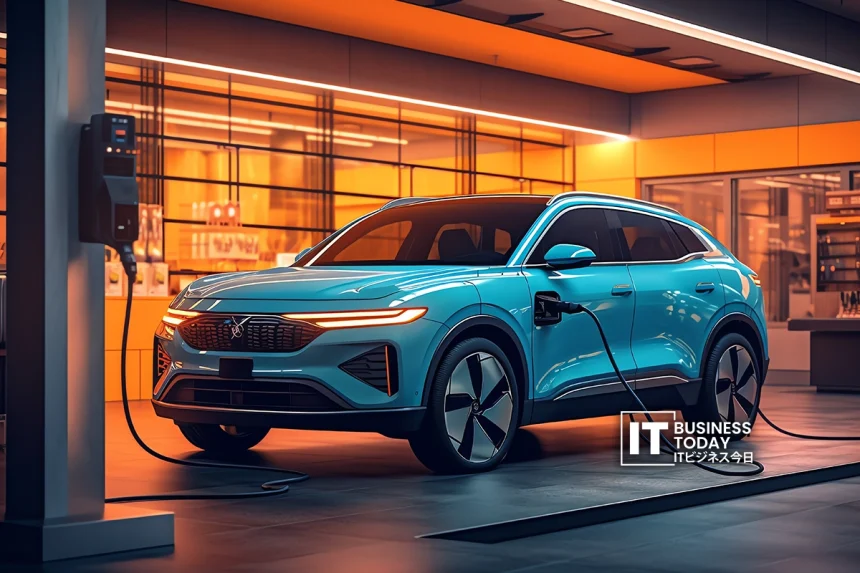
The industry of electric vehicle motors has seen rapid growth, thus leading to the development of the high demand for the performance magnet utilized in the motors of the EVs. The permanent magnet utilized in the motors of the EVs, such as neodymium, iron, boron (NdFeB) magnet, is a crucial part of the motors that generates electricity, thus providing higher torque, efficiency, and compact motor designs.
A recent industry study reveals that the global EV magnet market is forecast to increase extremely over the upcoming years, hitting $9. 5 billion by 2030 from only nearly $5. 3 billion in 2025, with a compound annual growth rate (CAGR) of roughly 12. 4%.
This increase is mainly attributable to the worldwide growth of the EV sector as well as the continuous demand for energy, efficient automotive parts and high, tech electric drivetrain systems.
こちらもお読みください: 現代自動車グループ、AI、水素、ロボティクスのハブを構築するために$7Bセマングム投資を目標
Key Companies in the EV Magnet Industry
Several global companies dominate the EV magnet supply chain, providing advanced magnetic materials for electric motors used in passenger EVs, buses, and trucks.
- Proterial Ltd. (Japan)
Proterial, previously known as Hitachi Metals, is recognized as one of the leading companies operating in the electric vehicle magnet industry. The firm fabricates high, performance NdFeB magnets for use not only in EV traction motors but for other advanced applications as well. Through its proprietary technologies, the company can manufacture magnets with enhanced heat resistance and durability, the two most notable qualities for electric vehicle performance.
- TDK Corporation (Japan)
TDK is a prominent Japanese technology company that provides a wide range of advanced magnetic materials for automotive and electronics sectors. The Neomax series magnets from TDK are famous for being used in EV motors and other high, performance electrical systems.
- Shin, Etsu Chemical Co., Ltd. (Japan)
Shin, Etsu Chemical ranks among the top three major manufacturers of rare earth magnets worldwide and boasts a robust global supply chain. The company plans to enlarge its production facilities to meet the requirements of the ever, expanding EV market as well as to provide high, quality magnetic materials to international automakers
- JL Mag Rare, Earth Co., Ltd. (China)
This is a Chinese company which mainly manufactures high, performance NdFeB magnets and serves component suppliers to numerous global EV manufacturers. With its vast production scale and cost advantages, it has become a prominent player in the worldwide magnet supply chain.
- Beijing Zhong Ke San Huan High, Tech Co., Ltd. (China)
The company is one of the largest manufacturers of rare, earth magnets in China and is significantly involved in supplying automotive sintered NdFeB magnets, especially for the EV industry.
- Ningbo Yunsheng Co., Ltd. (China)
Ningbo Yunsheng is a firm that mainly produces permanent magnet materials and components of electric vehicles as well as other high technology electronic gadgets. The strong manufacturing capabilities of the company have made it a significant player in the EV supply chain.
- Vacuumschmelze GmbH & Co. KG (Germany)
The acronym VAC is often used to name this German company, which develops high, performance magnets for EV motors and other automotive applications. The products of the company are mostly used by the European automakers, who are developing next, generation electric drivetrains.
- Arnold Magnetic Technologies (United States)
Arnold is engaged in the manufacturing of engineered magnetic solutions that find applications in automotive and industrial systems. The company’s advanced magnet designs contribute to enhancing the efficiency and performance of EV motor technologies.
Importance of Rare Earth Materials
EV magnets mostly use rare earth elements like neodymium, praseodymium, dysprosium, and terbium. These elements make it possible for magnets to keep strong magnetic fields even at high temperatures and when subjected to mechanical stress.
But the availability of these materials is still mainly limited to a few places. China is the leading one in rare earth processing worldwide, with more than 90% of the global capacity under its control, which has caused the concern of supply chain security among automakers and tech companies.
Consequently, a lot of nations and enterprises are looking into different ways of diversifying supply chains, investing in local magnet manufacturing, and coming up with alternative materials.
Impact on the Global EV Industry
The supply of EV magnets plays a crucial role in the expansion of the electric vehicle sector. These magnets are essential components of electric motors as they help to provide high performance in a small, energy, efficient package. A lack of dependable magnet supply chains would mean that automakers are likely to encounter production delays or higher manufacturing costs.
Actually, rare earth material shortages have already impacted car production in some countries, thus underlining the strategic significance of magnet manufacturing in the worldwide EV network.
In order to reduce the exposure to such risks, car manufacturers and local authorities are putting their money in new magnet production plants and recycling systems so as not to rely solely on single, region supply chains.
Future Outlook for the EV Magnet Market
As the adoption of EVs increases across the globe, it is estimated that the demand for better magnet technology is likely to increase exponentially over the next few years. The increase in technology related to EVs, along with renewable energy and robotics technology, is likely to fuel the growth of rare-earth magnets.
The companies that hold the key to the technology used in magnet manufacturing and rare-earth processing are likely to play a major role in shaping the future of EV technology. On the other hand, advancements related to magnet technology to reduce the usage of rare-earth materials are likely to form a major part of research and development.
The EV magnet technology space is one of the most important segments in the EV technology space globally. As EV technology grows globally, magnet technology manufacturers are expected to be key players in defining the future of EV technology globally.