 日本語
日本語 





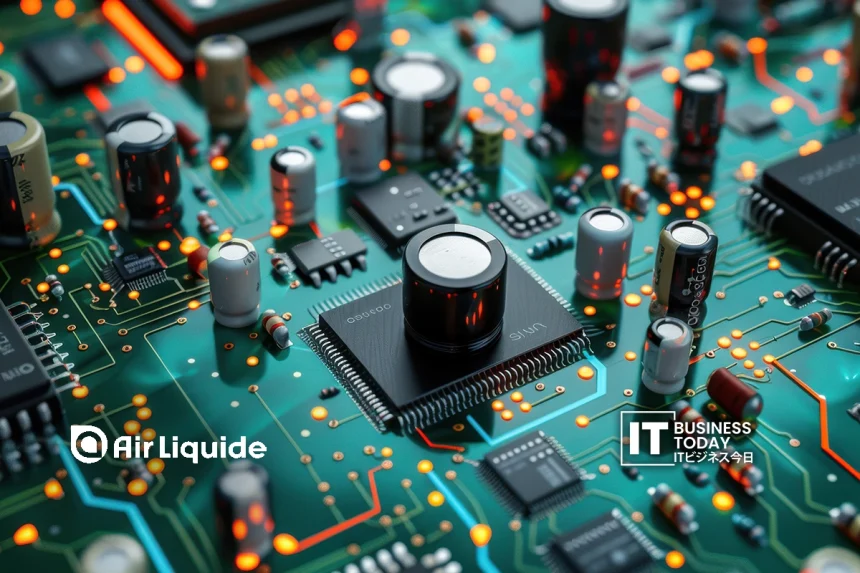
Air Liquide has revealed a $236 million (around 200 million) plan in Japan to help produce next-generation AI chips. The firm is going to construct, possess, and manage two industrial gas production units in Hiroshima as part of a long-term contract with a global semiconductor player.
The plants, which may start production at the end of 2028, will provide supply the ultra-high-purity gases including nitrogen, oxygen, and argonessential elements in the manufacture of leading-edge semiconductors. This capital injection shows the rising role of specialized facilities in facilitating the manufacture of high-performance chips, especially for AI-related purposes.
Strengthening Japan’s Semiconductor Ecosystem
Japan is vigorously restoring its semiconductor industry, and this commitment is a step that aligns very well with this goal. While a lot of spotlight has been placed on the chip fabrication plants, the decision of Air Liquide points to the significance of upstream parts of supply chain components, e. g. industrial gases, which are key to ensuring the precision and quality of chips.

Also Read: Japan Doubles Down on Rapidus with Massive Funding to Reclaim Semiconductor Leadership
The establishment of the Hiroshima-based plants will be instrumental in providing additional production capacity for sophisticated chips, which is in line with general efforts to localize and secure the semiconductor supply chains. One aspect of Japan’s plan is to woo foreign investment while backing local players in order to lessen dependence on foreign production centers.
Rising Global Competition in AI Infrastructure
Air Liquide’s new investment in the Japanese semiconductor industry is just one part of the large inflow of international capital into this sector. Japan’s semiconductor market has attracted a number of major players who want to benefit from the increasing demand for AI chips.
For example, the government of Japan is providing financial support to a local chip manufacturer Rapidus Corporation, aiming at producing 2-nanometer chips, whereas foreign companies are also strengthening their operations here to cater to the rising demand for AI.
The rapid growth in investments highlights the rising geopolitical relevance of Japan in the global semiconductor industry. Amidst conflicts and interruptions in chip supply among the usual hubs, Japan stands out not only as a stable but also a highly innovative country making it a viable option for developing chip facilities over the long term.
Impact on Japan’s Tech Industry
The implications of this investment are not confined to the semiconductor sector only. By the strengthening the supply chain of AI chips, Japan is paving the way for technological advancement at a larger scale across different industries such as cloud computing robotics automotive and advanced manufacturing.
Developing cutting edge technologies is totally dependent on having reliable source of high quality semiconductor components. With AI becoming more and more popular, the requirement for advanced chips–as well as the infrastructure that supports them–will keep increasing. Investments such as Air Liquide’s are a great way of making sure that Japan is capable of meeting this demand without sacrificing production standards.
Besides that, the emphasis on infrastructure also indicates a change in our perception of the technology industry. The focus has moved away from simply designing microchips to constructing a whole system of materials, equipment and services. Such a comprehensive attitude is of great importance to the continuation of innovation in the industry.
Business Implications and Opportunities
Operating a business in Japan, you will find great potential in the growth of semiconductor infrastructure. The improvement in chip technology will be one of the main advantages for companies in the electronics, automotive, and other manufacturing sector in enhancing their product performance and innovativeness.
Furthermore, such investment will be a great opportunity for supplementary industries like suppliers, contractors, and technology providers in building and maintaining these facilities. As the semiconductor ecosystem expands, the desire for particular skilled workers and services will naturally increase, resulting in fresh business opportunities throughout the value chain.
On the other hand, the amplifying rivalry in the AI and semiconductor markets will be one of the factors driving companies to innovate at a faster pace. Companies incorporating advanced technologies in their systems will be the winners, while those that have not will be the ones struggling to catch up.
A Critical Step in Japan’s AI Strategy
Air Liquide’s investment is a significant component of Japan’s overall ambition to establish itself as a leader in AI and semiconductor technologies. Meeting the critical supply chain requirements, the project lays a stronger groundwork for new innovations and economic upgrade.
With rapidly increasing worldwide demand for AI chips, Japan’s ability to encourage and incorporate investment throughout the entire semiconductor value chain will be one of the main factors determining its success. For the country’s technology sector and the entire business community, this is a great sign that the future of innovation is not only about breakthrough ideas but also about the supporting infrastructures that make the ideas feasible and tangible.


 English