 日本語
日本語 





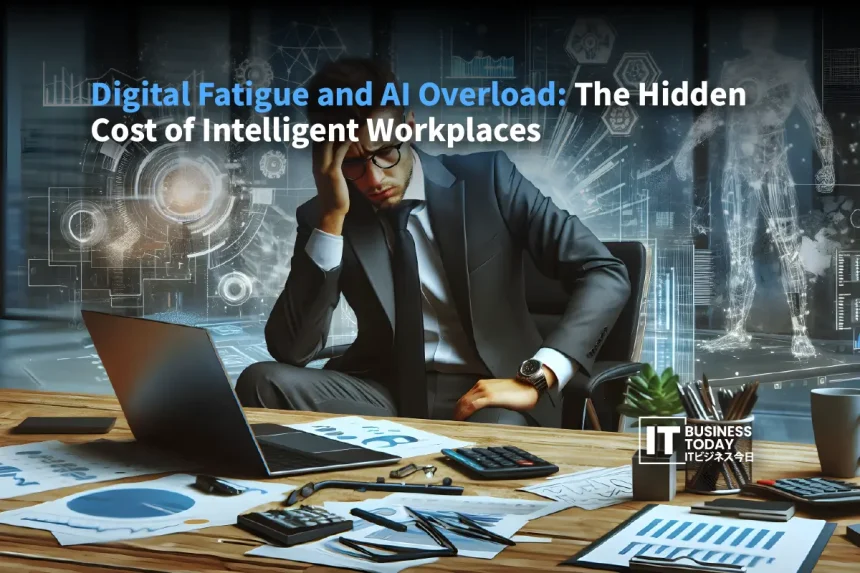
AI was supposed to remove friction from work. Instead, for many employees, it has simply changed the shape of exhaustion. A 2026 Harvard Business Review report found that while 77% of managers believe AI improves efficiency, 88% of heavy AI users report increased burnout. That contradiction explains the modern workplace better than most boardroom presentations ever will.
The conversation is no longer about Zoom fatigue. That phase already passed. The bigger issue now is context-switching fatigue. Employees are jumping between copilots, dashboards, prompts, notifications, approvals, and productivity trackers all day long. Work feels faster, yet strangely heavier.
Intelligent workplaces are creating a new kind of pressure where the brain never fully powers down. Companies chasing AI productivity gains are slowly discovering the hidden tax attached to constant digital acceleration. The future of work will not be decided by AI adoption alone. It will depend on cognitive sustainability.

Also Read: Space Data Commercialization: How Japan Is Turning Satellite Data into Enterprise Value
The Anatomy of AI Fatigue
Digital fatigue in intelligent workplaces is not happening because employees dislike technology. The problem runs much deeper. The brain is being forced into continuous cognitive negotiation.
Traditional software usually follows predictable pathways. Click a button, complete a task, move on. AI systems behave differently. Employees now spend hours interpreting outputs, refining prompts, validating responses, and correcting mistakes. That sounds lighter on paper. In reality, it increases mental load because the brain remains in active judgment mode the entire time.
This is where cognitive load theory becomes important. Human brains are designed to focus intensely on limited streams of information. AI tools disrupt that rhythm. Every notification, recommendation, rewrite, or generated summary demands evaluation. The employee is no longer simply doing work. The employee is supervising work produced by machines.
That shift sounds small until it compounds across an eight-hour day.
Google Cloud reported in 2026 that frequent AI users are 45% more likely to experience high burnout than non-users. The company also described ‘approval fatigue’ as a growing workplace problem where AI-generated updates create endless micro-approvals that mentally drain reviewers.
That single phrase explains modern AI workplaces perfectly.
Employees are trapped in permanent quality assurance mode.
The situation gets worse because of shadow AI. Teams under impossible deadlines quietly adopt unapproved tools just to keep up with output expectations. Managers often pretend not to notice because productivity numbers still look good on dashboards. However, employees carry the stress privately. One tool for writing. Another for meetings. Another for research. Another for automation. Nobody fully understands the workflow anymore.
The result is decision density. Too many small choices. Too many fragmented interactions. Too many unfinished cognitive loops sitting open in the brain at the same time.
People are not tired because AI exists. People are tired because AI keeps demanding attention every few minutes.
The HR Tech Debt Problem Nobody Wants to Admit
Most organizations talk about digital transformation like it is automatically progressive. More tools. More automation. More integrations. More dashboards. More visibility.
Yet very few companies ask a basic question.
At what point does workplace technology stop improving productivity and start damaging attention itself?
This is where HR tech debt enters the conversation.
A 2026 report cited by the Miami Herald found that 52% of software licenses go unused. Still, these unused platforms continue adding notifications, integrations, dashboards, login systems, and communication layers into everyday work environments.
That creates digital noise even when employees are not actively using the software.
Then comes the toggle tax.
Workers constantly shift between messaging apps, project trackers, AI copilots, CRM systems, workflow automation platforms, and meeting tools. Each switch looks harmless individually. Collectively, it destroys focus.
Deloitte’s 2026 Gen Z and Millennial Survey found that 58% of Gen Zs and 54% of millennials report digital fatigue caused by constant alerts, tool switching, and multiple platforms.
That statistic matters because it confirms something companies still avoid admitting.
The issue is not simply workload anymore. The issue is workflow architecture.
Many intelligent workplaces are accidentally designing fragmentation at scale.
Ironically, organizations introducing AI to save time are often increasing operational clutter instead. Employees now spend large portions of their day managing systems rather than doing meaningful work. Productivity starts becoming performative. Everyone looks busy because everyone is responding to something every minute.
Meanwhile, deep thinking disappears quietly in the background.
This is why digital fatigue in intelligent workplaces is becoming harder to solve through surface-level wellness initiatives. Meditation apps cannot fix broken workflow ecosystems. Burnout workshops cannot solve notification addiction designed directly into enterprise operations.
The problem is structural.
The Hidden Psychological Cost of Intelligent Workplaces
Most companies measure AI productivity through visible metrics like speed, tickets closed, response time, or task volume. The invisible psychological cost rarely appears on dashboards.
That cost is growing fast.
Modern AI workplaces create a state of constant vigilance. Productivity tracking systems monitor activity patterns, response times, meeting participation, and output frequency. Employees know the systems are always watching, even when managers claim the tools exist only for optimization.
Over time, this creates vigilance fatigue.
Workers stop focusing on meaningful contribution and start optimizing for perceived visibility. Activity becomes performance. Presence becomes pressure.
Microsoft’s 2026 Work Trend Index found that 65% of AI users fear falling behind if they do not adapt quickly.
That fear changes workplace behavior dramatically.
Employees begin overusing AI tools simply to avoid appearing outdated. They stay online longer. They respond faster. They multitask harder. They rarely disconnect mentally because the competitive pressure never fully disappears.
Then comes the erosion of autonomy.
Many AI systems now recommend priorities, suggest actions, rewrite communication, and score performance patterns. Slowly, employees begin feeling managed by algorithms instead of humans. The workplace starts resembling a constant stream of nudges, prompts, reminders, and behavioral corrections.
Some workers describe this as the ‘novice manager’ effect. The system keeps intervening without understanding context, nuance, or emotional reality.
At the same time, loneliness is rising quietly inside intelligent workplaces.
AI handles scheduling. AI summarizes meetings. AI drafts communication. AI coordinates workflows.
Efficient? Yes.
Human? Less and less.
Creative collisions keep happening when people talk messy, with side discussions, disagreements and these kind of spontaneous exchanges. It’s like, once coordination turns into automation, human unpredictability kind of fades out from the work culture slowly. Teams end up communicating more often than ever, but somehow real connection feels weaker, not exactly the same anymore.
That contradiction is becoming one of the defining tensions of AI-driven workplaces.
Moving Toward Cognitive Sustainability
Most organizations are still approaching AI like a race. Faster adoption. More deployment. Bigger integration stacks.
That mindset is becoming dangerous.
The smarter companies will not be the ones using the most AI tools. They will be the ones creating the most sustainable cognitive environments.
First comes the subtractive audit.
HR leaders need to stop asking which new AI tools should be added and start asking which existing tools should be removed. Every platform creates cognitive overhead. Every integration adds mental switching costs. Every notification competes for attention.
Sometimes productivity improves not by adding systems, but by deleting them.
Second, performance metrics need redesigning.
Many organizations still reward visible activity instead of meaningful judgment. Employees are praised for responsiveness, volume, multitasking, and constant availability. That model directly fuels digital fatigue in intelligent workplaces.
The next phase of workplace productivity will prioritize focus quality over output quantity.
Employees should be rewarded for:
- better decision-making
- strategic thinking
- creative problem solving
- sustained concentration
- contextual judgment
Not simply for generating more digital movement.
Adobe’s 2026 AI and Digital Trends report found that 63% of organizations expect agentic AI to give employees more time for strategic and creative work.
That future only becomes possible if organizations intentionally protect human cognitive space.
Otherwise AI simply fills every empty minute with additional workflow noise.
This is where focus zones become critical.
Companies need policy-driven deep work blocks where non-essential notifications, AI prompts, and communication interruptions are intentionally reduced. Not as optional wellness advice. As operational design.
Because fragmented attention is becoming one of the biggest hidden productivity killers in enterprise environments.
The irony is brutal.
Companies adopted AI to improve efficiency. Yet without cognitive sustainability, many workplaces are slowly producing distracted employees operating inside permanent low-grade mental exhaustion.
From AI-First to Human-First AI
The next phase of enterprise AI will not be about dumping more tools into workflows. That phase is already collapsing under its own complexity.
The future belongs to strategic consolidation.
Organizations will move away from disconnected AI ecosystems and toward outcome-driven systems designed around human attention capacity. AI should reduce cognitive clutter, not multiply it.
Salesforce said in 2026 that the real enterprise challenge is at the system level, not just the model level. That statement cuts straight to the core problem facing intelligent workplaces today.
Most companies are optimizing models while ignoring workflow psychology.
That approach does not scale sustainably.
Human-in-the-loop systems also need reframing. Employees should not become AI babysitters endlessly reviewing machine outputs. The real opportunity is transforming workers into strategic orchestrators who guide systems with judgment, context, ethics, and creativity.
AI handles acceleration.
Humans handle meaning.
That balance matters more than most organizations currently realize.
Conclusion
AI should create leverage, not anxiety.
Right now, many intelligent workplaces are drifting toward the opposite outcome. Employees are overwhelmed by approvals, alerts, dashboards, tool switching, and constant digital supervision. The problem is no longer technology adoption. The problem is cognitive sustainability.
Organizations that ignore this shift will eventually face rising burnout, weaker creativity, lower engagement, and quiet talent erosion hiding behind strong productivity dashboards.
The smartest leaders will not ask how much AI their company uses.
They will ask whether their systems still allow humans to think clearly.
That is why every organization now needs a digital health audit. Not next year. Not after another burnout survey.



 English