 日本語






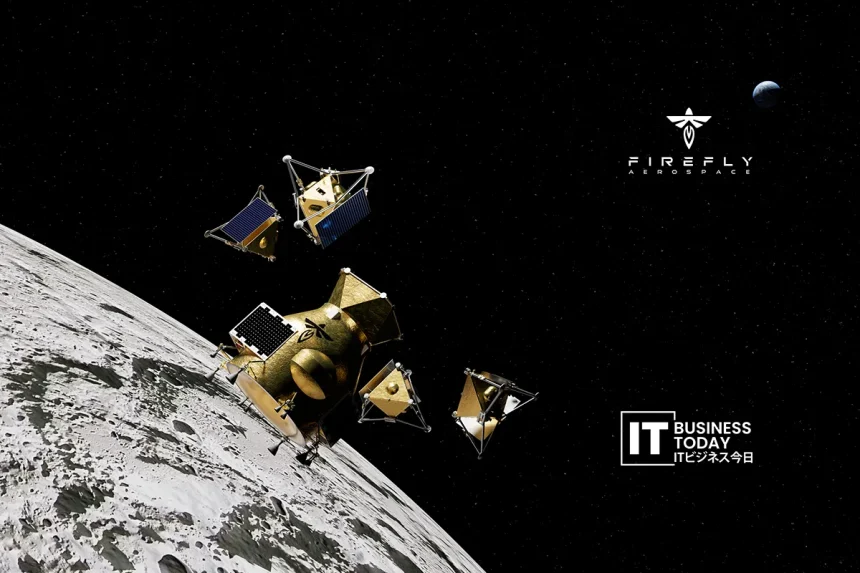
Firefly Aerospace has finished the design review (PDR) for its Elytra spacecraft. This is a step in NASAs MoonFall mission to look at the Moons south pole. The news came out on October 21 2026. This step brings the spacecraft closer to the design review. It also starts the process of making the hardware.
The Elytra spacecraft is being made to carry four drones. These drones are built by NASAs Jet Propulsion Laboratory (JPL). When they get to the Moon the drones will check the land take pictures and gather science data. They will also find places to land and look for things that could be useful for future trips by people.
People from Firefly Aerospace, NASA and JPL were part of the review. They checked parts of the spacecraft. These parts include how it is built, how it handles heat how it moves, the electronics, how it moves through space how it finds its way how it talks and how it controls itself. They also looked at the rules for testing and making sure everything works well. The review said the Elytra design is good enough for the mission.

Firefly will now prepare for the design review (CDR). This is the big step before making the real parts of the spacecraft.
The company got a $75 million deal from NASA JPL in May 2026. This deal is to send the four drones, for MoonFall. The mission is supposed to be ready to go by the end of 2028.. The exact schedule could change as things get ready. NASA will handle the rocket that takes everything to the Moon. JPL will build the drones. Take care of the whole mission.
Why the MoonFall Mission Matters for Lunar Exploration
The Moon’s pole has become a key spot for space agencies. They see science chances there and think water ice might be hidden in the dark shadowed caves. Knowing how the ground looks and picking landing spots is a big step toward putting people on the Moon for a long time.
MoonFall was made to meet these challenges with robots. Once MoonFall leaves Earth Elytra will go to the Moon’s orbit. Drop the drones over the south pole. The drones will carry cameras and other tools to look at the land and draw maps of where people could land and where water and other goodies might be.
MoonFall is part of NASA’s step in the Moon Base plan. That plan wants to help people stay on the Moon for a time and grow science and business there.
For the space industry MoonFall shows how private companies are stepping into special jobs, in government projects. Moving craft, dropping payloads, running robots and doing Moon work are all parts of one growing field.
Potential Impact on Japans Space Technology Industry
Although MoonFall is a mission involving U.S. Organisations MoonFall development offers relevant lessons for Japans space industry. I think MoonFall development shows paths for growth.
Japan has capabilities across satellite manufacturing, robotics, precision engineering, scientific instrumentation and space exploration. These areas are relevant to missions that require spacecraft to operate in demanding environments far beyond Earth.
Fireflys design milestone illustrates the importance of validating spacecraft systems before committing to full‑scale hardware production. Fireflys design milestone highlights opportunities for aerospace manufacturers and technology suppliers to develop components, sensors, navigation systems, thermal‑management solutions and communications technologies for future space missions. I see a chance for small firms.
MoonFall mission also reinforces the growing role of robotics in exploration. Autonomous systems can collect data and examine terrain in locations that’re difficult or dangerous for human operators to reach. Japanese companies with expertise in robotics, imaging and autonomous navigation could find opportunities to contribute to exploration programmes, subject to mission requirements and partnership arrangements. I think collaboration will grow.
However the announcement does not establish a role for Japanese companies, in MoonFall. MoonFall relevance lies in the technological and commercial developments that may influence future space missions. I am watching how this unfolds.
Business Opportunities Across the Commercial Space Sector
The MoonFall milestone highlights areas of potential opportunity for businesses operating in aerospace and advanced technology.
Spacecraft. Manufacturing: As commercial companies take on mission responsibilities demand may grow for specialized spacecraft components, testing services and manufacturing capabilities.
Robotics and autonomous systems: Lunar exploration requires platforms capable of operating with limited direct intervention. This creates opportunities for developers of navigation, imaging, sensing and control technologies.
Scientific. Analytics: Data gathered from surfaces can support geological research, terrain mapping and mission planning. Software providers may contribute tools for processing and interpreting these datasets.
Supply-chain collaboration: Government space programmes depend on networks of specialist suppliers, research institutions and contractors. Businesses with technical capabilities may be able to participate in future programmes through partnerships and procurement opportunities.
These opportunities come with challenges. Space systems must meet demanding reliability requirements, withstand environmental conditions and operate within strict cost and schedule constraints. A successful design review is a step but it does not guarantee mission completion or launch, on schedule.
The Path Forward for Commercial Lunar Missions
Also Read: Flyte Aviation Launches B2B Partner Portal to Modernize Private Aviation Distribution
Firefly Aerospace has finished the preliminary design review, which takes NASAs MoonFall mission to the next stage of engineering development. The next important step is the design review, which will be a major check before building and putting together the hardware can begin.
For the space industry the project shows how companies that build spacecraft are helping with more and more challenging efforts to explore the Moon. For Japan it points to areas where they can get involved such as robotics, spacecraft engineering, systems that work on their own and tools for science.
As governments and private companies work on longer-term goals for exploring the Moon making sure the technology works and working well together across the aerospace industry will stay very important. The next steps, for MoonFall will show how well the program can turn its engineering progress into a mission that can help with exploration of the lunar south pole.



 English