 日本語
日本語 





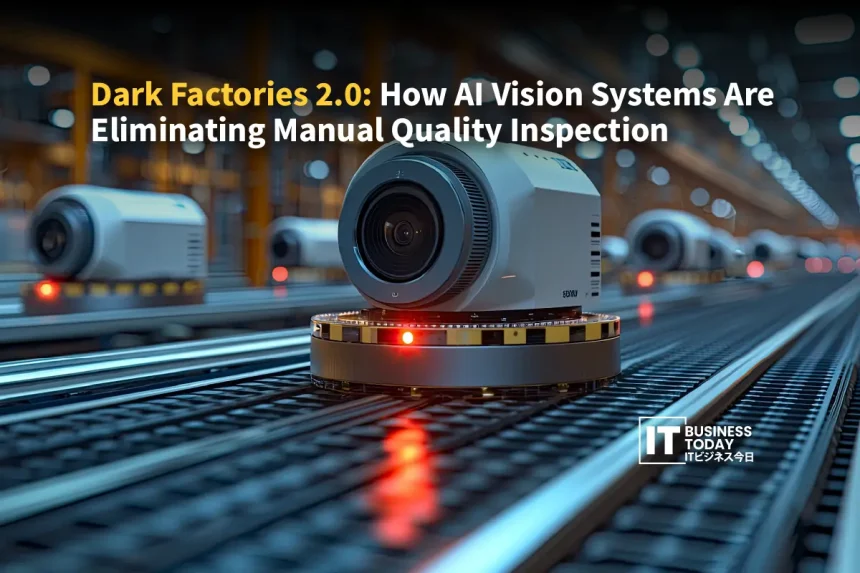
Factories that run without lights once sounded like some industrial science fiction. Nowadays they are quietly turning into an operating model, a little bit at a time. Robots assemble products, autonomous vehicles ferry materials around and software coordinates production with very little human involvement. Still, even with all that automation, one stubborn dependency stayed in place, under the fluorescent lights, for a long while. Human quality inspectors.
That final checkpoint is now under pressure. Not because people stopped being valuable, but because products became too small, production lines became too fast, and defects became too subtle for even experienced eyes to catch consistently. The next phase of factory automation is not about building faster robots. It is about building better eyes.
This article explores how AI visual inspection is replacing manual quality checks, why machine vision in manufacturing is becoming the new standard for quality control, and what this shift means for factories and workers alike.

Also Read: Japan’s Smart Industrial Campuses: The Future of Connected Manufacturing
The Hidden Cost of Manual Quality Inspection
Factories did not arrive at manual quality inspection because it was efficient. They arrived there because for decades, the human eye remained the most flexible inspection tool available. A trained inspector could spot scratches, inconsistencies, discoloration, and assembly issues that rigid rule-based systems often missed.
The problem is that manufacturing changed faster than human capability did.
Modern semiconductor components, battery cells, precision gears, and automotive electronics operate at tolerances measured in microns rather than millimeters. Production lines move faster, product complexity keeps rising, and defect windows continue shrinking. The same pair of eyes that performs perfectly during the first hour of a shift rarely performs at the same level several hours later.
In micro-manufacturing environments, human inspection introduces limitations that are difficult to eliminate:
- Eye fatigue gradually reduces detection accuracy during long inspection cycles.
- Different inspectors often apply slightly different quality standards to the same product.
- Inspection speed becomes a production bottleneck when output volumes increase.
- Tiny cracks, surface variations, and alignment defects can escape even experienced inspectors.
- Scaling production requires scaling headcount, training, and supervision costs alongside it.
The uncomfortable reality is that factories spent years automating machines while leaving the final decision to human judgment.
That contradiction is becoming harder to justify. METI’s FY2025 Measures to Promote Manufacturing Technology and Manufacturing Industries White Paper 2026 notes that conventional visual inspection of industrial parts requires considerable labor cost and highlights finished-goods inspection systems built on deep-learning image generation and recognition technologies as part of the industry’s next direction.
AI Vision Systems Become the Eyes of the Dark Factory
Traditional machine vision systems were never truly intelligent. They operated more like strict rulebooks. Engineers would define acceptable dimensions, colors, angles, or shapes, and the system would simply compare every product against those fixed instructions. If the lighting changed, the surface reflected differently, or the defect appeared in an unexpected form, accuracy often collapsed.
AI visual inspection changes the equation completely.
Instead of simply obeying pre-programmed rules, today’s AI vision systems kind of learn patterns the way seasoned inspectors form intuition across years, walking the factory floor. In a similar manner, deep learning models, especially Convolutional Neural Networks, get trained on thousands, or even millions of images that include both acceptable items and defective cases. Bit by bit, the system starts to recognize what feels ‘normal’ and, just as crucial, what does not belong there at all.
The result is not just defect detection. It is anomaly detection.
A tiny microscopic crack, a barely visible misalignment, or even that kind of surface inconsistency that could slip past human attention can immediately become obvious to an AI model because it doesn’t rely on fixed, predefined limits. It basically notices the deviation from what it learned as ‘normal’ patterns, not just a specific threshold.
Edge computing takes that further too. Rather than shipping images off to far away cloud servers for analysis, the decision is made right on the production line, in a matter of milliseconds. This typically trims the latency, cuts down bandwidth demands, and helps AI visual inspection systems stay synchronized with fast manufacturing cycles.
NVIDIA describes this shift as turning video streams into operational intelligence rather than simple surveillance footage. Its 2026 Factory Operations Blueprint positions vision AI as a new factory brain capable of delivering complete operational visibility across industrial environments.
The camera, in other words, is no longer acting as a sensor. It is becoming a decision-maker.
Four Ways AI Vision Is Eliminating Manual Quality Assurance
Micro-Defect Detection Moves Beyond Human Limits
The first job AI visual inspection took from manual quality assurance was the microscope.
Modern manufacturing defects mostly don’t just pop up with those clear cracks or obvious broken bits. Instead, they lurk inside tiny soldering inconsistencies, microscopic surface scuffs, slight alignment drift, and material variations that remain way under what reliable human inspection can catch. Even worse, these problems can show up sort of at random, so inspection setups that follow rigid rules tend to struggle, more than you’d think.
AI vision systems approach the problem differently. Instead of searching for a predefined defect, they search for deviations from normal patterns. That allows them to identify problems even when engineers never explicitly programmed the defect into the system.
Accenture highlights this shift through a North American semiconductor manufacturer that achieved a 30% reduction in quality errors after deploying AI manufacturing systems. The company described the move as a transition from late-stage quality checks to early intervention using high-precision 3D computer vision and robotic inspection.
Predictive Quality Assurance Stops Defects Before They Exist
Traditional quality assurance operates like a rearview mirror. It discovers defects after materials have already been processed, assembled, and packaged.
AI visual inspection changes quality control into an early warning system.
Small shifts in vibration rhythms, thermal impressions, component placement, or even surface regularity often show up quite a while before the failure rates really start to climb. AI models can link these faint signals across thousands of production cycles, and from there pick out patterns that people simply would not see on their own, because each signal in isolation looks pretty ordinary.
The result is a shift from defect detection to defect prevention.
The World Economic Forum, reported through its third MINDS cohort, that 55% of verified applicants saw improvement in accuracy, defect detection or maybe even fewer errors after deploying those AI technologies. At the same time, 50% also jumped in output or throughput, and 30% managed to lower energy consumption.
Continuous 24/7 Operation Removes Human Constraints
Human inspection operates on shifts, concentration levels, and physical endurance. AI does not.
AI visual inspection systems maintain the same level of accuracy during the first minute of operation and the millionth. With infrared imaging mixed in, plus thermal cameras and certain industrial sensors, inspections can go on even in total darkness and in situations that, frankly, would be impractical for people to work in.
‘Dark factories’ stop being just a marketing idea once quality assurance no longer depends on human presence, or whatever you want to call it, because the whole process keeps moving anyway.
Automated Sorting and Rejection Closes the Loop
Finding a defect is only half the battle. The real advantage comes from acting on it immediately.
Modern AI vision systems connect directly with robotic arms, conveyor systems, and production software. The moment a defect appears, the product can be rejected, rerouted for rework, or isolated for investigation without interrupting the production line.
Quality control no longer sits at the end of manufacturing waiting to judge what happened. It becomes an active participant inside the production process itself.
Overcoming the Implementation Hurdles
The biggest myth around dark factories is that they arrive through a software update.
In reality, AI visual inspection projects fail for the same reason many digital transformation projects fail. Companies underestimate the amount of operational change hiding behind the technology.
The first hurdle is capital outlay. Cameras, sensors, industrial GPUs, edge systems, connectivity upgrades, and the whole integration work can very fast turn a pilot into one of those boardroom conversation and everyone suddenly has questions. And yeah unlike consumer AI, factory AI really has to endure dust, vibration, temperature swings and relentless production runs, day after day, without any real breaks. Industrial reliability carries an industrial price tag.
Training data creates the second hurdle. AI vision systems are only as good as the examples they learn from. Building datasets of acceptable products, rare defects, edge cases, and production variations takes time and patience. The irony is hard to ignore. Factories need experienced inspectors to teach the AI that may eventually replace parts of their inspection workload.
Cybersecurity creates the third challenge. As IT systems move closer to operational technology environments, production equipment suddenly becomes part of the attack surface. A compromised email server is an inconvenience. A compromised production line is a business continuity problem.
The industry understands these challenges are temporary rather than structural. PwC estimates the physical AI market could reach approximately $450 billion by 2030 and notes that enterprise physical AI deployments can require six to eighteen months per site.
The companies doing well now are taking a sort of other, slightly different route. They begin with one very high-risk inspection step, then they process the data straight on the machine by using edge AI so latency stays low, and they team up with specialized integrators who really grasp both factory operations as well as the AI infrastructure, in a practical way.
Dark factories are not plug-and-play products.
They are industrial transformation projects wearing an AI label.
The Workforce Shift from Inspectors to AI Supervisors
The image of AI replacing factory workers makes headlines because it is simple. Factory floors, however, rarely operate in simple ways.
In a lot of environments, manual quality inspection is sort of fading away, but real quality expertise is not. Somehow someone still needs to show AI systems what a defect looks like, sort out the fuzzy cases, dig into false positives, and then retrain the models when products, suppliers, or manufacturing methods shift.
The folks in the best spot to handle that are often, oddly enough, the inspectors themselves.
All those years spent catching surface inconsistencies, alignment problems, and assembly defects, build instincts that datasets alone can’t truly imitate. And now those instincts are getting moved into training datasets too, plus into model validation workflows, and even into exception handling systems.
The role is shifting from inspecting every product to supervising the system that inspects every product.
Dark factories may reduce repetitive work on the production line, but they increase demand for people who understand quality deeply enough to teach machines how to think about it.
The Real Meaning of Dark Factories 2.0
Dark Factories 2.0 are not really about turning the lights off. They are about removing the last bottleneck that prevented factories from operating with true autonomy.
For years, manufacturers automated movement, assembly, and logistics while quality inspection remained stubbornly human. AI visual inspection changes that equation by turning quality from a checkpoint into a continuous process running alongside production itself.
The temptation for manufacturers will be to chase the fully autonomous factory immediately. The smarter move is smaller and far less glamorous. Start with one inspection stage where defects are expensive, frequent, or difficult to detect manually. Prove the economics there first. Scale comes later.



 English