 日本語
日本語 





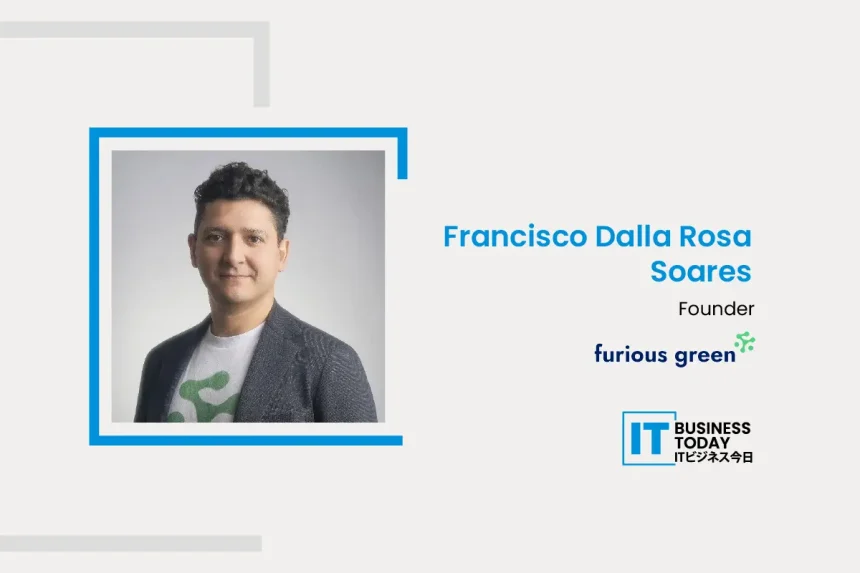
Francisco, can you tell us about your professional background and your current role at Furious Green?
I’m originally from Brazil, but I’ve been based in Japan for about 19 years now. My background is in computer science and software engineering, and most of my career has been hands-on engineering. From research in natural language processing during my master’s, to working at companies like Google, CyberAgent, and Retail AI, mainly building data and machine-learning-driven systems.
Around 2021–2022, I started feeling a strong gap between how fast AI technology was advancing and how slowly companies were actually internalizing those skills. So I founded Furious Green to focus on exactly that: helping engineers, teams, and organizations build real, practical AI capabilities.

Today, as founder, my role is a mix of technical lead, educator, and strategist. I design and deliver hands-on training programs, mentor engineers and technical leaders, advise startups and corporate teams on AI architecture and product strategy, and stay deeply involved in real-world projects. The goal is always the same: shorten the distance between cutting-edge AI and real business impact.
Francisco, you started as a hands-on engineer working on NLP, mobile, and infrastructure, and today you are focused on AI capability building at an organizational level. Looking back, what moments or frustrations pushed you from writing code to thinking about skills, systems, and people at scale?
It started with frustration around control. As an engineer, I could control how things were built, but not what was being built or why. I could make systems better, faster, and cleaner, but the bigger product and business decisions often felt disconnected from technical reality.
As I moved into roles like tech lead, manager, and eventually head of department, that changed. I started seeing the same problems repeating across teams. Great engineers blocked by communication issues, unclear goals, or lack of shared understanding. That’s when it became clear that technology wasn’t the main bottleneck. People, skills, and organizational structure were.
Once I realized that, my focus shifted from writing better code to creating better environments for people to do good work. Helping teams learn faster, communicate better, and build smarter systems ended up having much more impact than any single piece of code I could write.
You were the first technical hire for ironSource in Japan and a specialist at Google. What is the biggest disconnect you saw between how Silicon Valley designs technology and how non-technical enterprises actually consume it?
What surprised me most was how much technology goes into things that look trivial. An ad looks simple, but behind it there’s heavy math, huge infrastructure, and systems running at massive scale.
The disconnect is that non-technical enterprises only see the surface. They use powerful tools as black boxes, without understanding their assumptions or limits. That gap often leads to unrealistic expectations and poor results. Bridging that gap is where real impact happens. That is something I see happening with AI as well today.
When you founded Furious Green in 2021, AI was still something many companies saw as a distant concept. What conviction made you believe AI skills would become a near-term necessity rather than a long-term experiment?
It really was a hard sell back then, especially because this was before LLMs. AI still felt abstract and distant for most companies. But I already believed these techniques could solve real business problems.
At Google, I worked on a project analyzing customer support text to understand why satisfaction scores in Japan were low even when customers were actually happy. By looking at language instead of just ratings, we uncovered patterns that traditional metrics completely missed. That reinforced my belief that machine learning could create very practical value.
Then at Retail AI, working with recommendation systems and computer vision, I actively pushed to build those capabilities. I spent almost a year helping an engineer with no ML background ramp up, so we could apply these techniques when the business needed them. And once we did, they directly contributed to real outcomes.
That experience convinced me that AI skills wouldn’t stay optional for long. They were about to become essential.
Today, almost every leadership team says AI is a priority, yet workforce readiness continues to lag behind investment. From what you see on the ground, why does AI adoption keep moving faster than AI capability inside teams?
I think this happens with every major technology shift. Leadership knows they need to get on board, but they’re not always sure what to do with it beyond investing in tools.
What I consistently see on the ground is that employees struggle to connect AI tools to their actual daily work. When I ask what’s blocking them, the answer is almost always the same: “I don’t know how this fits into my workflow.” So the tools exist, but they live outside real processes.
That’s why, in my training, I focus much less on prompt techniques or the latest models, and much more on integration. How does this tool fit into your job, your tasks, your decisions, your existing systems? Once people see that connection, adoption accelerates very quickly.
In short, adoption moves fast because tools are easy to buy. Capability moves slower because it requires changing how people think and work. And that’s the harder problem.
Japan’s lifetime employment system should theoretically yield the world’s highest ROI for upskilling. Why is there still such a hesitation among Japanese enterprises to reskill internal teams rather than relying on external vendors?
You’re touching on one of the main reasons why I felt upskilling and reskilling made so much sense in Japan.
I think one big factor is that hiring is simply easier to budget and justify. You need X people, they cost Y, the recruiting fee is Z, and you get a very clear plan and ROI on paper. It feels predictable.
Upskilling is messier. You need to anticipate what skills the company will need far in advance. You need to understand how those skills will actually be applied. You need to design training, support people through the learning curve, and wait for results. The ROI is real, but it’s harder to measure and harder to explain.
Another factor is leadership demographics. In many large organizations, top decision-makers tend to be older and further removed from rapid technology shifts. That makes it harder to fully grasp how fast things are changing and how deeply new technologies will reshape work. And when uncertainty is high, people naturally default to familiar models.
On top of that, Japanese companies are not exactly famous for fast organizational change. Stability is a strength, but it also makes experimentation and reskilling harder to push through.
The irony is that lifetime employment should make Japan the perfect environment for long-term skill investment. The structure is there. What’s missing is the mindset and systems to fully leverage it.
With Japan facing a significant shortage of software and AI talent over the next decade, do you believe reskilling existing employees can realistically close that gap, or is there a hard ceiling to what upskilling alone can achieve?
Japan doesn’t just have a talent shortage. It has a people shortage. With a declining population, there are structural limits to how much hiring alone can solve. That makes reskilling not just helpful, but necessary.
I don’t think reskilling alone will solve everything. There are real ceilings, especially for highly specialized roles. But I do believe it can be a major transformational force. A large part of today’s workforce already understands the business, the culture, and the systems. If you give them the right technical skills, the leverage is enormous.
In many cases, it’s faster and more effective to turn strong domain experts into capable AI practitioners than to hire external specialists and hope they understand the business. Especially in Japan, where long-term employment and deep institutional knowledge are common, reskilling can close a surprisingly large part of the gap.
Your background is in machine learning before generative AI made the technology accessible to everyone. What do you think leaders misunderstand most when they assume prompt-based tools reduce the need for deep engineering and ML literacy?
A common misunderstanding is thinking that prompt-based tools remove the need for deep engineering and ML knowledge. A simple way to think about it is cars. Drivers know what the experience should feel like, but that doesn’t mean they know how to design and build a car. Without understanding mechanics, engineering, and manufacturing processes, you can’t really create reliable vehicles.
AI tools make it impressively easy to build basic software, but production systems are about much more than just generating code. You still need to deal with scalability, security, reliability, cost control, and long-term maintenance. Those problems don’t disappear just because you can write code faster.
There will absolutely be more space for people with strong domain knowledge to turn ideas into working software. But that doesn’t remove the need for experts. If anything, it increases their leverage. AI is a multiplier. The more technical depth you already have, the more value you can extract from it.
You have grown Tokyo Startup LunchClub to over 1,000 members and advise Shibuya City. In an era of formal accelerators and government programs, what is the “informal magic” that happens in a simple meetup that formal structures cannot replicate?
It really comes down to serendipity and human connection.
Formal programs and structured networking events definitely have value, but they naturally push people into a transactional mindset. You start filtering: who can help me, who can’t, who is useful right now. That changes the tone of every interaction.
When you’re just sharing a meal, that pressure disappears. You connect first as people, not as job titles or business cards. You talk about life, struggles, ideas, and curiosity. That creates trust, and trust is what leads to real collaboration.
Most of the strongest partnerships and opportunities I’ve seen didn’t come from formal pitching or scheduled meetings. They came from casual conversations where nobody was trying to sell anything. That informal setting creates a kind of psychological safety and openness that formal structures simply can’t replicate.
For young engineers, product managers, or founders entering the workforce today surrounded by AI tools and noise, what is the one capability or mindset they should build that will still matter when today’s AI trends inevitably change?
Build deep domain expertise, and use AI as a multiplier, not a crutch.
Find something you truly understand at a deep level, something AI can’t easily replace. At the same time, use AI aggressively to increase your productivity. The combination of strong fundamentals and AI leverage is what creates real differentiation.
I sometimes compare this to exercise. We don’t need to carry heavy things, walk long distances, or climb mountains to survive anymore, but we still do these things to keep our bodies healthy and functional. The same applies to thinking. Don’t outsource your brain just because AI can do parts of the work. Keep training it.
There’s a quote from an Accenture executive that really stuck with me. He said there will be four types of people: those who excel at using AI, those who build AI, those who have something AI doesn’t have yet, and those who are cheaper than AI.
You definitely don’t want to be in the last group. For most people, the sweet spot is a mix of the first and third. As I said earlier, AI is a multiplier. The better the input, the more powerful the output.
Thank you, Francisco San!



 English