 日本語
日本語 





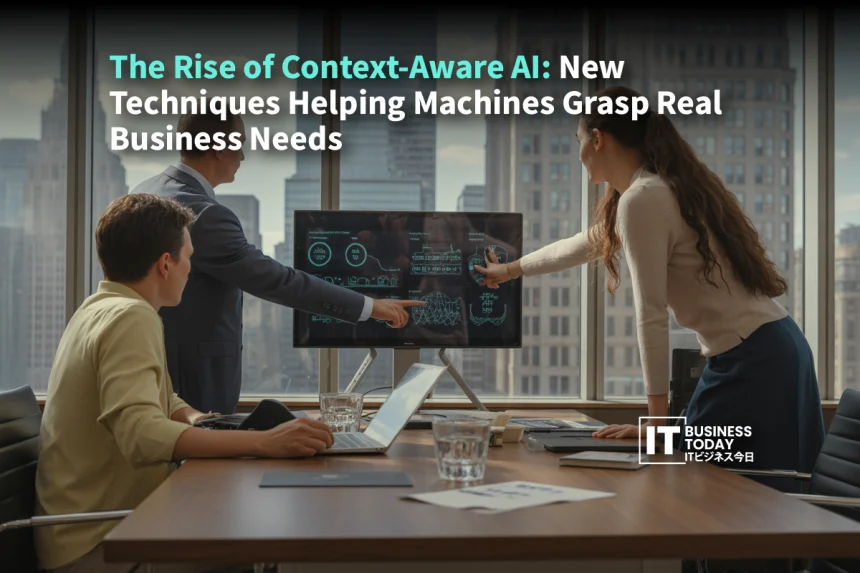
Businesses are excited about AI, but many end up frustrated. Most AI today is generic. It can write sentences, summarize text, or answer questions, but it does not really know your company. It does not know your customers, your brand voice, or your inventory. As a result, the replies are frequently uninteresting, standard, or even incorrect. At times, it generates false information and presents it in a believable way which is not the case.
Context-aware AI is the solution to all this. It separates an AI which is just familiar with the English language from an AI which is familiar with the specific industry. It stores customer data, comprehends the company’s processes, and adjusts to the communication style of the brand. It can give answers grounded in your reality, not just what it read online.
We are moving from static prompts to dynamic, stateful AI systems. These systems can check real company data, remember interactions, and provide answers that make sense in the real world. OpenAI’s 2025 blog emphasizes that AI is driving economic opportunity and broader business adoption. This shows that context-aware AI is not just a fancy tool. It is a real business advantage.

Also Read: Private 5G in Japan: How Enterprises Are Building Faster, Safer, On-Prem Networks
From ‘Stateless’ Chatbots to ‘Stateful’ Partners

Most businesses have tried using AI but end up frustrated. The problem is simple. Standard language models are stateless. They don’t remember previous conversations. They don’t know your company or your workflows. They are trained on frozen public data. That means they answer questions like someone reading Wikipedia for the first time. It works sometimes, but often it feels generic or even wrong. It is not enough if you want AI to actually help your business.
Context changes everything. And context is not just what was said in the last chat. It has layers. Situational context looks at who is asking, what time it is, and where they are. Semantic context tries to understand the intent behind the question, not just the words. Enterprise context is even deeper. It looks at your internal PDFs, databases, and proprietary workflows. When AI can access all this, it starts to behave like someone who knows your company from the inside, not a stranger guessing.
Without context, AI is a toy. It gives generic answers and can make mistakes. With context, it becomes useful. It can suggest the next steps, point out risks, and even adapt to customer history. It stops being a simple responder and starts acting like an employee who gets the bigger picture.
This is why businesses need it. Stateless AI is just a tool. Context-aware, stateful AI can speed up work, reduce errors, and help teams make decisions faster. It becomes a real partner. It stops being something you use and starts being something you rely on.
Techniques Driving Context Awareness

So how does AI actually start understanding context instead of guessing? There are a few techniques that are changing the game. Let’s start with something called Retrieval-Augmented Generation or RAG. It is simple if you think of it like an open-book test. Instead of asking AI to rely only on what it remembers from training, you give it your company’s data. It can pull information from internal documents, past emails, databases, anything relevant. That way it can answer questions with facts from your own environment, not just what it learned from the internet. Suddenly it stops hallucinating and starts giving answers that actually make sense for your business.
Next up is massive context windows. Most older AI could only look at a few thousand tokens at a time. That is like trying to read a book by looking at one page at a time. Now, models like Gemini 1.5 and GPT-4o can process over a million tokens in one go. That means the AI can read entire books, full codebases, or long customer histories in one prompt. Everything it needs to answer a question is right there. You get continuity, depth, and understanding that was impossible before. This is also where Google DeepMind’s 2025 research fits in. Their work shows that vision models are achieving more human-like generalization. That same kind of grounding is now being applied to language models so they can handle much more context and understand information the way a human would.
Finally, knowledge graphs. Consider them as connections that connect everything and draw a map. Client A relates to Product B, which is subjected to Regulation C. The creativeness of the AI does not stop at just presenting facts; it uses these connections to think. It can, for example, suggest, point out risks, or forecast results if it grasps the links, similar to a human specialist.
Together, RAG, massive context windows, and knowledge graphs give AI the tools to be stateful, context-aware, and useful. They turn what used to be a generic assistant into a partner that actually understands your business.
How Context Works in Real Business Situations
AI becomes powerful only when it actually understands the situation it is used in. Take customer support for example. Most chatbots still ask generic questions like ‘How can I help?’ That is fine for basic info, but it is frustrating for customers. Context-aware AI changes the game. It can check past orders, track shipping delays, and even notice things like bad weather affecting delivery. So instead of a bland reply, it can say, ‘I see your shipment was delayed due to weather in Memphis. ‘Would you prefer your money back or a fast re-order?’ Out of nowhere, the AI seems like a person who really cares. That is hyper-personalization at work, and it creates trust and loyalty.
Legal and compliance is another area where context matters. Old AI might summarize a law or a regulation, but it does not know your company policies. Context-aware AI can cross-reference a specific contract against your internal rules and policies. It can spot inconsistencies, flag risks, or suggest amendments. That reduces errors and saves a lot of time for legal teams. It stops being a tool that only reads and becomes a partner that understands the rules that matter for your business.
Developers also benefit from context. Instead of helping with only the file open on your screen, a context-aware coding assistant can understand the entire legacy repository. It can suggest changes, detect potential bugs, or even predict the impact of a new feature across the codebase. That accelerates development and reduces costly mistakes.
Businesses are seeing real results. According to Microsoft, organizations investing in generative AI see an average return of $3.70 for every $1 spent. More than 85% of Fortune 500 companies are already using Microsoft AI solutions in 2025. Salesforce adds another layer, showing that companies can safely query internal CRM data using AI to create context-aware workflows. That makes AI not just a helper, but a fully integrated part of daily operations.
Overcoming the Trust Barrier with Security and Accuracy
Even the smartest AI can get things wrong. Context-aware AI is better than regular models, but it is not perfect. One big problem is hallucination. That is when the AI makes up answers. It sounds believable but it is actually wrong. In business, that can be really costly. Imagine AI giving the wrong legal advice or suggesting a shipping route that does not exist. That is why grounding is so important. AI has to check its answers against real company data. The more it can do that, the less it will hallucinate. Then you can actually trust it to give useful information.
Data privacy is another big worry. Companies are careful about putting sensitive information into AI. No one wants proprietary data to leak or be exposed. But context-aware AI can still work safely. You can use private clouds, enterprise-grade security, or even on premise LLMs. This way AI can look at your data, answer questions, give recommendations, but never leave your secure environment. Your information stays inside your company while the AI uses it to give the right answers.
Trust comes from control and design. When AI is grounded in real data and secured properly, it stops being a black box. It starts acting like a partner you can rely on. Businesses can use it with confidence. They can get the values without having to worry about blunders and leaks. Trust issue is very obviously real, but it can be handled without a solid damaging force behind if done meticulously.
The Future is Contextual
The days of using AI just for the sake of it are over. The real advantage now comes from AI that actually knows your business, your processes, and your customers. That is what sets companies apart. AI is a technology that goes beyond mere question-answering capacity and penetrates the realm of decision-making, risk management, and opportunity creation.
The next step is agentic AI. This is AI that does not wait for instructions but can act on context. It can take information from your systems and make recommendations or perform tasks on its own. The World Economic Forum says in 2025 that enterprise AI is moving from passive tools to agentic systems. This is where context-aware AI becomes critical for readiness and productivity.
Leaders cannot put off auditing their data infrastructure any longer. Data is the most important source of information for context-aware AI. Poor data quality results in a misuse of all the available capabilities.



 English