 日本語
日本語 





Japanese hospitality has always been kind of built on anticipation. Like a truly great hotel doesn’t wait, for the guest to ask for help. A skilled shopkeeper can notice what a customer might need before the actual question is even spoken. This whole idea, called omotenashi, is now getting a new spot in the digital space. Only now, it isn’t one person making that little prediction. It’s artificial intelligence.
And yeah, that shift is quietly changing the commerce playbook across Japan. Consumers aren’t simply walking a straightforward line of search, comparison, and purchase anymore. Instead, AI systems are absorbing patterns from behavior, context, and intent signals, so they can surface products before people even realize they’re looking. The aim isn’t just to recommend ‘better’ stuff. It is to anticipate, better.
From there, this evolution is leading to Predictive Commerce, a model where AI moves closer to understanding what consumers are likely to need next. At the same time, a new momentum in agentic commerce is taking it even further. AI isn’t only assisting people while they shop. It’s starting to shop alongside them, and in some situations, on their behalf. In this piece we look at how Predictive Commerce is evolving in Japan, the technology doing the heavy lifting, which companies are pushing the shift forward, and the trust problems that will end up deciding what happens next.

Also Read: Battery Lifecycle Intelligence: The New Data Economy Behind Electric Vehicles
The Shift from Reactive to Predictive Commerce
Traditional ecommerce has always been kind of reactive, you know. A customer opens an app, then types a search query, compares a couple products, and eventually buys. The whole discovery part mostly sits on the consumer. Brands just respond to whatever signals customers give them, kind of after the fact.
Predictive Commerce flips that whole setup.
Rather than waiting for people to spell out intent, AI tries to spot intent before it becomes fully explicit. Purchase history, browsing behaviors, seasonal shifts, weather conditions, location data, plus engagement signals all turn into little fragments of one bigger puzzle. Then the system studies those patterns and guesses what a customer may want next.
That difference might sound subtle, but it really changes everything.
A traditional ecommerce platform waits for someone to actually search for an umbrella. A predictive platform watches that heavy rain is coming, figures out the customer recently looked at outdoor gear, and then serves relevant suggestions before the search ever happens.
This shift is becoming increasingly important as Japan’s digital economy expands. Per METI’s most recent e-commerce market survey, Japan’s B2C e-commerce market hit 26.1 trillion yen, while B2B e-commerce got to 514.4 trillion yen. At that magnitude, depending only on hand driven discovery, and classic recommendation systems gets more and more clunky, and honestly inefficient.
Tech has also moved forward, a lot. At first, recommendation engines leaned on plain rules and collaborative filtering, if someone purchased Product A then they would be shown Product B, or something close to that. Today it’s not like that. Modern AI systems work in a noticeably different way. Deep learning can take in huge amounts of behavioral data, and it can also fold in zero-party data, situational context signals, plus real-time interactions. Because of that, Predictive Commerce is trending away from merely responding to what happened before, and toward grasping the future intent.
The real competitive advantage is no longer knowing what customers bought yesterday. It is understanding what they are likely to buy tomorrow.
The Mechanics Behind How AI Unlocks Japanese Consumer Intent
The promise of Predictive Commerce depends entirely on one thing. Understanding intent accurately.
That challenge becomes a bit even more complex in Japan. The Japanese language mixes Kanji with Hiragana and Katakana, sometimes letting people write the same idea in multiple ways. Search behavior can drift quite a lot depending on age, platform, region, and even the situation. So, AI systems working in Japan really need very sophisticated Natural Language Processing abilities.
Modern NLP models look through search queries, product reviews, customer chats, plus those behavioral signals to spot patterns that humans often cannot quite notice, or maybe just overlook. They do not simply process words. They process meaning, context, and probability.
However, language is only one part of the equation.
Intent emerges when online and offline signals are combined in real time. The latest Communications Usage Survey from MIC tracks mobile device usage, internet behavior, SNS activity, e-commerce payment methods, and household digital usage patterns. These are exactly the types of behavioral signals that predictive models analyze to understand how consumers move through digital environments.
A customer might engage with travel content on social media, browse luggage online, compare hotel prices, and then visit a physical retail location. Individually, those actions may seem unrelated. Together, they create a powerful signal about future purchase intent.
This is where AI begins to resemble digital omotenashi.
The system continuously gathers information, identifies patterns, and updates predictions as new signals emerge. Rather than relying on a single action, it evaluates hundreds of small behavioral indicators simultaneously.
Fujitsu’s Vision AI offers a practical example of this approach. The company states that its technology can analyze dwell time, product engagement, and traffic flow to enable hyper-personalization, dynamic merchandising, and frictionless retail operations. In simple terms, AI is learning not only what customers buy, but also how they behave before they buy.
That distinction matters.
Purchase data reveals outcomes. Behavioral data reveals intent.
Predictive Commerce succeeds when brands can understand the second before the first occurs.
Agentic Commerce and the Rise of the Ultimate AI Shopper
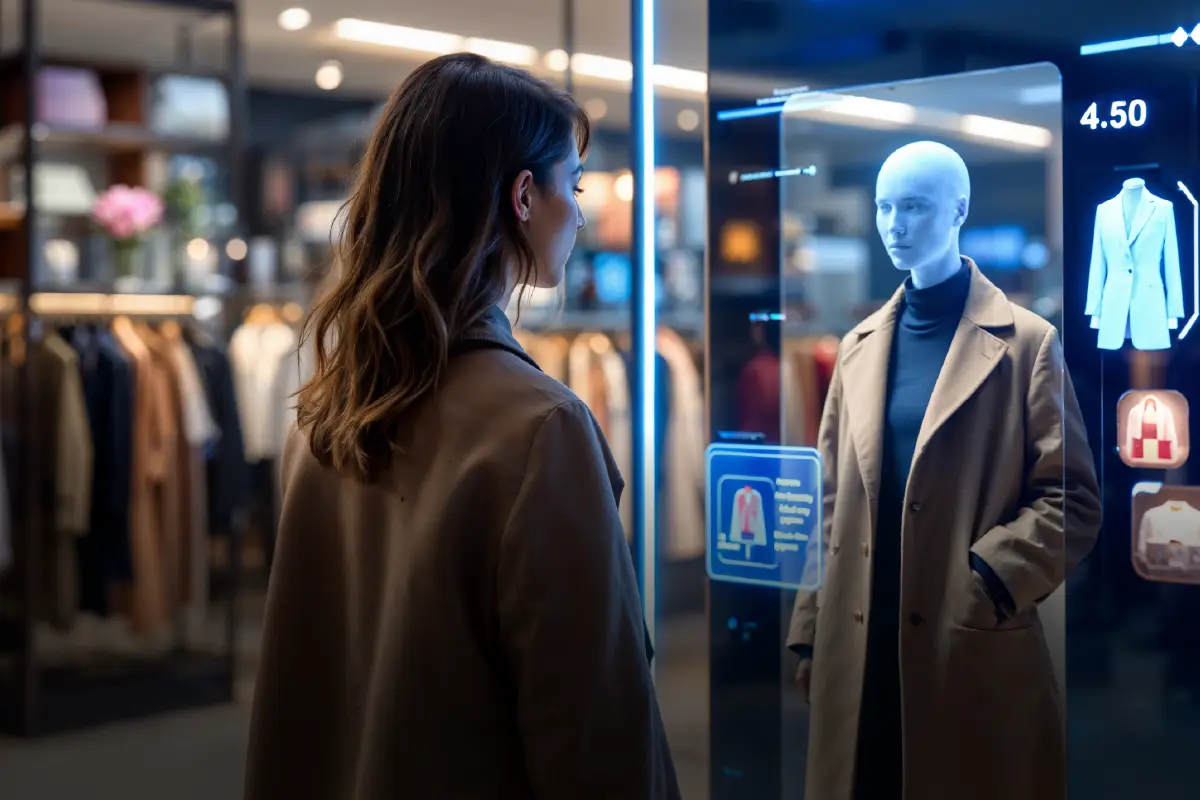
If Predictive Commerce is about anticipating intent, agentic commerce is about acting on it.
For years, AI operated as an assistant. It recommended products, answered questions, and simplified product discovery. Consumers still handled the comparison process, decision-making process, and checkout process themselves.
That boundary is beginning to disappear.
Agentic commerce brings in AI systems that can basically complete tasks on their own. Like they can evaluate options, compare specifications, look at reviews, check delivery timelines and then offer recommendations based on preset preferences, or somewhat similar ones.
And yeah the practical implications are pretty huge.
Think about a consumer living in a small Tokyo apartment who wants an air purifier for under ¥50,000. Rather than manually searching across multiple websites, the user simply tells an AI agent what they need. The agent assesses room size compatibility, energy efficiency, customer reviews, maintenance costs, shipping speed and also any current promotions that are available. Then it trims the list, picks the best match, and moves through the buying steps with minimal human involvement, so the person kind of just waits.
In other words, the consumer isn’t really navigating the whole shopping journey anymore.
The AI is.
This is no longer theoretical. Rakuten’s 2026 materials explicitly describe a future where AI agents move beyond search and answers to complete transactions. The company has also introduced Rakuten AI 3.0 while expanding AI concierge capabilities and discovery recommendation functions within Rakuten Ichiba.
The broader implication is difficult to ignore.
Search has traditionally been the starting point of digital commerce. Agentic commerce challenges that assumption. When AI agents can discover, evaluate, and purchase products independently, the importance of traditional search behavior begins to decline.
The future battleground may not be who ranks first in search results. It may be who becomes the preferred choice of AI agents making decisions on behalf of consumers.
That is a fundamentally different game.
Real-World Case Studies and the Companies Leading Japan’s AI Race
The most interesting aspect of Predictive Commerce is that many of its core ideas are already operating in the real world.
Rakuten provides one of the clearest examples. Its ecosystem spans ecommerce, travel, financial services, mobile communications, and digital content. Because these services are interconnected, Rakuten can identify relationships between consumer activities that would remain invisible within a single platform.
A customer purchasing luggage today may become a travel customer tomorrow. A travel booking may create opportunities for financial products, insurance offerings, or loyalty-driven recommendations later. Predictive Commerce becomes more powerful as ecosystems become larger.
The objective is not simply to recommend products.
The objective is to predict needs across multiple stages of a consumer’s life.
Physical retail is also evolving rapidly.
Japan’s convenience store industry has spent decades mastering operational efficiency. Now, AI is helping extend that advantage into predictive retail. Smart konbini operators increasingly combine weather forecasts, foot traffic patterns, purchasing history, and local demand signals to optimize inventory decisions and merchandising strategies.
A sudden temperature increase may trigger higher demand for cold beverages. Rain forecasts may influence umbrella inventory. Local events may alter product preferences in specific neighborhoods.
These decisions were once based heavily on historical trends and managerial experience.
Today, AI allows retailers to respond dynamically as conditions change.
The result is a retail environment that feels increasingly responsive, personalized, and efficient without requiring consumers to actively communicate every need.
Trust and Privacy in the Japanese Consumer Mindset

Every conversation about Predictive Commerce eventually reaches the same question.
When does helpful become intrusive?
Japanese consumers place a high value on privacy and trust. Therefore, successful Predictive Commerce strategies must balance personalization with transparency.
The challenge is not gathering more data. The challenge is using data responsibly.
Japan’s January 2026 APPI reform outline offers insight into how regulators are approaching this balance. The framework indicates that data used solely for statistical purposes and AI development may not require consent when individuals cannot be identified. At the same time, stricter identity verification requirements are being introduced for opt-out usage.
The message is clear.
Innovation is welcome. Misuse is not.
For Martech leaders, this creates an important strategic lesson. Consumers are often willing to share information when the value exchange is obvious and the safeguards are visible. However, trust erodes quickly when data collection feels opaque or excessive.
The brands that win will not necessarily be the ones with the most data. They will be the ones that use data most responsibly.
Conclusion and Strategic Takeaways for Martech Leaders
Many brands still think commerce begins when a customer starts searching. That assumption is becoming outdated. Predictive Commerce is shifting the focus toward the moments before a search even occurs, while agentic commerce is pushing toward a future where AI actively participates in purchasing decisions.
For companies entering Japan, the bigger lesson is not technological. It is strategic. Digital omotenashi is ultimately about relevance. Consumers do not reward brands for collecting more data. They reward brands for understanding context and reducing friction.
The winners in the next phase of Japanese commerce will be those that combine prediction with trust, automation with transparency, and intelligence with genuine customer value. If your brand is still waiting for consumers to declare intent, there is a growing chance that a competitor’s AI has already acted on it.



 English