


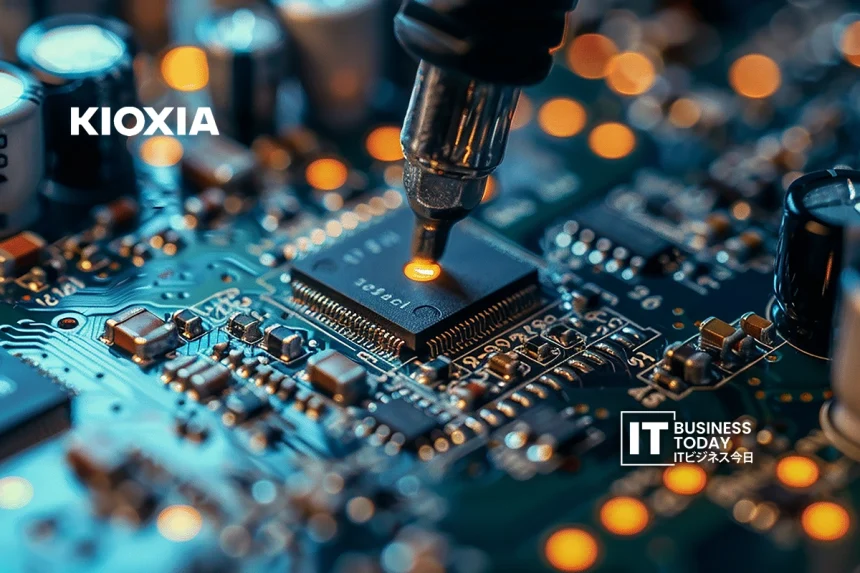
Japan’s Kioxia is widely seen as one of the country’s top beneficiaries of the global AI boom, mainly because the company matters a lot in providing memory solutions for AI data centers and HPC environments.
As AI keeps gaining traction across the globe, advanced storage technologies have become the latest focus of demand alongside GPUs, cloud infrastructures and hyperscale data centers. Though companies manufacturing AI processors have captured most of the market’s attention, analysts are beginning to emphasize memory and storage players like Kioxia as necessary players in the AI value chain.
This increased attention is an indicator of a wider change in investors’ and enterprises’ perspective towards AI-related infrastructure. Besides having cutting-edge processors, building efficient AI systems also needs a huge volume of high-speed storages that can manage vast amounts of training and inference data.
こちらもお読みください: 日立とアステモ、自動運転車向けAIプラットフォーム開発で提携
AI Is Creating Unprecedented Demand for Memory Solutions
Generative AI models are dependent on having huge amounts of data accessible at all times for storage, processing, and retrieval. This development has elevated the role of NAND flash memory and storage enterprise technologies inside modern data centers.
Kioxia, one of the world’s foremost NAND flash memory producers, is in an excellent position to ride this wave. Their line of storage products is used in high-performance, highly reliable, and scalable enterprise servers, cloud computing platforms, and AI infrastructure settings.
As businesses continue to roll out large language models, AI agents, and sophisticated analytics systems, the volume of data produced and worked on is escalating very fast. This leads to a continuous need for memory technologies that are capable of handling increasingly data-driven workloads.
Some industry insiders think that memory might turn out to be the most significant element of AI infrastructure as companies expand their AI activities.
Japan Strengthens Its Position in the Global Semiconductor Industry
Japan’s role in the global semiconductor ecosystem is brought into sharper focus by Kioxia’s rising prominence. Although US Taiwan South Korea, and China are usually the first to be brought up when discussing AI chips, Japan is still a major supplier of semiconductor materials, manufacturing equipment, sensors, and memory technologies.
Kioxia’s rising star is a signal of Japan’s increasing clout in the semiconductor market. Yes, the government has put semiconductors at the center of their industrial strategy by supporting the building of production capacities, advanced chip manufacturing, and AI infrastructure. key players like Rapidus, Tokyo Electron, Advantest, and Kioxia are also of consideration to the government for Japan’s technology long-term roadmap.
Memory is a segment where Kioxia can provide Japan extra leverage in one of the fastest growing areas of the global AI economy. Should the demand for AI infrastructure keep on increasing, makers of memory modules may be able to have a say in the performance and scalability of future computing systems.
Data Center Growth Creates Long-Term Opportunities
Expansion of AI-focused data centers is probably one of the main reasons for Kioxia’s growth prospects.
Technology companies worldwide are investing billions in building facilities for supporting AI model training, inference workloads and cloud-based AI services. Besides powerful processors, these setups also need advanced storage systems capable of handling huge datasets efficiently.
Demand for enterprise grade memory solutions is being driven by the growth of hyperscale cloud providers, sovereign AI infrastructure projects and enterprises AI deployments.
This could be a major source of revenue for Kioxia as customers will be looking for storage technologies that can support complex AI workloads.
Analysts say demand from the AI segment might even help stabilize a memory market that has traditionally been driven by the ups and downs of consumer electronics demand.
日本の技術セクターへの影響
As Kioxia is making its way as an AI infrastructure player, the move could trigger widespread changes in Japan’s technology industry.
The firm doing well actually backs the point that Japan need not necessarily be a master in AI model development only to find the country a major player in the global AI economy. On the contrary, the nation can base their works on semiconductors manufacturing industrial technology and infrastructure components which are the main factors of a successful AI system.
Mostly, Japan’s technology development plan and production power of semiconductor, which is their weak point, infrastructure with AI are technologically re-activated are in line with each other.
The rising memory demand can be a lever for investment along the entire Japanese semiconductor supply chain, leading to the growth of equipment manufacturers, suppliers of materials, research institutions, and advanced manufacturing facilities.
With AI infrastructure expenditure worldwide only going up, Japan-based tech companies across the semiconductor ecosystem might get more chances to grow and devise innovative products.
Businesses Prepare for an AI-Driven Infrastructure Era
Businesses stand to benefit from the increasing role of memory technologies as a sign of how AI transformation is not only related to software applications.
Businesses that are making investments in AI are requiring that their infrastructure be very powerful to the degree that it can accommodate large-scale data storage, real-time analytics, and high-performance computing workloads. This opens up the possibility of business not just for software providers but also for semiconductor companies, cloud operators, and infrastructure vendors.
The expanding demand for AI services will probably be the main reason for a continual increase in spending on storage systems, network equipment, and data center technologies through the next years.
Entities that function in these infrastructure layers might be the major ones reaping the benefits of the forthcoming stage of AI adoption.
The Future of Japan’s AI Infrastructure Economy
Kioxia becoming a main AI memory company is just one example of how AI success is going to be leading to a global technology transformation: AI achievements will require a whole ecosystem of other technologies to support them.
Most people keep focusing on AI models and processors, but memory and storage solutions are becoming just as necessary as organizations have to handle larger amounts of data and more complex AI tasks.
To Japan Kioxia is not only a semiconductor company, it is a symbol for the country to potentially gain more recognition in the global AI infrastructure economy through a range of technologies that are essential at every stage of AI deployment.
Coming demand for AI computing is constantly growing, and Kioxia’s contribution to the world’s data infrastructure could make it one of the major players who will benefit from the new generation of artificial intelligence expansion.