
Japan spent years carrying a strange contradiction. The country built some of the world’s most advanced industrial systems, yet large parts of its digital infrastructure stayed trapped inside outdated workflows, aging software, and painfully slow transformation cycles. For years, that gap damaged Japan’s digital competitiveness. While the US and China raced ahead in cloud ecosystems, AI deployment, and platform economies, Japan looked cautious, fragmented, and too dependent on legacy systems that no longer matched the speed of modern industry.
2026 feels different. Not because Japan suddenly discovered technology. Japan always had the engineering strength. The difference now is urgency. The country’s labor crisis, ものづくり pressure , energy transition goals, and geopolitical supply chain risks have forced both government and industry to move faster than before. Society 5.0 is no longer just a policy slogan buried inside government presentations. It’s kind of becoming a real industrial strategy, tied directly to semiconductors, artificial intelligence, robotics, telecom infrastructure, and smart production, day by day. Japan isn’t trying to imitate Silicon Valley anymore either. It is trying to define the infrastructure standards behind the next industrial cycle.
The Government Push Behind Japan’s Digital Competitiveness
Japan’s digital transformation was never going to happen through private companies alone. The pressure became too large. Years ago, METI warned about the so-called ‘Digital Cliff,’ where outdated systems could create massive economic losses if businesses failed to modernize. That warning looked dramatic at the time. In 2026, it looks realistic.
こちらもお読みください: 日本における合成データ:プライバシー、希少性、AIトレーニングの課題を解決
The important shift is that Japan’s government is no longer behaving like a slow regulator sitting on the side-lines. It is acting more like an industrial coordinator. That change matters because digital competitiveness does not come only from startups or apps. It comes from infrastructure, policy alignment, talent development, and deployment at scale.
One of the clearest examples is the Digital Agency’s FY2026 Government AI pilot involving around 180,000 government employees across ministries and agencies. Full-scale implementation is already planned from FY2027. That number matters because it shows Japan has moved beyond experimentation. This is not another ‘innovation vision’ document designed for conferences. This is operational AI deployment across government systems.
At the same time, the government is trying to reduce the long-standing dependence on fragmented vendor ecosystems. Japan’s public sector historically had trouble with siloed systems, and also those expensive maintenance contracts. So the push toward open-source frameworks and shared AI systems is not only the technical angle, it is really about economic efficiency and institutional speed, sort of a pragmatic thing.
This broader transformation directly supports Japan’s digital competitiveness because regional governments, manufacturers, logistics firms, and telecom operators now move inside the same modernization wave instead of acting independently. That coordination gives Japan something it lacked for years, which is digital momentum at national scale.
Silicon Carbide Semiconductors and the Reinvention of Japan’s Auto Industry
Japan’s automotive sector still remains one of its strongest industrial advantages. However, the global EV race changed the rules of competition. Traditional manufacturing quality alone is no longer enough. Efficiency, battery optimization, energy management, and semiconductor capability now decide who leads the market.
That is exactly why silicon carbide semiconductors have become strategically important.
Traditional silicon chips create higher energy loss during power conversion. Silicon carbide, or SiC, changes that equation. These semiconductors can handle higher temperatures, improve power efficiency, reduce system weight, and increase driving range. In simple terms, SiC chips help electric and hybrid vehicles waste less energy. That becomes critical in a market where every kilometre of battery range influences consumer adoption.
Toyota’s latest RAV4 PHEV shows how seriously Japan is treating this transition. According to Toyota, the vehicle uses silicon carbide semiconductors in the power control unit, helping raise BEV-mode range from roughly 95 kilometres to around 150 kilometres by reducing power loss. That is not a minor engineering tweak. That is a direct example of semiconductor innovation reshaping vehicle performance in real-world conditions.
This matters far beyond Toyota alone. Japan understands that future industrial leadership will depend heavily on semiconductor independence and power electronics expertise. The country already lost ground in several digital consumer markets over the last two decades. It cannot afford the same outcome in 自動車 technology, especially when mobility remains one of Japan’s most globally respected industries.
At the same time, SiC semiconductors also fit perfectly into Japan’s broader green technology strategy. Better energy efficiency means lower energy waste, stronger EV competitiveness, and reduced pressure on battery systems. Therefore, the semiconductor story is no longer separate from the climate story or the industrial policy story. All three are now connected.
That connection is becoming central to Japan’s digital competitiveness because semiconductors are no longer viewed as components. They are now viewed as national infrastructure.
Smart Connectivity, 6G Ambitions, and Japan’s Telecom Reset

Japan’s telecom ambitions in 2026 go far beyond faster mobile speeds. The bigger goal is influence. For years, countries competed mainly on hardware production. Now they are competing to shape digital standards, AI governance frameworks, and trusted data ecosystems.
Japan wants a seat at that table.
That became visible during the JAPAN-ASEAN Digital Ministers’ Meeting in 2026, where the デジタルエージェンシー focused heavily on Data Free Flow with Trust, secure data sharing through privacy-enhancing technologies, cross-border personal data transfers, regulatory transparency, and AI-related governance frameworks. On the surface, these sound like policy discussions. In reality, they are economic strategies.
Countries that influence future digital rules gain long-term advantages in trade, AI infrastructure, cloud systems, and international technology partnerships. Japan understands this very clearly. Instead of trying to dominate through aggressive platform monopolies, it is positioning itself as a trusted infrastructure and governance partner.
This shift also connects directly to Japan’s 6G ambitions. The country knows that future telecom competition will involve AI-enabled networks, cloud-native architectures, edge computing, satellite connectivity, and ultra-low-latency communication systems. In other words, telecom is no longer just telecom. It is becoming the operating system behind industrial economies.
Japan’s advantage here comes from reliability and industrial integration. While some countries focus mainly on consumer ecosystems, Japan is building telecom infrastructure around manufacturing, mobility, logistics, automation, and public systems. That approach aligns naturally with Society 5.0 because the objective is not only faster connectivity. The objective is connected infrastructure that supports factories, transportation systems, healthcare networks, and urban services simultaneously.
This is exactly why Japan’s digital competitiveness discussion cannot be reduced to apps or startups alone. The country is rebuilding digital infrastructure from the industrial layer upward.
Enterprise AI, Robotics, and Japan’s Demographic Reality

Japan’s aging population is not a future problem anymore. It is already reshaping labor markets, manufacturing capacity, logistics systems, and productivity levels. That reality changes how Japan approaches AI and robotics. In many countries, automation is mainly about efficiency gains. In Japan, it is increasingly about economic survival.
Factories cannot rely on labor expansion forever because the workforce itself is shrinking. Therefore, enterprise AI, robotics, digital twins, and hyperautomation have moved from optional innovation projects to operational necessities.
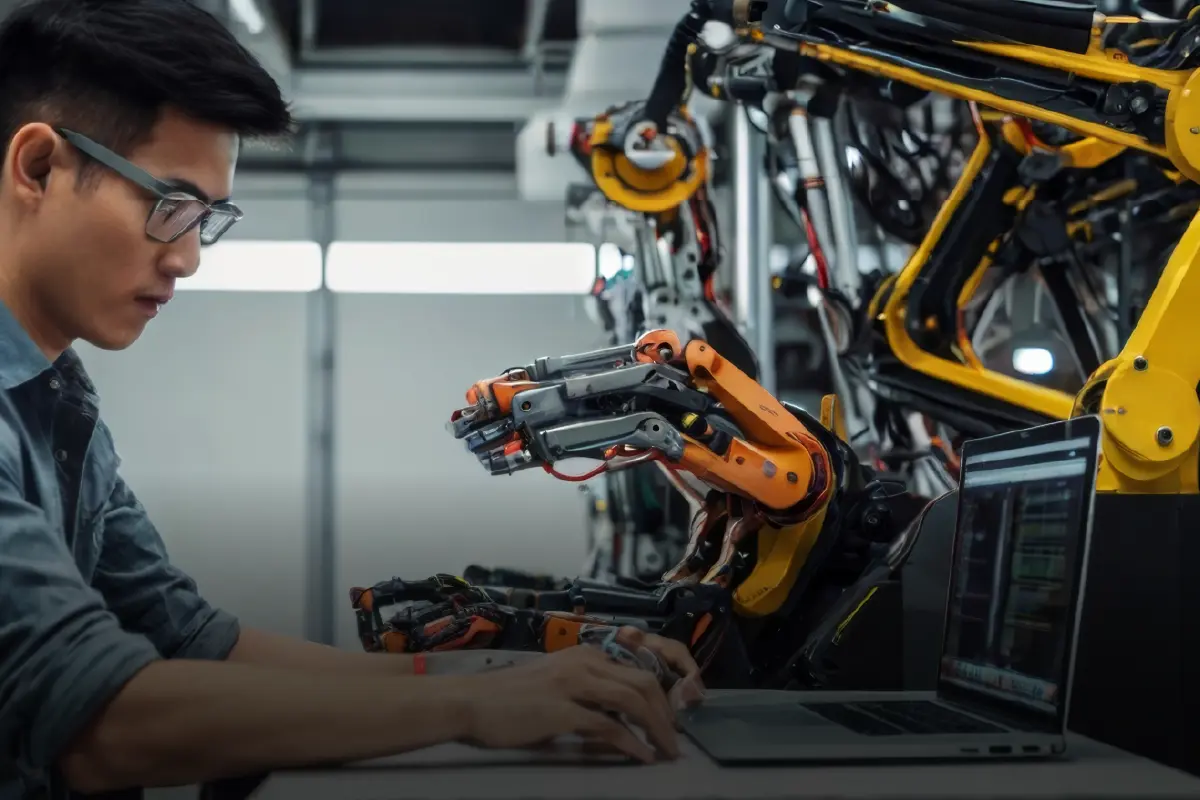
Japan already holds a massive position in this sector. According to JETRO, the country controls 46% of the global industrial robot market, while 50,413 industrial robots were installed in Japan in 2022, marking a 9% year-on-year increase. Those numbers matter because they show Japan is not preparing for automation theoretically. It is already deeply embedded into industrial production systems.
The bigger change now is, like, the integration of AI into these robotic environments. Modern Japanese factories increasingly use predictive AI systems, edge AI processing, and digital twin models to keep production quality steady while operating with fewer workers. Machines aren’t just doing repetitive tasks by themselves anymore. They are analyzing the workflow, predicting maintenance needs, optimizing energy usage, and reducing downtime in real time, yeah, more or less.
This transition gives Japan a unique industrial advantage. The country spent decades mastering precision manufacturing. Now it is combining that manufacturing discipline with AI-driven 自動化. That combination could become one of the strongest foundations of Japan’s digital competitiveness over the next decade.
At the same time, Japan’s demographic pressure creates urgency that many competitors still do not fully face. That urgency often accelerates innovation faster than optimism does. Japan is innovating because it has to.
Investing in Japan’s Digital Future
Japan’s digital competitiveness in 2026 isn’t really about nostalgia, for past industrial dominance anymore. Instead, the country seems to be re-building itself around semiconductors, AI infrastructure, robotics, telecom standards, and those connected manufacturing systems that actually match the realities of the next decade. And maybe more important, this strategy looks oddly coordinated, for the first time in years, not just a bunch of separate moves.
JETRO says Japan wants to push domestic semiconductor revenues above 15 trillion yen by 2030, while also locking in around 12 trillion yen in added public and private investment. That target by itself shows just how seriously the nation treats industrial technology as a kind of national priority, even if it sounds a little ambitious on paper.
Still, Japan’s biggest advantage may not be speed. It may be stability. While other markets chase hype cycles, Japan is building long-term industrial systems tied directly to manufacturing, energy efficiency, infrastructure resilience, and trusted digital governance. That makes the market slower in some areas, but also far more durable.
For investors, enterprise technology firms, and industrial partners, that durability matters. The next phase of digital transformation will not be won only by whoever moves first. It will be won by whoever builds systems that industries can trust for the next twenty years.