





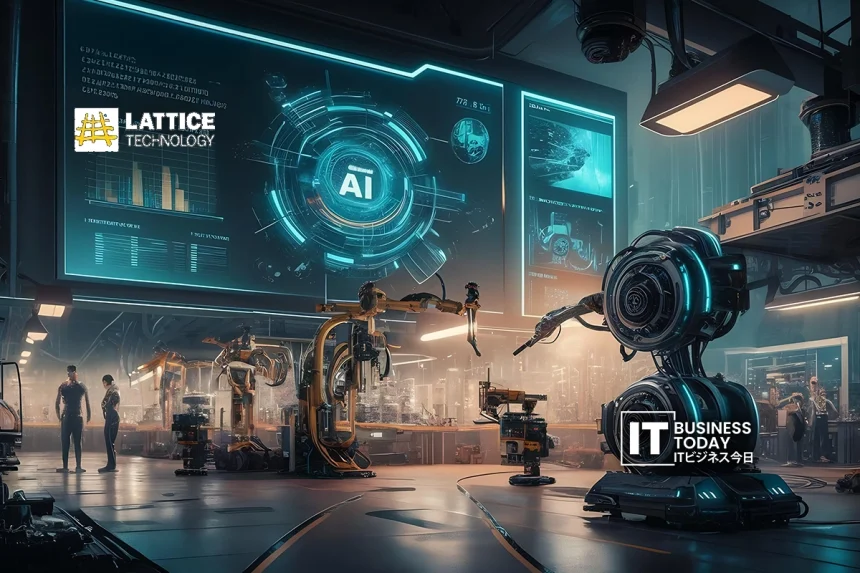
Japan’s manufacturing sector is heading for a further big step towards digital transformation as Lattice Technology Co. Ltd. has revealed a feature powered by generative AI for its most popular platform, XVL Studio. The update offers automated program generation through natural language, which drastically reduces the level of factory-floor innovation even without the involvement of highly skilled programmers.
The new feature allowing users to build and run intricate 3D data processing workflows without having a programming knowledge at a high level will be available as a demo version in June 2026. It is a significant change in how manufacturing teams can deal with digital tools since it gives operational staff more control directly.
Bridging the Gap Between Shop Floor and Software Development
Customizing industrial software programs like XVL Studio was traditionally a complex process that only specialized IT engineers could perform. However, the recent introduction of Lattice’s generative AI function completely transforms the situation. Simply by providing natural language instructions, the users are able to program the system to generate executable programs automatically through platform’s SDK.
こちらもお読みください: 日本、労働危機をフィジカルAIの実戦実験場に
Take the case when users want to obtain certain product information such as measurements or weights but they do not want to take steps manually. Instead, users can give the AI commands like measuring dimensions, calculating weight, and exporting results to a spreadsheet, etc. Then, the AI will instantaneously plan and carry out the entire process.
Such a move means that factory software customization is no longer the preserve of specialists in manufacturing areas where processes differ greatly from one company to another. Besides, it also resolves an old and serious problem of the scarcity of programming knowledge on the production floor.
Unlocking the Value of 3D Data
Modern manufacturing techniques produce huge amounts of 3D data at different stages of design, production, and maintenance. Lattice’s unique XVL format has already become popular as a lightweight and efficient method of handling such data.
The company, through the use of generative AI, is giving manufacturers a way to gain more insights and operational value from these datasets. Businesses will no longer consider 3D models as mere static assets but as a source of dynamic actionable intelligence.
This feature is especially useful in sectors like automotive and industrial machinery where products are made up of thousands or even tens of thousands of individual parts. What used to be the work of several manual steps can now be done by giving a single instruction.
Addressing Japan’s Manufacturing Challenges
The moment for this kind of innovation couldn’t be better as Japan’s manufacturing industry is confronting severe challenges due to labor shortages and an increasingly senior workforce. Manufacturers are turning to different methods that can help them keep up their production levels despite having fewer human resources.
Leveraging AI in automation, Lattice provides a practical solution to the problem by giving non-technical operators the ability to identify efficiencies and make their work processes more effective. They are also allowing workers right at the service level to come up with their own solutions thereby lessening the dependence on central IT teams and enabling quicker improvements in operations.
In essence, it fits well with Japan’s initiative towards Manufacturing DX (digital transformation), where the aim goes beyond just converting processes into digital forms but is about radically altering how work is carried out through the use of advanced technologies.
Industry-Wide Implications
The introduction of generative AI into 3D data workflows could have far-reaching consequences for the global manufacturing industry.
- Democratization of Industrial Software
Removing the barrier of requiring coding skills, software such as XVL Studio are being unlocked for use by a much larger audience. As a result, innovation cycles might get shortened significantly, as more workers contribute to industrial process improvements.
- Manufacturing’s Greater Commitment to AI
When it comes to using AI for maintenance or quality control, factories are already familiar with these applications; however, automating work processes using AI is a completely different aspect. This could be the trigger for widespread AI deployment in manufacturing facilities throughout the world.
- Early Adopters Will Gain a Competitive Edge
Those organizations that choose to implement AI powered automation in their production will be able to achieve not only efficiency but also cost advantages. In sectors where competition is fierce, a small increase in output can lead to a significantly larger increase in profits.
Business Impact: Efficiency, Agility, and New Value Creation
In addition to improving operational efficiency, the possibilities for rapidly creating custom workflows also enable enterprises to innovate greatly.
Lower Operation Costs: Automation greatly reduces the need for human involvement, thus lowering time and labor costs.
Quick Decision-Making: The ability to extract and analyze data in real-time allows rapid responses to production issues.
Increased Flexibility: Empreses are able to alter workflows as needed, thus reacting to different changes without having to go through the long development phases.
In addition, the combination of AI with 3D data could allow the creation of completely new services, such as digital twins, highly detailed simulations, and design optimization through AI.
今後の展望
Lattice is planning to demonstrate this innovative feature at Manufacturing DX x 3D Seminar 2026 in Tokyo this May, giving the industry stakeholders a preview of what it can do.
While rolling out generative AI to augment its platform, the company is essentially making a bet on next-generation manufacturing technologies. Above all, this reflects a bigger industry transformation: the integration of AI and industrial data is reshaping factory operations.
This is a big plus for Japan where such breakthroughs help maintain its position as a leader in advanced manufacturing and at the same time tackle serious labor shortages. On the other hand, on a global level, these developments point toward a world in which smart automation will not simply be a means of gaining an edge but rather a survival factor to keep pace with an industrial environment that is getting more and more digital.