 日本語
日本語 


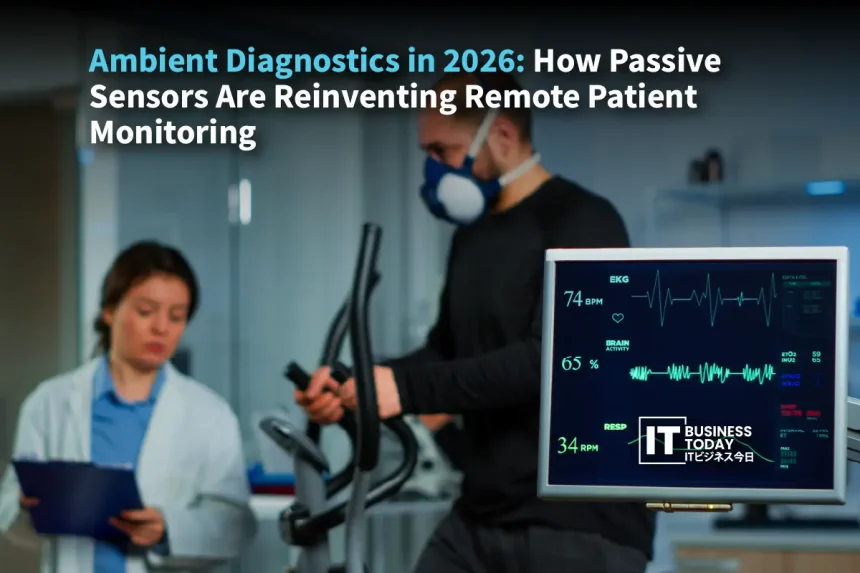
Picture a patient in 2026 sitting in their living room thinking everything feels normal. No smartwatch buzzing. No chest strap digging into the skin. Yet the Wi Fi signals brushing past their body pick up a subtle change in breathing and gait. The home flags a pattern that usually shows up days before a heart failure flare up. That quiet early alert becomes the difference between a calm intervention and a rushed hospital admission.
This is the world of ambient diagnostics. Instead of relying on active monitoring where people must wear, charge, or remember a device, the environment itself becomes the sensor. Sound, radio waves, and thermal shifts map what the body is doing without demanding any effort from the patient.
And the shift is not random. The global strategy for digital health adopted by the World Health Assembly and WHO is pushing health systems toward low friction, always on monitoring. In 2026, RPM is moving from wearables to invisibles powered by mmWave radar, Wi Fi sensing, and fast edge AI.

The Friction Problem and Why Wearables Hit a Ceiling
Wearables looked like the heroes of remote patient monitoring, but the shine fades fast once you see how people actually use them. Smartwatches need charging every day. Elderly patients forget to wear them. Some users remove them because their skin gets irritated. So the whole thing collapses before the data even starts to flow. This compliance gap keeps showing up across studies and across markets.
Then comes the data silo. A smartwatch provides the heart rate at that instant only, but not the story associated with it. It is similar to getting an isolated frame from a film and assuming you know the storyline. For this reason, medical professionals witness still images rather than the entire surrounding context. The messy middle stays messy.
Now the world is pouring more money into digital health infrastructure in 2025 and that is the signal everyone should notice. The real solution lives in passive sensors. They remove the human from the workflow. They turn the home into a diagnostic tool that works in the background. Wi Fi sensing, radar based systems, and smart speakers watch patterns continuously and quietly.
Because nothing needs charging or remembering, the adherence problem disappears. The data finally moves from scattered snapshots to a full story.
Also Read: From Genomics to Generative AI: Japan’s Bold Step in Personalized Medicine
The Core Technologies of 2026
If 2025 was the warm up, 2026 is the year the real tech steps out from the shadows. And honestly, this is the part that separates hype from systems that actually work in messy, real homes.
First comes Wi Fi sensing. Most homes already run on mesh networks, so the infrastructure is sitting there doing nothing useful beyond streaming video. These networks create radio waves that bounce around the room. When a human moves or even breathes, the body disrupts those waves. By reading this disruption through something called Channel State Information, the system can track chest wall movement for breathing and even measure gait speed. So the same router that pushes YouTube can quietly flag early respiratory distress or mobility decline. The clever part is that people do not need to wear anything or remember anything.
Then we have mmWave radar. This tech reads micro movements with surprising accuracy. A small change in posture. A tremor. Restless sleep. A hard fall. And it does all of this without cameras, which means privacy stays intact. Facilities in the United States already use a radar based vital sign sensor called the XK300. It monitors respiratory rate, resting heart rate, presence, and motion index without touching the patient. So the idea is not futuristic. It is already running in skilled nursing centers today.
Now shift to Acoustic AI. Most people think of voice assistants that play music or set alarms. That is kindergarten level compared to what is coming. Specialized microphones can hear patterns humans often miss. A wet cough that hints at COPD. A gasp during sleep that signals apnea. Minor alterations in voice that indicate the initial stages of mental deterioration or increasing depression. Such systems operate perpetually in the background and, more significantly, without requiring the user to communicate with a robot on a daily basis.
Together, these technologies change the entire playbook. Instead of chasing people to wear devices, the environment takes responsibility. Instead of random snapshots, we get a continuous understanding of health. And instead of waiting for a crisis, the system spots the early signals while life goes on normally.
Clinical Use Cases Moving from Reactive to Predictive

Healthcare has spent decades playing goalkeeper. Something goes wrong. Then everyone scrambles. The whole point of ambient sensing is to flip that script and start spotting the trouble before it becomes a crisis.
Take the hospital at home model. Post-operative recovery has always been a black box once the patient walks out the door. With passive monitoring, that gap closes fast. Gait speed becomes a quiet signal of how well the body is healing. A steady walk usually means the recovery curve is on track. A slowing or uneven walk can hint at pain, infection, or fatigue. Even sleep quality becomes a diagnostic clue. Fever often shows up as restless movement long before the thermometer catches it. So the home becomes a real extension of the ward instead of a gamble.
Chronic disease management takes an even bigger leap. Heart failure patients often show signs days before they feel anything. Fluid retention changes how they walk. Breathing narrows. Their body sends warnings long before they rush to an emergency room. Ambient sensors read these shifts naturally. The beauty is that patients do not need to do anything special. No button presses. No app updates. Just living their life while the system tracks the red flags.
Elder care and aging in place might be the strongest use case. The old model was a pendant button that seniors forgot to wear anyway. Now sensors catch the patterns that lead to a fall. Shuffling. Slower turns. Hesitation during movement. Instability that grows over days instead of hours. These signals give caregivers a chance to intervene early. The same sensors can track activities of daily living. Bathroom usage that drops can point to dehydration or a possible UTI. A silent kitchen for too long can hint at missed meals or cognitive decline. It is gentle monitoring without taking away independence.
When you zoom out, the impact becomes massive. Even modest digital health interventions are projected to prevent around 2 million deaths and avert nearly 7 million acute events in the coming decade. That is what happens when care shifts from reacting to predicting while people simply live their lives.
The Privacy Paradox and Why We Still Trust the Listening Walls
Let us not pretend this part is small. The moment people hear that their walls can sense their breathing or gait, the first instinct is suspicion. It feels too close. Too watchful. The real question becomes simple. If the home is listening, who controls that information and how far does it travel.
This is where the tech finally grows up. In 2026, the processing does not happen in the cloud. It happens right inside the device sitting in the room. That shift to edge computing turns the sensor into a quiet analyst rather than a roaming spy. The system detects a fall, labels it, and sends a single alert that says Fall Detected. No raw audio leaves the living room. No video feeds ever hit a server. No breathing patterns or speech snippets get archived somewhere unknown. The insight leaves the home, not the data.
The consent model also gets a reality check. Instead of vague terms of service that nobody reads, healthcare moves toward prescription based privacy. A doctor prescribes a monitoring plan the same way they prescribe a medication. The patient opts in as part of their treatment and understands the purpose, the duration, and the limits. It feels more transparent because it actually is.
Even the science behind this space is becoming more rigorous. Researchers have already demonstrated contactless ECG capability using mmWave radar in peer reviewed engineering studies. So the idea of sensing without touching or recording is not a moonshot. It is a working reality that just needs trust layered on top.
When the walls listen responsibly, patients finally get protection without sacrificing dignity.
The Integrated Ecosystem and How the Smart Home Becomes a Clinic
If ambient diagnostics is the engine, interoperability is the fuel that keeps it moving. The rise of standards like Matter finally lets devices speak the same language. A Samsung fridge, a Google Nest, and a medical radar can plug into one shared ecosystem and push their signals toward the same EHR without wrestling with ten different formats. The home starts acting less like a patchwork of gadgets and more like a coordinated clinical space.
Doctors also get a break. Instead of drowning in motion logs or breathing curves, they see the clean trendline that matters. AI sorts, filters, and ranks the firehose of signals so clinicians avoid alarm fatigue. They get the early warnings without the noise. A slow shift in gait. A drop in sleep quality. A red flag on hydration patterns.
Picture a simple floor plan. Sensors in the bedroom, bathroom, and kitchen all feeding a single dashboard that acts like the home’s quiet command center. It is care without clutter.
The Future is Contactless

Ambient diagnostics is not another shiny health gadget. It is a hard pivot from sick care to true health assurance where the walls quietly track the signals long before symptoms show up. You get protection in the background while life goes on in the foreground. This is the entire point. The most intelligent technology is that which you never need to charge, wear, or even think of.
If a company wants to be on the cutting edge, it should first ask itself a simple question. Do your current RPM vendors have a non-wearable roadmap? If not, it is time to audit your stack and plan for the passive sensing wave.


 English