 日本語






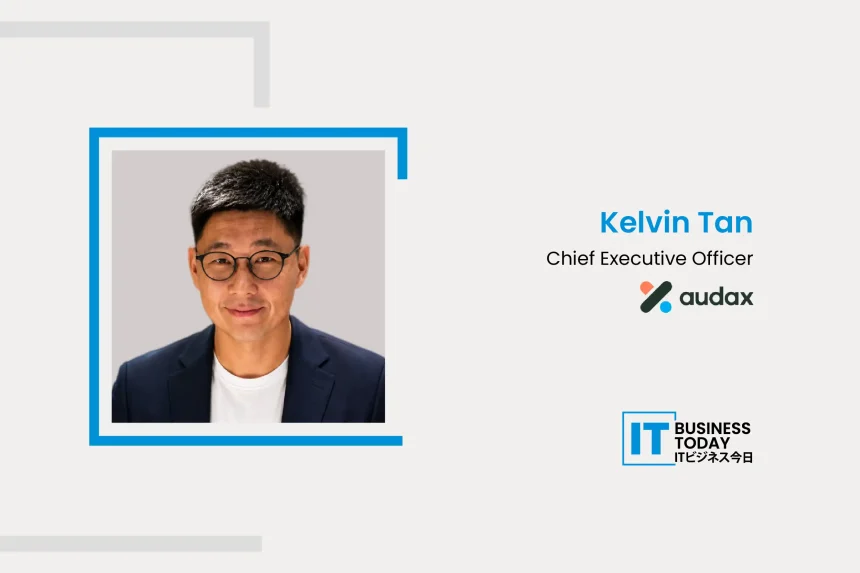
Kelvin, can you tell us about your professional background and your current role at audax?
I have spent the last 20 years – aside for a slight detour into FMCG – in banking, covering Transaction Banking, Retail Banking and Consumer Finance. At Standard Chartered, I eventually conceptualised and built nexus, its Banking-as-a-Service business, which gave me first-hand experience of what it takes to build new banking models inside a large, regulated institution.
Currently, I am the CEO of audax Financial Technology, where we have built a digital banking platform that enables banks to transform into future-ready enterprises. The idea is to empower our clients to modernise around their existing estate while creating the optionality to pursue advanced banking business models – such as embedded finance, data-led services and ecosystem plays – in conjunction with frontier capabilities such as AI or digital assets.
Kelvin, your career has moved from consumer banking and FMCG to transaction banking, digital payments, Standard Chartered nexus, and now audax. Looking back, which experience most changed the way you think about difficult business problems, and did that lesson influence how you eventually chose the problems you wanted to solve at audax?
All of my experiences have informed the way I think about difficult business problems. I find that the most useful approach is always to take an overarching problem and break it down to its atomic components and create a plan to solve each sub-component.

If there was one experience that brought this approach into focus, it was building new banking propositions within Standard Chartered. You could have a compelling customer proposition and perfectly capable technology, but still fail because the operating model, risk framework or economics had not been solved.
The overarching problem I wanted to solve at audax was to provide banks around the world the option to pursue advanced business models while building the flexibility to adopt frontier capabilities, such as AI and digital assets. This change is coming and it is inevitable over the next two decades. Banks will increasingly explore new ways to create value through embedded finance, data and broader ecosystems, while AI and digital assets accelerate those possibilities.
The question is not whether these changes will happen, but whether banks have the infrastructure and flexibility to participate in them. That is ultimately the problem we set out to solve at audax.
You spent years building new propositions from inside Standard Chartered before moving to the other side of the table with audax. What did you understand about banks only after you began trying to help them transform from outside the institution?
For me, the real learning is that there are a lot of common pain points, concerns and obstacles across different banks in different geographies. Whilst the details may differ, the high-level issues are pretty uniform. We have found that conversations and solutions to problems with one client bank can largely be repurposed for another client.
Having built banking technology from within Standard Chartered, we have experienced many of these challenges ourselves, which helps us recognise the common issues facing other banks. That is the reason why one of the benefits that we offer to our clients is the continuous evolution, upgrading of our services/platform and approach as we onboard banks. As we develop new capabilities and solve common challenges, those improvements will be made available to other clients, with room for local customisation.
When you built SC nexus, Banking-as-a-Service was still emerging as a new way for banks to reach customers through digital ecosystems. Having now seen the model evolve in practice, what do you think the industry initially got wrong about BaaS, and what has it since learned?
I think there was a severe underestimation of the risks involved in the BaaS model – particularly in Europe and the United States where early BaaS models involved a technology intermediary working between the banks and the front-end ecosystems. While this made distribution easier, it introduced complexity around accountability, visibility, and risk management. When something went wrong, the important question became: who actually understood the customer, the transaction and the risks involved?
Where we are today indicates an increasing awareness that only technologically and philosophically advanced banks can execute BaaS correctly. This means banks that have both the technological maturity — including infrastructure, data capabilities and operational controls — and the philosophical willingness to rethink traditional distribution models, embrace ecosystem partnerships and operate beyond conventional banking boundaries, while retaining responsibility for regulated activities.
This is why I believe the technology intermediary model, while interesting in creating early awareness, is probably the wrong way to go about it.
Audax’s proposition is built around helping banks modernise without forcing them into a disruptive rip-and-replace exercise. Having experienced the constraints of large financial institutions firsthand, where do you think the real bottleneck sits today, in technology itself or in the organisational and risk structures surrounding that technology?
In my experience, technology is not usually a barrier in this context. The key challenge is usually people and risk frameworks – where mindsets of yesteryear are being used to assess the delivery of future capabilities.
Banks have spent decades building systems, processes and controls designed to protect customers, manage risks and maintain operational resilience. These have served the industry well, but they can also create institutional inertia when the same approaches are applied to fundamentally different technologies and business models.
For example, traditional banking transformation has often been approached through large, multi-year programmes with extensive dependencies and approval processes. Yet today, banks have the technology to introduce new capabilities incrementally, modernising around their existing infrastructure rather than replacing everything at once. The challenge is whether their internal decision-making, risk assessment and governance processes can adapt to support these different approaches.
The issue is not that banks are too cautious. It is that they sometimes assess new possibilities through frameworks designed for a different era.
I believe the next phase of banking transformation will require as much change in organisational thinking as in technology. Banks need people who are willing to challenge established assumptions, risk frameworks that distinguish between genuine risks and legacy practices, and leadership that can balance the need to innovate with the responsibility to remain resilient.
Ultimately, modernisation is not just about changing the technology banks use. It is about changing how banks think about what is possible, and how they get there.
Bank Indonesia reported 16.07 billion digital payment transactions in Q2 2026, up 36.88% year on year. As more financial activity happens inside digital ecosystems rather than traditional bank interfaces, do you think the very idea of a ‘digital bank’ is beginning to become outdated? If so, what replaces it?
Not at all. I think what is potentially becoming outdated – particularly in the age of agentic execution and distributed rails – is the idea that the bank will continue to own the primary interface with the end client. There are different views on this and we will see where we land, but expecting your customers to interface with you only through your application will probably disappear with time.
In that context, the ‘digital bank’ is very much alive. The bank whose data infrastructure is modern, scalable and real-time will probably be far better placed to engage in new creative business models in the age of comprehensive ecosystems – particularly as regulations will continue to create a moat around the controls and capital required to do banking as a business.
Much of the industry’s AI conversation has focused on models becoming more capable. Your current work at audax increasingly focuses on what happens when AI needs to operate within real banking environments. What changes when an AI system moves from advising a banker to actually interacting with banking data, APIs and workflows, and where should the boundary of that autonomy sit?
We are actually working on this subject extensively at audax.
The moment AI moves from answering a question to interacting with banking data, APIs and workflows, the problem changes completely. You are no longer asking, “Is the model intelligent enough?” You have to ask: “What information can it see? What is it authorised to decide? And what is it permitted to execute?”
Also Read: Interview with Marc Wesseling, founder and Director @UltraSuperNew K.K.
Audax has built an AI control plane for banks and financial institutions to provide observability, auditability, guardrails and controls that our clients can define. This enables banks to govern how AI interacts with their existing systems, while maintaining visibility and accountability over its activities.
The boundaries of the autonomy should be defined jointly by the bank’s customers and the bank to ensure that safety, security and regulatory controls remain robust against the many threats afflicting the banking industry – e.g. fraud and anti-money laundering (AML) risks.
I don’t believe there should be one universal boundary for AI autonomy. The appropriate level of autonomy should depend on the nature of the activity, the customer’s consent and the risks involved.
For example, AI gathering information and recommending a financial product is fundamentally different from an AI agent initiating a payment. The latter requires clearly defined authorisation, transaction limits and appropriate human oversight, particularly when actions could have financial or regulatory consequences.
The goal is not maximum autonomy, but appropriate autonomy with clear accountability. Banks must remain able to determine what AI can do, under which conditions and when human intervention is required.
Your career has repeatedly put you at the intersection of established institutions and unconventional business models. With AI, embedded finance, open banking and digital assets now converging, what is one assumption about the future of banking that you think is particularly likely to be wrong?
I think the assumption that the future of banking business models lies primarily in balance-sheet activities is going to be severely challenged in the next decade or so.
Lending and deposits will obviously remain fundamental. But banks possess something increasingly valuable beyond capital: trusted customer relationships, identity, transaction data, permissions, regulated infrastructure and the ability to move value safely.
As AI, open banking, embedded finance and digital assets converge, those assets can support entirely different business models. A bank could increasingly become a trusted mediator of data and financial capabilities across ecosystems rather than simply the institution at which the customer begins every financial journey.
That raises a much more interesting question than whether banks will adopt AI or stablecoins: what is a bank actually for when the interface, the intelligence and even the settlement rail may sit somewhere else?
I don’t think we know the complete answer yet. But I suspect the institutions that start asking that question now will have far more strategic options ten years from now.
You have spent much of your career bringing together people from banking, technology, product, strategy and external ecosystems. What have you learned about creating an environment where people can challenge conventional thinking without losing the discipline, governance and resilience that banking demands?
I don’t see challenge and discipline as opposites. In fact, the best teams I have worked with are very willing to challenge assumptions, but equally rigorous about evidence and accountability.
The first thing I try to do is make the objective very clear. Once everyone understands the problem we are trying to solve, people should feel completely comfortable challenging how we get there — including challenging me.
At the same time, banking has certain non-negotiables. Customer trust, security, regulatory obligations and operational resilience cannot simply be wished away in the pursuit of innovation. So the question becomes: which constraint is genuinely immovable, and which constraint exists because “this is how we have always done it”?
Good leadership creates enough safety for people to ask that question, and enough discipline to know the difference.
You’ve said that you never really had a long-term career plan and instead kept moving toward the next difficult challenge. Having built audax around some of banking’s hardest transformation problems, what is the difficult problem you are most curious about solving next, and what makes that problem worth taking on?
The problem I am most interested in is still the one that brought us to audax: what does the banking business model of the future actually look like?
I sincerely hope I will be able to help banks around the world build those future business models. Banking is entering a period of significant change, and I believe the institutions that succeed will be those that have the flexibility to adapt, explore new opportunities and create value beyond their traditional businesses.
What makes this problem worth solving is that banks play a fundamental role in the economy, yet many are constrained by technology, processes and operating models built for a different era. If we can help them overcome those constraints, we are not just enabling innovation. We are giving them the ability to remain relevant and continue serving customers in a financial landscape that could look very different over the next two decades.
Aside from that, and if I ever get the opportunity, I would be very interested in solving for Singapore’s viability as an entity over the next hundred years.



 English