 日本語
日本語 





Japan talks about the future very differently. It does not start with disruption or domination. It starts with coexistence. The idea is called Society 5.0. It is the government’s official vision for a super-smart society where cyberspace and the physical world are deeply connected. Not as separate layers. As one system that supports real human life.
In this vision, robots, AI, IoT, big data, and cyber-physical systems are not optional tools. They are core technologies. They exist to solve everyday problems. Productivity gaps. An ageing population. Economic slowdown. And they are meant to do this not only in factories or labs, but inside homes, workplaces, and communities.
This framing already puts Japan on a different path. In many Western narratives, robots arrive with fear attached. They replace jobs. They watch people. They go out of control. Think Terminator. Machines as threats or, at best, cold tools. Japan’s mental image is different. Closer to Astro Boy. Robots as helpers. As partners. Sometimes even as companions.

Also Read: From Segmentation to Signals: The End of Static Customer Personas Website
That difference is not cosmetic. It shapes design decisions. Because the real challenge in robotics today is not intelligence. It is trust. People do not reject robots because they lack computing power. They reject them because they feel unsafe, invasive, or emotionally wrong.
Human-centric robotics is not about making machines smarter. It is about making them physically and emotionally acceptable. How they move. How they react to touch. How they behave when humans are nearby. Trust is built through the body first. Japan understands that. Quietly. Consistently.
Why Japan leads in soft automation
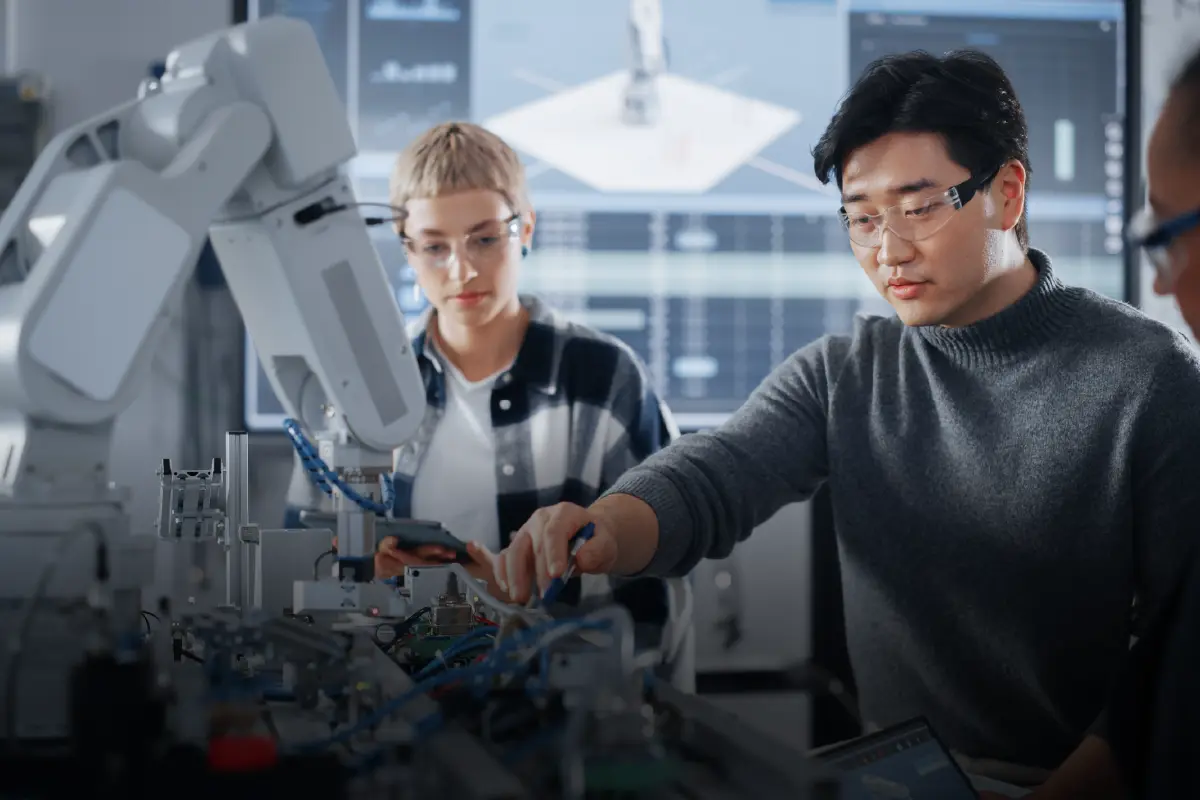
To understand Japan’s comfort with robots, you have to look beyond technology. You have to look at belief systems. Shinto, one of Japan’s oldest spiritual traditions, is rooted in animism. The idea that objects can carry presence. Meaning. Even spirit.
This does not mean people think robots are alive. It means forming emotional connections with non-human entities does not feel strange. It feels familiar. So when humanoid robots appear in public spaces, the reaction is not immediate rejection. It is curiosity. Sometimes affection. Sometimes cautious acceptance. But rarely panic.
This mindset shapes what human-centric means in Japan. It does not mean people bending themselves to fit machines. It means machines adapting to people. Their pace. Their strength. Their mistakes. Their emotions.
And this philosophy scales. In 2024, Japan installed approximately 13,000 industrial robots in its automotive industry. That was an 11 percent increase over the previous year and the highest level seen in five years. Japan also accounts for 38 percent of global robot production. In its automotive sector alone, robot density stands at 1,531 robots per 10,000 employees.
These numbers matter. But not just because they are big. They show that Japan is not afraid to deploy robots widely. It does so because it designs them to coexist with humans, not to be isolated behind cages. The aim is shared space. Humans and machines working near each other without constant fear.
This is what soft automation really means. Not weak machines. But machines that know when to yield.
From metal arms to living movement
For a long time, robots were built like machines first and last. Rigid frames. Hard joints. Predefined paths. They worked well because humans stayed away from them.
That model breaks down the moment robots enter human spaces. Human-centric robotics shifts from metal to muscle. From rigidity to responsiveness. This is where soft robotics comes in. Instead of solid joints and fixed motion, designers use materials and systems that bend, compress, and absorb force.
Artificial muscle actuators are a good example. These systems often use air pressure to contract and relax, similar to how human muscles work. If such a robot bumps into a person, it does not push harder. It gives way. The force is absorbed. The risk of injury drops.
That single change alters everything. Proximity becomes possible. Then there is sensory feedback. Haptic technologies allow robots to feel resistance. They can tell when something is fragile. Or alive. A robot holding a cup behaves differently from a robot holding a human hand. Grip strength adjusts continuously. This is not elegance for show. It is basic respect for human safety.
But realism has limits. Push too far and you fall into the uncanny valley. Robots that look almost human but not quite often feel unsettling. Japanese designers tend to approach this carefully. Instead of chasing perfect faces, they focus on natural motion and calm behavior. A robot does not need to look human to feel trustworthy. It needs to behave predictably.
This direction is supported at a systems level. In 2025, Japan’s Ministry of Economy, Trade and Industry adopted multiple research and development themes aimed at building an open software development infrastructure for robotics. The goal is to speed up the creation of diverse robot systems and expand adoption across industries.
Open systems matter because trust is contextual. A robot in a hospital is not the same as one in a shop or a home. Flexible platforms allow robots to adapt to human environments instead of forcing humans to adapt to robots.
Privacy, safety, and consent by design
When robots enter homes, trust becomes fragile. To function well, robots need sensors. Cameras. Microphones. Proximity detection. That immediately raises privacy concerns. The same systems that help robots avoid obstacles can feel like constant monitoring. Japan’s human-centric approach treats this as a design problem, not a legal afterthought.
Clear recording indicators matter. People should always know when a robot is sensing or recording. Local data processing matters too. When data stays on the device through edge AI, exposure drops. So does fear. Response time improves as well, which builds confidence.
Then there is physical control. Simple kill switches. Easy ways to pause or shut down a robot without navigating menus or apps. These are not signs of distrust. They are signs of respect for user autonomy.
Safety standards reinforce this thinking. ISO 13482 focuses on safety requirements for personal care robots. It exists because physical interaction carries real risk. Compliance signals that designers have considered failure, not just success.
Trust is not built by promises. It is built by control. Human-centric robotics treats consent as something that can be withdrawn at any moment.
When theory becomes daily life
The easiest way to understand human-centric robotics is to look at where it already works. In elder care, the most effective robots are not always the strongest. Emotional robots like the seal-shaped Paro reduce anxiety and loneliness among patients. They do not lift bodies. They provide comfort. That matters in ageing societies where emotional health often declines quietly.
Avatar robots take this further. At places like the Dawn Avatar Robot Cafe, people with severe physical disabilities remotely control robots that serve customers. The robot becomes a body. The human becomes present again. Public interaction returns.
This flips the automation story. Technology does not replace people. It gives people back their role.
SoftBank Robotics reflects this philosophy. The company positions itself as a robot integrator focused on enhancing human work and services. Its humanoid robot Pepper is designed specifically for human interaction. It has been deployed across homes, malls, schools, workplaces, and eldercare environments. The focus is approachability, not dominance.
In healthcare, CYBERDYNE pushes human-centric design even further. Its wearable robotic exoskeleton HAL received official certification in Japan in January 2025 for a smaller-size medical model. This expanded access to rehabilitation and support. In the same year, HAL was reported to uniquely induce neuroplasticity and provide therapeutic benefits across neurological conditions. Here, the robot does not lead. The human body does. The machine listens and amplifies intent.
The blueprint the world is watching

Robotics works when three things align. Empathy in design. Ethics in data. Utility in solving real problems like labor shortages and ageing populations.
Japan’s approach is not loud. It is deliberate. It treats trust as something that must be engineered, not advertised. Robots are built to yield, to adapt, and to coexist.
The world is watching because this problem is universal. If Japan solves the trust equation at scale, it offers a blueprint for how humans and AI can live together without constant resistance.
For engineers and investors, the lesson is uncomfortable but necessary. Hard skills build machines. Soft skills decide whether people accept them. In human-centric robotics, trust is not a feature. It is the outcome.


 English