
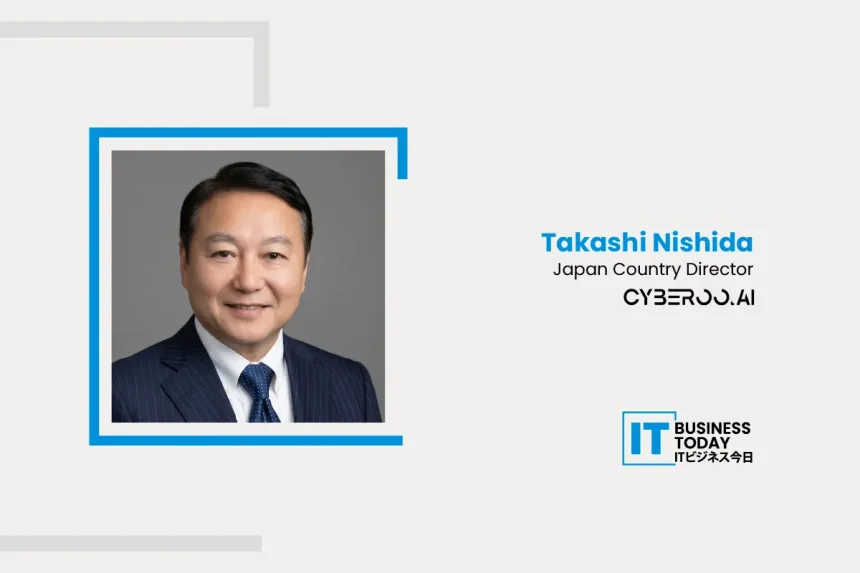
Takashi, can you tell us about your professional background and your current role at Cyberoo.AI?
Over the past 30 years, I have built my career at the intersection of business strategy and technology, working across industries including industrial manufacturing, telecommunications, enterprise software, consulting, financial analytics, and artificial intelligence. In addition to my experience in Japan, I have also worked in the United States and France, where I led business transformation initiatives in diverse commercial and regulatory environments. These international experiences have shaped the foundation of my professional approach.
As Japan Country Director at Cyberoo.AI, I oversee business development, strategic partnerships, and customer implementation across the Japanese market. Our mission is to transform fragmented fraud signals into explainable intelligence that organizations can confidently use for real-world decision-making. My role is to bridge this value to financial institutions, telecommunications providers, and public sector organizations throughout Japan.
Takashi-san, your career has taken you across telecom, enterprise software, consulting, financial analysis, AI, and now cybersecurity, with experience spanning Japan, the United States, and France. Looking back, was there a particular experience or turning point that fundamentally shaped how you approach business transformation and technology adoption today?
The defining turning point in my career was the period I spent working in the United States and France. In Japan, business emphasizes consensus-building and operational excellence. In the United States, speed and rapid hypothesis testing are prioritized, while France places strong emphasis on institutional design and logical consistency.
I realized that even the same technology creates value only when it is communicated and implemented in ways that align with the local business context. Witnessing many excellent products struggle to gain traction in Japan reinforced my belief that success depends less on the technology itself and more on how effectively it addresses real business challenges. This perspective remains especially important in cybersecurity, where trust is fundamental to adoption.
You’ve worked through multiple waves of innovation, from telecom and enterprise software to AI and cybersecurity. Across all these technology shifts, what patterns have remained surprisingly consistent when it comes to helping organizations turn new technologies into real business value?
Regardless of how technology evolves, the most important question remains the same: whose business challenge or decision-making process will this technology improve?
Whether in telecommunications or AI, successful implementations have always included practical use cases that employees could begin using immediately. Even the most advanced technologies fail to create value if they are not integrated into existing business processes and organizational responsibilities.
Another constant is trust. Particularly in the Japanese market, organizations expect not only accurate outcomes but also clear explanations of how those outcomes were reached. Ultimately, transforming technology into business value depends on a deep understanding of people and operational workflows, and that principle remains timeless.
Having spent decades working at the intersection of business strategy and technology, how has your own thinking about innovation evolved over time? Are there lessons you believed strongly earlier in your career that you would approach differently today?
Early in my career, I believed that superior technology would naturally succeed. Experience has taught me otherwise. The highest-performing solution does not always win in the marketplace.
Ease of implementation, compatibility with existing business processes, and an organization’s readiness to embrace change often have a much greater impact than technical superiority alone. Today, I place greater importance on designing for adoption rather than simply pursuing technological excellence.
I also once believed that transformation should happen as quickly as possible. Now, I recognize that building momentum through small, successful initiatives and earning the trust of frontline teams ultimately leads to faster and more sustainable transformation. In Japan, where careful decision-making is highly valued, this gradual approach has proven particularly effective.
Cyberoo.AI focuses on turning fragmented scam signals into actionable intelligence. From your perspective, how has the nature of scams and digital fraud evolved over the last few years, and why do you believe organizations need a different approach today than they did even five years ago?
In the past, many scams could be identified through unnatural language or poorly executed tactics. Today, however, automation and generative AI have enabled attackers to produce highly convincing fake websites and messages at an unprecedented scale and speed.
Fraud has become increasingly organized and industrialized, with attacks spanning brand impersonation, SMS, social media, and multiple digital channels. Five years ago, organizations could often respond through isolated alerts and point-based defenses. Today, fraud signals are fragmented across numerous sources, making it impossible to understand the full picture without connecting them.
Organizations therefore need an approach that integrates scattered indicators, provides contextual understanding, and prioritizes threats intelligently. The focus must shift from defending individual points to understanding the broader attack landscape.
Recent industry reports suggest that AI-enabled fraud and AI-related vulnerabilities have become some of the fastest-growing concerns for business leaders worldwide. As someone working at the intersection of AI, business strategy, and cybersecurity, how do you see generative AI changing both the threat landscape and the way organizations defend themselves?
Generative AI has dramatically increased the scale, speed, and sophistication available to attackers. They can now rapidly generate convincing fraudulent messages and fake websites across multiple languages and regions, making traditional manual monitoring increasingly ineffective.
At the same time, generative AI is also a powerful defensive tool. It enables organizations to analyze enormous volumes of signals, identify anomalies within their broader context, and clearly explain why certain activities appear suspicious, helping security professionals make better-informed decisions.
I believe AI should not be viewed simply as an automated blocking system. Instead, it should be designed to enhance human decision-making. As attackers continue to leverage AI, defenders must do the same while ensuring that final decisions and accountability remain with people. Maintaining this balance will define the future of organizational cybersecurity.
One aspect of Cyberoo.AI’s positioning that stands out is its focus on explainable intelligence and decision support rather than simply generating more alerts. Why do you think explainability has become such an important requirement for enterprises, particularly in regulated industries such as finance and telecommunications?
In regulated industries, organizations are accountable not only for the decisions they make but also for the reasoning behind those decisions. Actions such as blocking customer transactions or protecting financial accounts require clear explanations for regulators, auditors, and customers alike. Black-box outputs alone are not sufficient.
Simply generating more alerts does not improve security if the rationale behind those alerts is unclear. In fact, excessive unexplained alerts can slow decision-making by creating uncertainty among security teams.
Explainable intelligence enables professionals to understand why a threat is considered dangerous, giving them greater confidence to act while also supporting compliance and audit requirements. In Japan’s financial and telecommunications sectors, where accountability is deeply embedded in corporate culture, explainability is no longer a competitive advantage, it has become a prerequisite for adoption.
Reports from Japan show phishing incidents and digital fraud activity continuing to rise, creating challenges for businesses, consumers, and public institutions alike. From your perspective, what is driving this shift, and how do you think collaboration between enterprises, technology providers, telecom operators, and policymakers needs to evolve if the industry wants to move from detection toward meaningful disruption of scam networks?
The rapid growth of phishing and digital fraud is being driven not only by attack automation but also by the accelerated digitalization of payments and messaging platforms. Attackers operate seamlessly across organizational and industry boundaries, while defensive information remains fragmented among individual companies and institutions. This imbalance significantly amplifies the impact of fraud.
To move beyond detection and toward meaningful disruption of scam networks, trusted mechanisms for sharing threat intelligence are essential. Telecommunications providers contribute visibility into communication channels, businesses provide insight into brand abuse, technology vendors supply analytical capabilities, and policymakers establish the legal frameworks and governance necessary for effective collaboration.
Only when these stakeholders share a common understanding of the threat landscape can they move beyond isolated responses and begin dismantling fraud networks themselves. I believe Japan has significant potential to lead this type of public-private collaboration.
Beyond your role at Cyberoo.AI, you continue to advise organizations on business architecture, strategy, and digital transformation through Sophia Projects. When you look at the next generation of business leaders, what capabilities or mindsets do you believe will become most critical in an environment increasingly shaped by AI-driven decision-making?
The most important capability will be critical judgment, the ability to question AI-generated outputs rather than accepting them at face value. AI is an extremely powerful tool, but it is not infallible. Future leaders must understand what decisions can be delegated to AI, when human review is necessary, and where ultimate accountability should remain.
Equally important is the ability to bridge technology, business operations, ethics, and regulatory requirements. Throughout my own career across Japan, the United States, and France, I have learned that creating value often depends on translating between different domains of expertise.
Finally, continuous learning is essential. More than simply mastering AI technologies, the next generation of leaders must learn how to collaborate with AI while designing organizations that maintain trust, accountability, and human-centered decision-making.
After more than three decades working across multiple industries, countries, and technology cycles, what continues to excite you most about the work you do today, and what opportunities or challenges do you believe will define the next chapter of innovation and business transformation?
What continues to motivate me is seeing new technologies make a tangible difference in people’s lives by improving their safety and peace of mind. Fraud prevention, in particular, is deeply meaningful because the people we protect are real, and the societal impact is immediate.
Looking ahead, I believe the greatest opportunity lies not in replacing human judgment with AI, but in amplifying human decision-making through intelligent systems. At the same time, trust remains the greatest challenge. As attackers become more sophisticated through AI, organizations must balance stronger defenses, accountability, and international collaboration across borders.
By combining the careful, trust-oriented approach of the Japanese market with the perspectives I have gained in the United States and Europe, I hope to help establish trustworthy, explainable intelligence as a foundation for society’s next phase of digital transformation.