
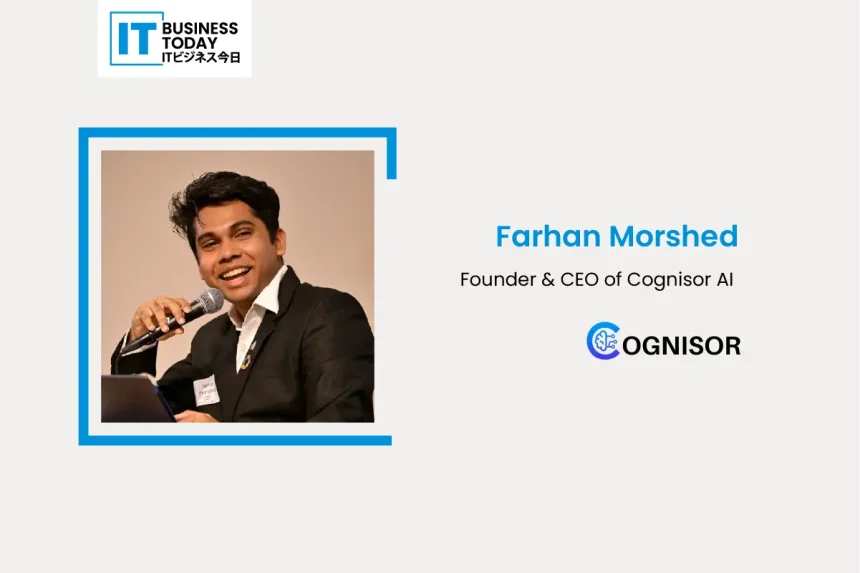
Farhan, can you tell us about your professional background and your current role at Cognisor AI?
I come from a non-traditional background. I’m a self-taught AI engineer and full-stack developer, but my journey didn’t start in tech. I built my skills from scratch—learning programming, AI development, and system design independently, without formal courses.
Alongside that, I developed a multidisciplinary skill set across UI/UX design, web development, graphics, and video production. Over the years, I’ve led and delivered more than 60+ projects, which helped me understand not just how to build products, but how to manage execution end-to-end.
Today, as the Founder and CEO of Cognisor AI, my role goes beyond development. I focus on building systems—bringing together technology, business strategy, and ecosystem partnerships to help ideas turn into scalable, real-world solutions.
Farhan, what were the early experiences that shaped how you think about building systems, communities, and eventually AI driven businesses?
My mindset was shaped through frustration.
As a non-technical undergraduate student who wanted to become an entrepreneur, I initially depended on others to build products. I paid for website development multiple times, but the results were always low quality—basic, non-scalable solutions that didn’t reflect my vision. That experience pushed me into a difficult but defining decision: to learn everything myself.
At the same time, I was always involved in leadership and community building. I founded my first club in school, later built communities in college, and during COVID, I co-founded an NGO that impacted over 5,000 people. These experiences taught me how to mobilize people, manage teams, and create impact at scale.
Later, I founded a startup focused on solving unemployment challenges in my home country, which led to recognition as a Top 15 Young Entrepreneur in Bangladesh.
When I came to Japan, I realized something critical—there was no accessible platform for students or early-stage builders to explore ideas and build startups. That led me to found TIU Impact Next, which is now supported by the university and connected with the Tokyo startup ecosystem, including government and institutional partners. Through all of this, one pattern became clear: people have ideas, but they lack systems, technical execution, and the right environment to scale. That realization ultimately led me to build Cognisor AI.
At what point did you realize you were no longer just executing projects, but actually building systems and ecosystems? What triggered that shift?
The shift happened when I started seeing patterns across different initiatives.
Whether it was community building, NGOs, student platforms, or startup projects—the challenges were always similar: lack of execution, lack of technical support, and lack of structured pathways to scale.
Instead of solving problems one by one, I began designing repeatable systems—frameworks that could take an idea, validate it, build it, and connect it to markets and opportunities.
Cognisor AI is essentially the result of that shift. It’s not just a service company—it’s a system designed to consistently turn ideas into scalable solutions.
You have been deeply involved in Japan’s startup ecosystem. What has changed for founders in recent years, and what still remains difficult?
Japan is changing.
Earlier, many young people preferred stable corporate careers. Today, there is a visible shift—more individuals are willing to take risks and explore entrepreneurship. There’s growing interest in startups, innovation, and building something independently.
However, structural challenges still exist.
For international founders, the language barrier remains significant. Beyond that, navigating legal systems, business regulations, and visa policies—especially recent changes in business manager visa requirements—can be complex and restrictive.
So while the mindset is evolving, the system still requires adaptation.
You describe yourself as a Global Ecosystem Connector. What does that mean in practice, and where do founders struggle most in Japan?
In practice, being a Global Ecosystem Connector means bridging gaps—between founders and technology, between ideas and execution, and between markets.
On a day-to-day level, it involves connecting startups with the right partners, helping them understand the ecosystem, and enabling co-creation opportunities.
The biggest challenges founders face in Japan are:
● Language and communication barriers
● Complex regulatory and operational processes
● Difficulty in finding the right co-creation partners
Without strong local partnerships, scaling in Japan becomes extremely difficult.
When international founders enter Japan, what are the most overlooked friction points?
The biggest overlooked factors are cultural and operational.
Many founders assume that if a product works globally, it will work in Japan. That’s often not the case. Market behavior, user expectations, and decision-making processes are very different.
Lack of proper market research is a critical mistake.
At Cognisor AI, we address this by combining business development with technology. We don’t just build products—we validate them for the Japanese market, design go-to-market strategies, and connect founders with investors and partners to enable co-creation.
What does real execution of AI solutions at Cognisor AI look like, compared to what people imagine?
Most people imagine AI development as just building models or tools.
In reality, execution is much broader.
At Cognisor AI, we provide a full-stack, end-to-end system—from idea validation to product development, and from development to market execution. This includes AI integration, automation workflows, product design, and ecosystem connections.
Our key strength is that founders don’t need to worry about technical complexity. If they have a strong idea with real-world impact, we handle the execution, partnerships, and scaling strategy.
What are the biggest bottlenecks in scaling Cognisor AI?
The main challenge right now is balancing demand with capacity.
We are growing quickly, and client expectations are high—which is a positive sign. However, scaling delivery requires expanding the team and strengthening internal systems.
Funding and talent acquisition are key priorities as we move to the next stage of growth.
As ecosystems become more AI-driven, how important will human ecosystem builders remain?
Human connection will become even more important.
AI can optimize processes, but trust is built through people. Real collaboration, partnerships, and long-term relationships cannot be fully replaced by digital systems.
My role is evolving to combine both—leveraging AI for scale, while strengthening human networks for trust and collaboration.
Looking back at your journey, what is one lesson founders only understand after building something themselves?
One of the most important lessons I’ve learned is that everything comes down to the people you build with.
Finding the right teammate is not easy, but it changes everything. I’ve been fortunate to meet Pritthy at an early stage of my journey. She has been there from the beginning of many of my initiatives and is also the co-founder of one of my startups. More than just a collaborator, she has been a constant source of motivation—pushing me to think bigger, work harder, and step outside conventional limits. Her ability to challenge ideas and bring a different perspective has played a significant role in shaping both my mindset and the direction of what we build.
At Cognisor AI, she continues to contribute on the business development side, helping us connect ideas with real opportunities.
Similarly, Irfan, a key member of Cognisor AI, has been consistently involved across multiple initiatives I’ve led in Japan. Having someone reliable who understands the vision and can execute alongside you in a completely different ecosystem makes a huge difference.
Building in Japan as a foreign founder is not easy. There are structural challenges, cultural differences, and constant uncertainty. In that environment, having the right people around you is not just helpful—it’s essential.
At the end of the day, ideas can evolve and strategies can change, but the strength of your team determines whether you can sustain, adapt, and move forward. It requires patience, resilience, and belief in both your vision and the people you build with.