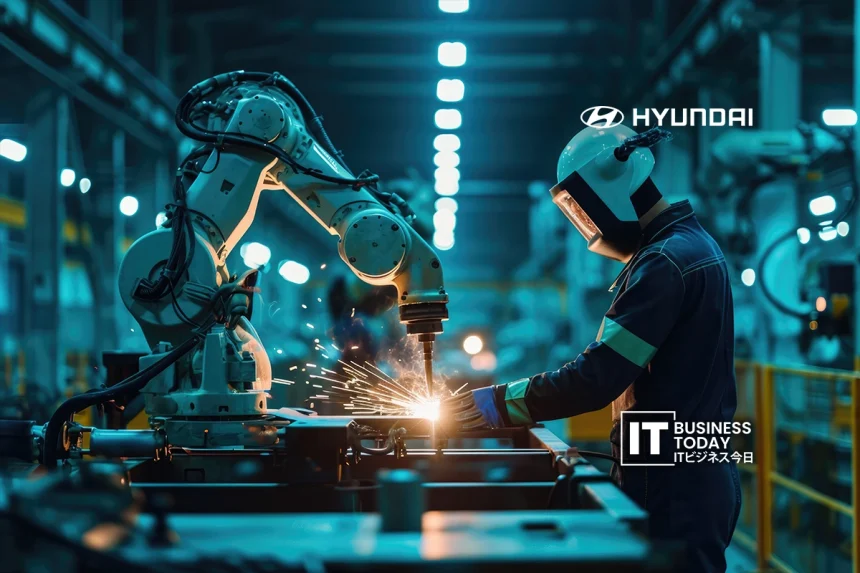
Hyundai Motor Group is pushing up the schedule for the mass production of humanoid robots and their integration in the next generation of manufacturing facilities. This is a clear indication of a major turning point in how the global automotive industry will use factory automation and AI-driven industrial operations.
Hyundai is planning to use the Atlas humanoid robot, which was developed by Boston Dynamics, as part of its Software Defined Factory approach. This is a comprehensive plan to implement highly automated and AI-powered manufacturing environments.
To support the integration of humanoid robotics throughout its manufacturing network, the company has set up a Software Defined Factory division together with a specialized robotics procurement office. Hyundai Motor Group Metaplant America in Georgia is becoming a major center for the manufacturing and deployment of these new systems.
こちらもお読みください: 日本のDICがチューリッヒを拠点にフィジカルAIスタートアップに投資するファンドを設立
Press coverage reveals that Hyundai plans to ramp up the deployment of Atlas humanoid robots A lot over the next few years, and their production goal could be as high as tens of thousands of units per year towards the end of the decade.
The Rise of the Software-Defined Factory
Hyundai’s latest step echoes a bigger change that’s happening in global manufacturing. Factories are turning from just simple assembly lines into AI-powered digital ecosystems.
A “Software Defined Factory” merges robotics AI IoT connectivity, cloud infrastructure, and real-time analytics, forming one manufacturing platform. Instead of using only fixed-function industrial robots, such systems are adaptive through software and AI models that can change production conditions dynamically.
At CES 2026, Hyundai announced their AI Robotics Strategy that includes human-robot collaboration, autonomous production systems, and wider deployment of humanoid robots in industrial settings.
Atlas robot is built to handle factory tasks that are physically intense, monotonous, and potentially dangerous like parts sequencing, material handling, machine tending, and assembly support. Usually, industrial robots are caged or fixed at controlled workstations. But, humanoid robots can work in areas designed for humans, which allows automating existing facilities without totally rebuilding ones infrastructures.
Why Humanoid Robots Are Becoming Important
Humanoid robotics represents one of the fastest advancing fields in the AI and automation sector. The development of reinforcement learning, computer vision, tactile sensing, and AI-enabled movement is equipping robots to accomplish more intricate physical activities.
A study into humanoid robotics showed that humanlike robots are capable of navigating autonomously, lifting and moving objects, regaining balance after falling and adjusting themselves to different environments quite efficiently.
Manufacturing companies see humanoid systems as a great way to address labor shortages while at the same time enhancing safety at work and ensuring more consistent operations. In the automotive industry Mostly, humanoid robots might become the co-workers that human beings share the space with rather than the ones that make human workers redundant.
Hyundai, a renowned automaker, has always maintained that its robotics plan hinges on the M-human and machines working together. Sheer replacement of human labor is not what the company is aiming for. It thinks that humanoid robots will ease the physical burden of employees and together keep up or even enhance the level of productivity in the malfunctioning of hazardous or monotonous tasks.
Impact on Japan’s Technology and Manufacturing Industry
Even though Hyundai is a South Korean company, the expansion of humanoid robots could have a far-reaching effect that Particularly changes Japan’s manufacturing and technology sectors.
Japan is still one of the leading industrial robotics markets in the world and boasts that it’s no. 1 in automation, precision manufacturing, sensor development, and high-tech machinery. Japanese companies in automotive electronics semiconductors, and industry segments have already made considerable investments in AI-driven factory systems and collaborative robotic technologies.
Increased speed of Hyundai’s operations may cause the rivalry between Asian manufacturers who desire leadership in “physical AI” and “smart manufacturing infrastructure” to become fiercer. Companies in Japan that produce robotics hardware semiconductors industrial AI software, machine vision systems, and advanced sensors stand a chance to profit from a growing demand for humanoid robotics ecosystems.
Also, the change might also compel Japanese automakers and industrial giants to hasten their efforts in software-defined manufacturing platforms and increased use of AI-enabled automation strategies.
Experts in the industry say that the global humanoid robotics market may emerge as one of the most strategically significant technology sectors within the next ten years, and it might lead to a complete makeover of manufacturing logistics warehousing, healthcare, and infrastructure maintenance.
Broader Effects on Businesses and Global Industry
The growth of humanoid robots may cause changes in areas other than just the automotive sector. For example, companies that work in cloud computing, AI chips, industrial software, battery systems, and infrastructure for connectivity and cybersecurity could find their portfolios changing as factories’ autonomy levels go up.
Humanoid robots are a huge challenge for both computation and training of the AI which also means that there will be a rise in the need for high-performance semiconductors and distributed AI infrastructure. Hyundai, for one, is making partnerships with AI companies to build its robotics arm, NVIDIA and Google DeepMind being the main ones.
Meanwhile, firms will be required to confront new employee issues as robotic automation is extended to even those tasks that were earlier considered too flexible or too human-oriented for robots. Labor unions and government officials are already raising concerns about the effect of humanoid robots on the factory employment structures. News stories mention that labor groups in South Korea have asked for regulation of the conditions of work with the robots and for greater worker safeguards.
Since the use of AI-driven robots is becoming more popular, in all likelihood the need for worker retraining in the areas of robot operations, AI monitoring, and software-based industrial processes will also be increasing at the same time.
The Future of Physical AI
The latest move by Hyundai to produce humanoid robots shows that ‘physical AI’ – combining AI software with movement, perception and interaction in the real world – is becoming the next big thing in artificial intelligence. While generative AI systems are mostly limited to digital tasks, physical AI is changing our interaction with the world around us.
Humanoid robots that can perform factory work logistics warehousing, and even the service sector might become commonplace based on some industry experts, as AI models improve and cost of hardware decreases.
Change is afoot in the industrial landscape due to the shift towards software-based factories and AI-operated robotics worldwide In particular Asian countries. Those companies who can blend robotics, AI infrastructure and real-time manufacturing intelligence seamlessly through automation may even outpace their peers in productivity, resilience, and operational efficiency in the next decade.