 日本語
日本語 





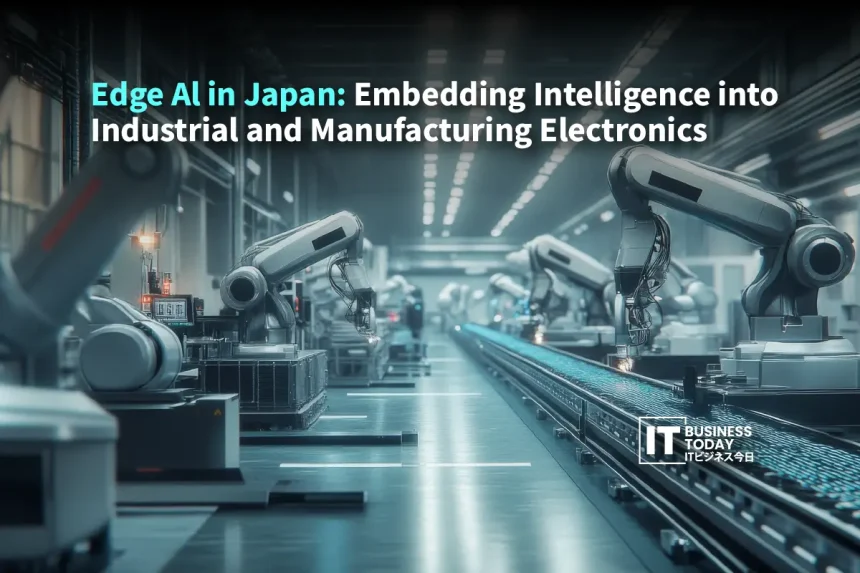
Walk inside a modern Japanese factory today and you will notice something subtle. The machines are not just moving anymore. They are observing. Calculating. Making tiny decisions on their own.
For years the industry relied on a simple model. Machines collected data. The data went to the cloud. Someone analyzed it. Insights came back later. That system works for reports and dashboards. It does not work when a motor begins to fail in the middle of a production cycle.
Factories cannot wait for the cloud.

That is exactly where Edge AI in Japan starts to make sense.
Also Read: Commercial Space Infrastructure: How Private Orbital Platforms Are Reshaping the Space Economy
Japan sits in a very unusual position. On one side the country is dealing with a shrinking workforce. On the other side it operates one of the most advanced robotics ecosystems in the world. The scale of that ecosystem is hard to ignore. Japan’s industrial robot production exceeded 280,000 units, surpassing the government target of around 260,000 units annually by 2025 according to the Japan Robot Association.
Now combine that robotics strength with a national strategy that pushes technology directly into everyday infrastructure. The vision known as Society 5.0 focuses on merging digital intelligence with the physical world.
Put those pieces together and a pattern starts to appear.
Edge AI in Japan is not about building smarter clouds. It is about building smarter machines.
And once that idea clicks, the rest of the industrial shift becomes easier to understand.
The Hardware First Mindset Behind Edge AI in Japan
Most countries approach artificial intelligence from a software angle. Japan usually goes the other way.
Hardware first.
That approach might sound old school but it creates a huge advantage when we start talking about edge computing. Edge AI only works if the physical environment already contains intelligent electronics. Sensors. Processors. Controllers. Communication modules. These things must exist on the factory floor before intelligence can move closer to machines.
Japan has spent decades building exactly that environment.
Look at the scale of industrial electronics production. Industrial electronic equipment production reached ¥430,986 million in March 2025 according to the Japan Electronics and Information Technology Industries Association.
That figure alone tells a bigger story. It reflects a dense network of companies manufacturing controllers, sensors, industrial processors, and automation equipment.
And the sector is not slowing down either. By September 2025 industrial electronic equipment production rose to ¥307,003 million, reflecting 4.8 percent year on year growth.
Behind those numbers are companies that rarely dominate headlines but quietly power global manufacturing systems. Firms like Renesas Electronics and Sony Semiconductor Solutions continue to lead the world in microcontrollers and embedded processors.
These chips sit inside machines that run factories.
Now add a layer of AI to that hardware and the shift becomes obvious.
Tiny machine learning models known as TinyML are small enough to run directly on microcontrollers. Instead of shipping data across networks, the models process signals locally. The machine analyzes its own behavior.
Sony offers one of the clearest examples. The Sony IMX500 Intelligent Vision Sensor is designed to perform AI processing directly inside the image sensor itself.
Think about how unusual that is.
Normally a camera captures an image and sends it somewhere else for analysis. The IMX500 does the analysis immediately. The sensor captures the image and the chip interprets it in the same moment.
This concept is often described as inference at the point of capture.
In practice it means factories respond faster. They also send less data across networks. Latency drops. Energy usage falls.
Edge AI in Japan feels natural because the hardware foundation already exists.
What Edge AI in Japan Looks Like on the Factory Floor
Technology conversations often stay too abstract. Edge AI becomes easier to understand once we step inside the factory.
Three use cases show where things are moving.
Predictive Maintenance
Factories operate thousands of machines at once. Motors rotate continuously. Bearings wear down slowly. Eventually something breaks.
The traditional maintenance approach relies on scheduled inspections. Engineers check equipment at fixed intervals. The problem is obvious. Machines do not fail on a schedule.
Edge AI changes the approach.
Sensors attached to motors collect vibration patterns, acoustic signals, and temperature readings. Instead of forwarding those signals to distant servers, the analysis happens locally. Small AI models run directly on embedded processors.
When the vibration pattern of a bearing starts to change, the system notices immediately. Maintenance teams receive alerts before the equipment fails.
The difference might be a few minutes or a few hours. In manufacturing that difference can protect entire production lines.
Quality Inspection
Inspection systems have existed for decades. Cameras monitor production lines and software looks for visible defects.
The weakness of traditional inspection is that it depends heavily on rule based algorithms. Engineers define patterns that the system should detect.
Reality rarely follows neat patterns.
Defects inside semiconductor fabrication lines often appear as tiny irregularities that standard vision systems struggle to detect.
Edge AI systems approach the problem differently. Instead of relying on strict rules, they learn from visual data. Neural networks analyze images directly within inspection hardware.
Factories gain two advantages. Defects are detected faster and inspection systems become more adaptable.
Autonomous Mobile Robots
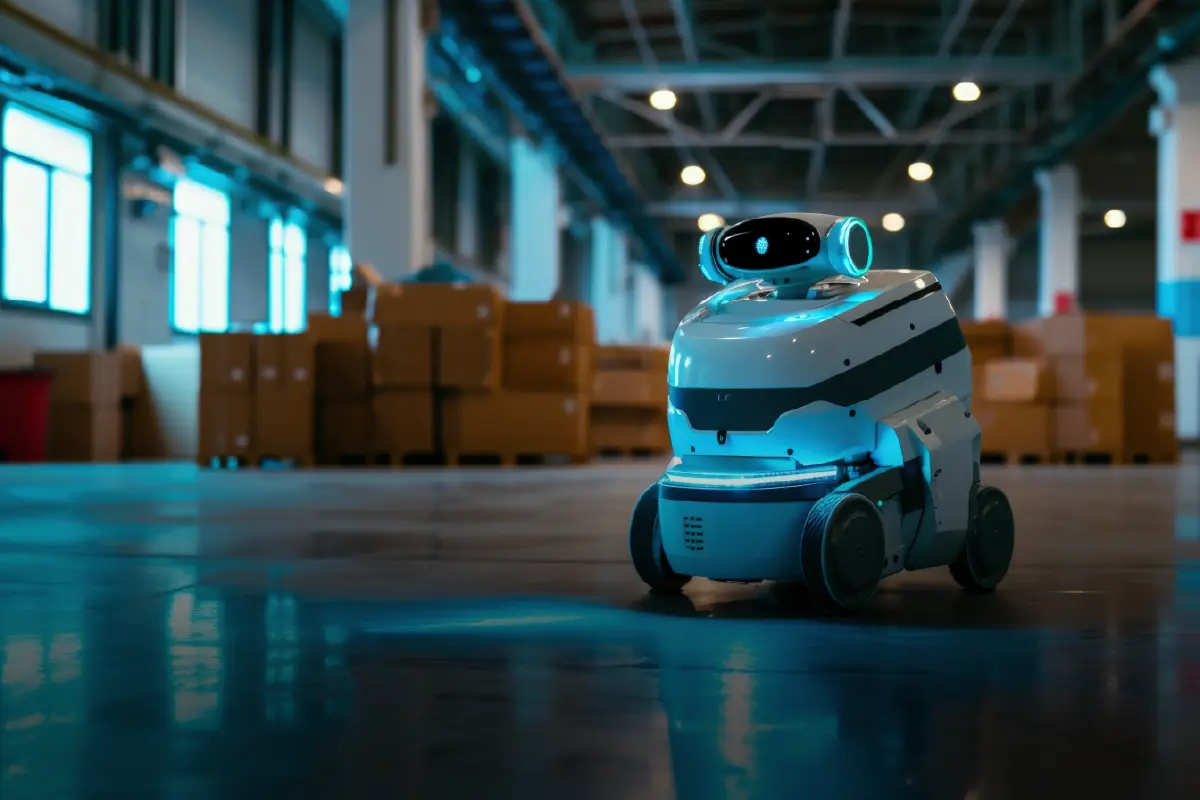
Logistics inside factories is also changing.
Autonomous mobile robots move components and finished products between workstations. These machines must react quickly to dynamic environments.
Workers walk through production areas. Equipment shifts positions. Pathways change.
Edge AI allows robots to analyze sensor data locally. Cameras, lidar systems, and environmental sensors feed data directly into onboard processors. The robot interprets the environment and makes navigation decisions in real time.
Japan’s robotics ecosystem strengthens this capability even further.
The domestic procurement rate for robot components is estimated at about 97 percent according to the Japan Robot Association. Most parts used inside industrial robots are produced within the same national manufacturing network.
That level of integration simplifies development and deployment.
Edge AI in Japan grows faster when the entire robotics supply chain sits close to the factory floor.
The Infrastructure Layer That Supports Edge AI in Japan

Edge intelligence cannot exist without the right infrastructure.
Factories require networks, processors, and control systems that can operate reliably under industrial conditions.
Japan’s electronics industry provides that layer.
Industrial electronics production includes key infrastructure components such as communications equipment, computing systems, electronic measurement instrumentation, and industrial control systems according to the Japan Electronics and Information Technology Industries Association.
These components form the technological skeleton of smart factories.
Connectivity is also evolving quickly.
Many Japanese manufacturers are deploying private 5G networks inside their facilities. These localized networks allow machines to exchange data quickly while keeping operational information inside factory boundaries.
The concept is often called Local 5G.
Local networks support edge computing by enabling high speed communication between devices without relying on distant data centers.
Energy efficiency plays another role here.
Processing data in large cloud facilities requires massive power consumption. Edge AI shifts part of that workload back to local devices. Data travels shorter distances. Systems process smaller data volumes.
The environmental benefit is becoming an important factor as companies push toward greener manufacturing strategies.
Edge AI in Japan fits naturally into this approach.
The Challenges That Still Exist
No technology transition happens without friction.
Edge AI adoption still faces practical challenges inside Japanese industry.
The first issue is talent.
Japan has a deep engineering culture but specialists who combine machine learning expertise with industrial system knowledge remain relatively scarce. Many manufacturing companies struggle to recruit professionals who understand both fields.
This shortage explains the growing interest in no code and low code AI platforms. These tools allow engineers to build and deploy machine learning models without writing complex algorithms from scratch.
Another issue relates to transparency.
Industrial operators often hesitate to trust AI systems that behave like black boxes. When a model makes a decision, engineers want to understand the reasoning behind it.
Explainable AI techniques are becoming more important for that reason. They help teams analyze how models interpret sensor signals or visual data.
Data sovereignty also influences decision making.
Manufacturers prefer to keep production data inside their own networks. Sending proprietary information to external cloud environments creates concerns around intellectual property protection.
Edge AI solves part of this problem. Analysis happens inside the facility where the data originates.
For many companies this architectural shift is as much about control as it is about technology.
The Road Ahead Toward 2030
Edge AI in Japan is still evolving but the trajectory is becoming clearer.
Factories are moving toward environments where machines respond to their surroundings instead of following static instructions. Robots adapt to new tasks. Sensors interpret patterns instead of simply measuring signals.
Physical systems and digital intelligence begin to merge.
Government initiatives are also supporting the shift. Programs connected to New Energy and Industrial Technology Development Organization focus on developing advanced semiconductor technologies and strengthening domestic AI hardware capabilities.
These efforts aim to reduce dependence on foreign GPU suppliers while expanding local AI innovation.
If these programs succeed Japan could control both the robotics infrastructure and the chips that power intelligent machines.
That combination would reshape the global manufacturing landscape.
Why Edge AI in Japan Matters
Edge AI in Japan is not a passing trend. It reflects a deeper industrial adjustment.
The country already leads in robotics. It maintains a powerful electronics manufacturing base. Now intelligence is being embedded directly inside machines that operate factory floors.
Motors detect failures before they stop working. Robots interpret their surroundings while moving through warehouses. Cameras recognize defects instantly.
For a country dealing with demographic pressure and workforce decline this transformation carries serious economic importance.
Edge AI in Japan is not simply an upgrade in technology.
It is the mechanism that allows Japanese manufacturing to keep moving forward even when the workforce gets smaller.
And if the pattern continues the rest of the global manufacturing sector will eventually follow the same path.



 English