 日本語
日本語 





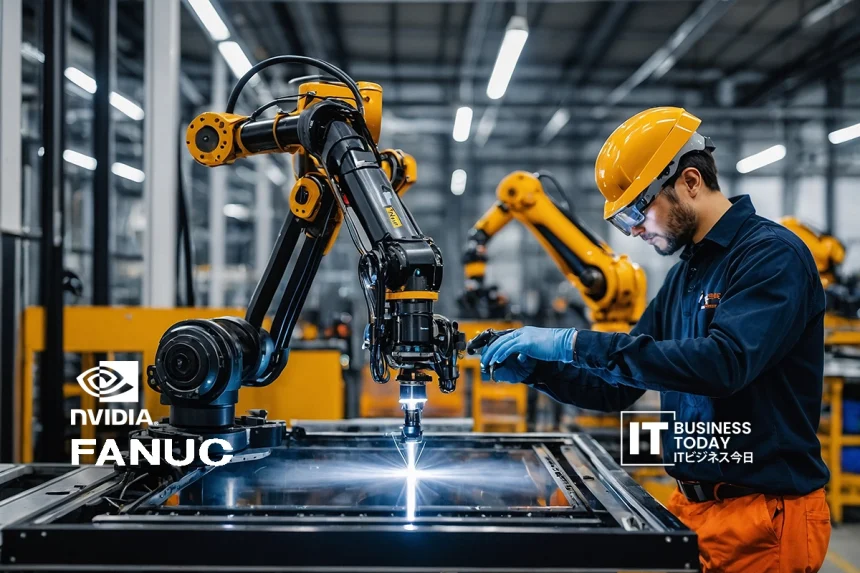
AI and Industrial Robotics have taken a giant leap forward: NVIDIA and FANUC have announced a strategic partnership through which “physical AI” will be embedded into Industrial robots, expected to transform the manufacturing and automation landscape across Japan and beyond.
Under this alliance, FANUC said it will support an open‑platform framework by releasing a ROS 2 driver for its entire robot lineup-from small collaborative models (3 kg payload) to heavy-duty robots of up to 2.3 tons. Source code will be made publicly available via GitHub. The robots will support Python, allowing developers to integrate AI, vision, and real‑time motion‑control algorithms with ease.
The integrated stack of NVIDIA and FANUC will also use NVIDIA’s AI computing solutions-on-robot Jetson compute, cloud/edge AI infrastructure, and simulation support via NVIDIA’s Isaac Sim + Omniverse-to facilitate “digital twins”: virtual copies of factories to simulate, train, and optimize prior to actual deployment.

Also Read: Nifco Launches Sustainability ERP “booost Sustainability”
FANUC confirms it will demonstrate how “Physical AI + open platform” works in the real world at the International Robot Exhibition scheduled for December 2025. The event underlines its commitment toward opening up next-generation robotics to manufacturers, startups, research labs–and effectively lowering the barrier to robotic innovation.
What Is “Physical AI” — And Why Now?
“Physical AI” is a term describing how artificial intelligence can be combined with robots and other physical hardware in order to enable machines to see, reason, and act within real environments, not just the world of software. In practice, this translates to robots reading sensor or camera data, dynamically adapting to ever-changing environments, and executing complicated tasks without the need for inflexible pre-programmed instructions.
Whereas previously industrial robots thrived in performing pre-defined, repetitive tasks, variability and unpredictability-or tasks that required “sense‑plan‑act” cycles-were beyond their capabilities. Today, thanks to AI and modern computing power, dynamic tasks can now be done by robots: visual inspection, object recognition, adaptive assembly, even possibly ones requiring safety around humans.
This new collaboration between NVIDIA-with its leading AI compute and simulation stack-and FANUC-one of the world’s largest makers of industrial robots-reflects a wider push globally, also in Japan, on ways to automate manufacturing and overcome shortages in manpower with intelligent, flexible robotic systems.
Implications for Japan’s Tech Industry and Manufacturing Sector
Democratizing Robotics: From Large Factories to SMEs
By releasing ROS 2 drivers publicly and allowing development on top of Python, FANUC and NVIDIA effectively democratize access to advanced robotics. This lowers the barrier not only for major manufacturers, but also for mid‑sized companies, startups, research institutions, and even educational labs.
SMEs — previously out of the range for custom automation — now have a route to take up robotics, customize workflows, and further accelerate the adoption of AI-driven automation. This could make for a surge in innovation in “smart manufacturing” across Japan.
Boost for Domestic Industrial Automation and Supply‑Chain Resilience
Japanese manufacturers face big challenges. They deal with global competition. They also face problems like labor shortages and an aging workforce. Physical AI robotics can help them stay productive and maintain quality. This way, they can reduce their need for manual labor.
Industries such as automotive, electronics, metalwork, and consumer goods depend on manufacturing. They can gain major benefits from it. Factories can quickly adapt to changing demand by using reliable and flexible robots. This helps cut production costs and shorten lead times.
Growth of Robotics Ecosystem – Software, Simulation, Services
The partnership doesn’t only benefit robot manufacturers. It creates opportunities for:
Software developers of AI models, vision modules, quality‑control algorithms.
Simulation and digital‑twin providers offering virtual factory design, pre‑deployment validation, and real‑time monitoring.
System integrators and automation consultancies enable factories to adopt robotic automation.
The training and education providers for robotics and AI skills-builders are indispensable for any effective adoption across sectors.
As more firms adopt physical AI, their demand for complementary services will create a robust robotics technology ecosystem in Japan.
Innovation Acceleration and Global Competitiveness
More firms are using physical AI. This will boost demand for related services. As a result, a strong robotics technology ecosystem will form in Japan.
This can be a competitive advantage for Japan in global manufacturing, automation, and “smart factory” exports.
You can easily prototype, improve, and launch advanced robotics systems with a strong, open robotics and AI platform available nearby. This includes startups and established manufacturers.
Challenges & What Needs to Be Addressed
Workforce skills gap: Companies require engineers and developers with experience in robotics, AI, simulation, and edge computing to make the most of “physical AI”-a talent pool that is still relatively limited. Education and training will become extremely important.
Integration and legacy systems: Many Japanese factories still run on legacy infrastructure. Integrating AI-enabled robots with the existing production lines, supply‑chain systems, and ERP software may be complex and costly.
Safety, Reliability, Regulation: Robots operating in real-world factories or near humans need to meet safety standards. Ensuring reliable AI behavior under all conditions is the challenge.
ROI and cost-benefit analysis: The initial investment in robotics + AI can be very high, especially for SMEs; scheduling returns on investment, long-term benefits, and convincing stakeholders remains important.
Why This Could Signal a New Era for Robotics in Japan
NVIDIA and FANUC‘s partnership marks a big change in Japan’s robotics industry. Robots are moving from rigid, pre-programmed machines to smart, adaptable partners. Now, they can learn, reason, and work alongside humans.
Japanese industry is strong in manufacturing and precision engineering. It can gain a lot from open platforms, AI infrastructure, and digital-twin simulations. These technologies can break down barriers to experimentation and adoption. This will lead to smarter factories, faster production, and higher quality. Plus, they can help protect against labor shortages.
Simultaneously, the robotics‑AI ecosystem — software developers, integrators, and simulation providers — could rapidly develop and create new startups, jobs, and business opportunities.
In all, the NVIDIA‑FANUC alliance may change not only how robots are constructed but also how business is conducted. This “physical AI” could become a cornerstone for the industrial and technological future of Japan.


 English